
Automatically apply for jobs with Zippia
Upload your resume to get started.
Interface designer skills for your resume and career
15 interface designer skills for your resume and career
1. Sketch
- Initiated and oversaw development from initial concept sketch to final production, working closely with Chinese engineering and manufacturing vendors.
- Developed handbags from initial sketch through final product including material sourcing, development of prototypes, sampling and technical specifications.
2. User Experience
- Developed user-centered UB web standards in navigation, tools, layouts, and user experience working toward a university-wide protocol.
- Collaborated with research and engineering team members to resolve issues with user experience and the existing site layout.
3. UI
- Collaborated with software developers and product managers to integrate groundbreaking new feature into defibrillator software while enhancing existing software UI.
- Engaged in visual UI design of Microsoft AdCenter desktop software application, also engaged in website design for existing clients.
4. Visual Design
Visual design is an art where the artist uses visuals and graphics to communicate to the user. A visual design aims to increase a product's aesthetic appeal. A visual design consists of lines, use of colors, white spaces, layout, and typography. Each element is executed to attract the customer towards it. Different styles and textures are also normally seen in visual designs.
- Lead planning, visual design, development and test deployment of custom web application focused on designing custom business cards.
- Specialize in user interface design, visual design, and branding.
5. Prototyping
- Created both low and mid-fidelity prototypes using various prototyping applications to deliver interaction and behavioral requirements to developers.
- Developed a custom object-oriented prototyping model in the design of a highly dynamic user interface.
6. HTML
- Worked as a graphic designer / interface designer responsible fordesign/coding sites in Flash and HTML.
- Updated and managed prototypes for the department using HTML, Photoshop and Adobe software.
Choose from 10+ customizable interface designer resume templates
Build a professional interface designer resume in minutes. Our AI resume writing assistant will guide you through every step of the process, and you can choose from 10+ resume templates to create your interface designer resume.7. CSS
- Executed the design via CSS onto Salmon commerce engine.
- Updated website universal typography hierarchy by generating CSS layout rules for consistent message and appearance.
8. Html Css
- Advanced use of HTML CSS, JavaScript, XML, MS SQL serverFluency in written and spoken English.
9. Web Site
- Illustrated and developed the interfaces for web sites that explore life surrounding the deep-sea thermal vents.
- Design of web sites for departments within the College of Agriculture.
10. Visualization
- Specialized in information visualization to design state-of-the-art dashboards, reports, and drill-down tools.
- Generated 3d architectural renders for client visualization during initial planning stages.
11. Adobe Creative Suite
- Designed user centered website prototypes following detail requirements using Adobe Creative Suite.
- Design and maintain WTH and partner web properties using Adobe Creative Suite and other graphics applications, techniques, and tools.
12. JavaScript
- Designed & implemented GUI wireframes for MDM project; created javascript Cost Center tool.
- Position included troubleshooting functionality and JavaScript issues as well as providing technical support for end users and online community management.
13. User Interface Design
- Produced storyboards, scenarios, flowcharts, innovative prototypes, and user interface design specifications.
- Implemented finalized versions of the user interface design with end-user applications.
14. User Research
User research is a term that has a direct connection with the psyche, behavior, needs, and thoughts of a user. On a large scale, it refers to the studying and understanding of all these facets so that product managers and brands may improve the usability of their products or services by redesigning their business models to fit the user's needs.
- Set user research objectives and evaluated outcomes.
- Investigated competitive products and conducted end-user research.
15. Style Guides
A Style Guide, otherwise known as a manual of style, as the name suggests, is a single document or a collection of such documents which offer a standard for the creation and formatting of other documents. These can either be designed for general use or for a specific company, for advertisements, or for individuals, organizations, or academic institutions. The style guide often speaks of a number of things, such as appropriate font choices and size, for colour palettes, and formatting of pages.
- Defined product branding, style guides, trade show collateral and marketing materials.
- Contributed to ongoing user interface guidelines for company-wide style guides.
5 Interface Designer resume examples
Build a professional interface designer resume in minutes. Browse through our resume examples to identify the best way to word your resume. Then choose from 5+ resume templates to create your interface designer resume.

What skills help Interface Designers find jobs?
Tell us what job you are looking for, we’ll show you what skills employers want.
What skills stand out on interface designer resumes?
Samantha Osborne
Assistant Professor of Graphic Design, Owner, Samantha Osborne Design, Eastern Illinois University
What soft skills should all interface designers possess?
Samantha Osborne
Assistant Professor of Graphic Design, Owner, Samantha Osborne Design, Eastern Illinois University
i. An ability to see big picture: there are an infinite number of details in graphic design, whether you work in website design on the front or back end, or in print media with physical outputs. It's easy to get caught up on the details, especially when clients are making specific demands about things such as paper type. A skilled designer must be able to see beyond the details and look at the big picture for an effective design solution. For example, a client may be asking for an invitation design for an up-coming event. A skilled designer will ask questions and dig in, eventually uncovering that perhaps for a successful event, the client also needs a splash page and social media, either in place of or in addition to an invitation. A skilled designer addresses design problems holistically, rather than minutely.
ii. An ability to "read" people: designers are trained in art-specific vocabulary. Hue, saturation, pixels, gestalt...most non-art folks don't use or speak that language. When clients are describing their goals, they aren't using art-vocabulary. It's a designer's job to translate what the client is saying into an advanced and effective creative solution. They must be able to speak and understand the language of non-creative folks, as well as the language of the broader creative industry.
iii. An ability to make a convincing argument for your design solution(s): many young and inexperienced designer tend to get their hearts broken when a client smashes one of their [very well thought-out] ideas. Rather than rolling over, a designer must learn to navigate how best to build support for their idea(s). That might mean in some instances you work more fluidly with the client throughout the design process, so that they feel they have ownership in the development of the solution. In other instances it might mean that the designer is presenting options, rather than a single solution, so that the client feels empowered to make choices throughout the design process. And in some instances, it might be a matter of better explaining and presenting your idea to a client; perhaps the designer needs to push back more, perhaps they need to provide more research as to why their solution is best, or maybe they simply need to present it with more excitement and enthusiasm.
What interface designer skills would you recommend for someone trying to advance their career?
Carmita Sanchez-Fong
Professor and Chairperson, Fashion Institute of Technology, SUNY
What type of skills will young interface designers need?
Bennie F. Johnson
Executive Director, AIGA, the professional association for design
In May of 2020, AIGA conducted an industry pulse check survey around the impact of COVID-19 on the design community and found, not surprisingly, that adaptability skills continue to be the most critical for design professionals, and collaboration made the list of top five skills for the first time.
List of interface designer skills to add to your resume
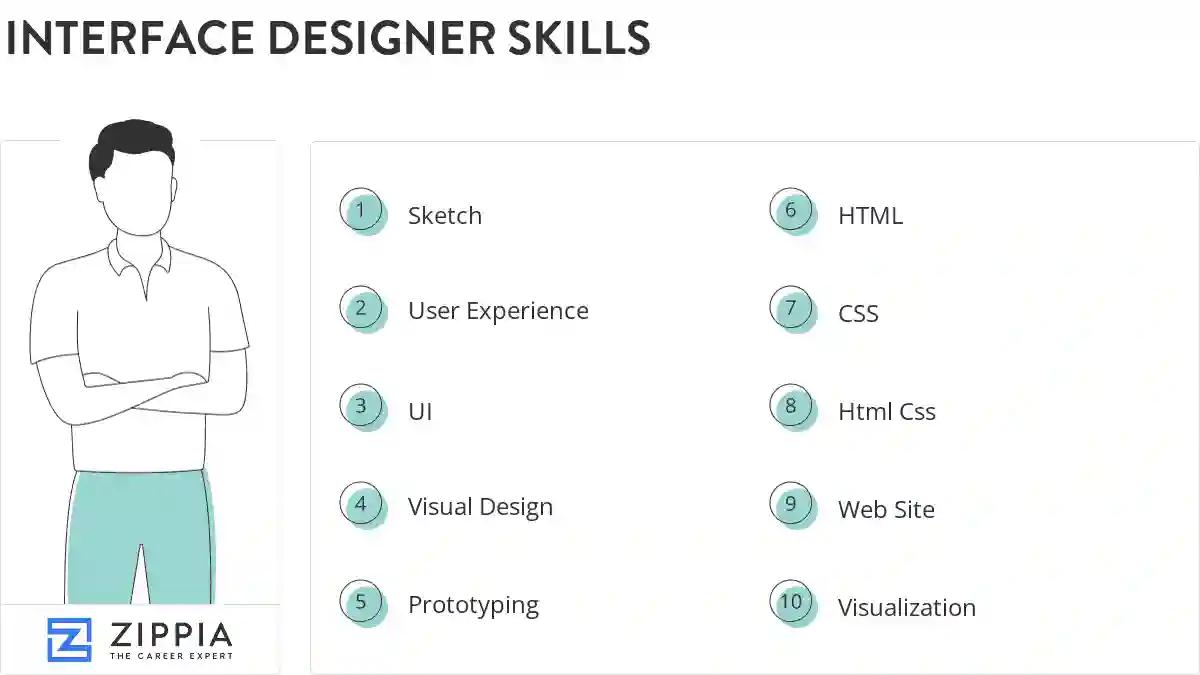
The most important skills for an interface designer resume and required skills for an interface designer to have include:
- Sketch
- User Experience
- UI
- Visual Design
- Prototyping
- HTML
- CSS
- Html Css
- Web Site
- Visualization
- Adobe Creative Suite
- JavaScript
- User Interface Design
- User Research
- Style Guides
- Front End
- Adobe Photoshop
- Java
- Usability
- UX
- EDI
- OS
- Art Direction
- CSS3
- Web Application
- Wire Frames
- Web Design
- Design Standards
- Content Management System
- Design Specifications
- PC
- ASP
- Site Maps
- QA
- Client Relationships
- Portfolio
- XML
- A/B
Updated January 8, 2025
