
Automatically apply for jobs with Zippia
Upload your resume to get started.
Joint terminal attack controller skills for your resume and career
15 joint terminal attack controller skills for your resume and career
1. Combat
Combat is a violent conflict between two parties. Combat can be held by using weapons or unarmed. The fighting between the armed forces of different countries can also be called combat and the main purpose of the combat is to eliminate and stop your opponent from achieving their goal.
- Managed operations related to security and law enforcement by maintaining Joint Terminal Attack Controller (JTAC) availability for combat activities.
- Supervised the allocation of equipment, munitions and monitored medical and training requirements for squadron combat readiness.
2. Military Operations
A military operation refers to the coordinated military actions of a government, or a non-state actor, in response to an emerging situation. These measures are devised as a military plan to best resolve the situation in the favor of the state or actor. Corresponding and reflecting similar framework for operations any organized components within the armed forces which prepare, prevent, or fight the war are also called military operations.
- Prepared personnel and equipment for military operations.
- Supported complex time-sensitive military operations, and identified and performed basic network analysis, and conducted planning efforts.
3. Joint Terminal Attack
- Participated in two deployments in Iraq (Operation Freedom) as a certified Joint Terminal Attack Controller (JTAC).
- Provided Joint Terminal Attack Control to Army Ground Commander during deployment in support of Operation Enduring Freedom.
4. Close Air Support
- Coordinated airspace for all aircraft executing close air support, medical evacuations, and resupply/transportation.
- Air ground liaison responsible for close air support operations from the forward edge of the battlefield while embedded with Ground forces.
5. DOD
Definition of Done (DoD) is a set of deliverables that are needed to devise software. These deliverables are valuable to the system and can be exemplified by writing code, coding comments, unit testing, integration testing, design documents, release notes, and so on.
- Evaluate and assist in certifying joint forces as Department of Defense (DoD) recognized JTACs and JFOs.
- Maintain and monitor professional development of 18 military and DoD controllers.
6. SATCOM
- Operated and maintained man portable radio communications equipment that expanded through the UHF, VHF, HF, and SATCOM ranges.
7. Mission Planning
- Performed tactical mission planning and preparation, allocating air and space resources according to priority and feasibility.
- Performed tactical mission planning and preparation and briefed maneuver commanders and staff on capabilities and limitations of air and space power.
8. Intelligence Surveillance
- Provided target analysis for Intelligence Surveillance and Reconnaisance flights.
9. Rotary Wing Aircraft
- Neutralize enemy forces as they engage American/coalition forces while acting as liaison between Fire Support Elements and Fix/rotary wing aircraft.
- Dispatch of fixed and rotary wing aircraft in the aerial delivery of payload.
10. Computer System
- Maintained various records and documentation for department computer systems.
- Identified possible improvements in computer systems.
11. VHF
- Operated VHF radio systems to maintain communication with civil aviation as well as air traffic control (ATC) operations.
12. Air Assets
- Advised the Battalion Commander and Operations Officer on the capabilities, limitations, ordnance and correct employment of air assets.
- Analyzed digital imagery maps to gather intelligence, surveillance, reconnaissance for preparation of the battlefield for air assets.
13. ISR
Intelligence, Surveillance, Reconnaissance, or ISR is a record that contains essential information crucial in the nation. It has a various function such as operation and intelligence that deals with the processing, coordination, providing timely and relevant information helps with the security of a state. Some info that ISR can capture is radar, infrared images, and electronic signals.
- Advised ground commander on best methods for JTAC and fixed wing CAS employment as well as ISR capabilities.
- Monitored ISR missions, relaying time-sensitive updates/focused collection to crews.
14. Subject Matter Expertise
- Provided AFATDS and JADOCS subject matter expertise to Soldiers in the Battalion FECC and subordinate unit fire direction activities.
- Provided subject matter expertise when reviewing publications prior to publishing to the military forces.
15. USAF
- Prepared and managed multiple self assessment checklists to evaluate overall effectiveness and ensure compliance with USAF directives.
- Provided leadership and training to incoming airmen and volunteered for many USAF organizations.

What skills help Joint Terminal Attack Controllers find jobs?
Tell us what job you are looking for, we’ll show you what skills employers want.
List of joint terminal attack controller skills to add to your resume
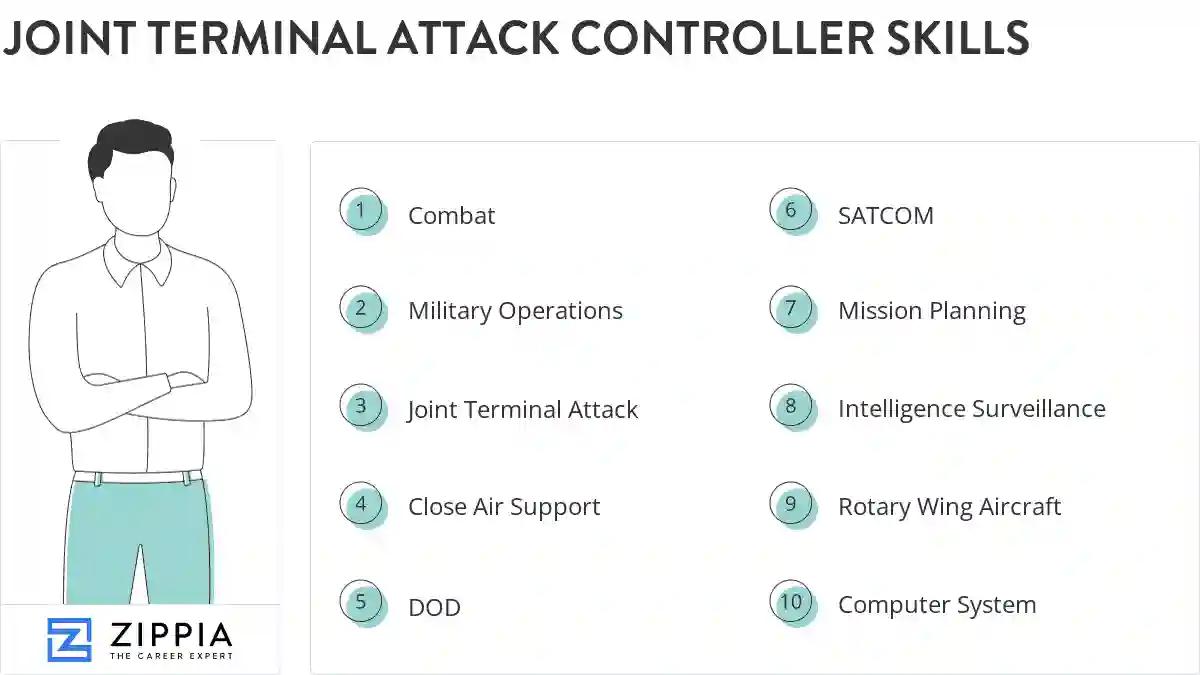
The most important skills for a joint terminal attack controller resume and required skills for a joint terminal attack controller to have include:
- Combat
- Military Operations
- Joint Terminal Attack
- Close Air Support
- DOD
- SATCOM
- Mission Planning
- Intelligence Surveillance
- Rotary Wing Aircraft
- Computer System
- VHF
- Air Assets
- ISR
- Subject Matter Expertise
- USAF
- Direct Support
- Operations Forces
- Joint Operations
- ODA
- Training Exercises
- Computer Network
- US Army
Updated January 8, 2025
