
Automatically apply for jobs with Zippia
Upload your resume to get started.
Kettle operator skills for your resume and career
14 kettle operator skills for your resume and career
1. HACCP
- Follow recipes & HACCP to ensure correct completion.
2. Cranes
- Transferred Material From Mono-Rail Hoists To Bridge Cranes, Where Material Was Moved To The Front Floor For Cleaning.
- Controlled crane that dipped parts into kettle.
3. Food Products
Food products are the types of various food items that are created and processed to be sold as a product. These products are consumed by humans for nourishment and are mostly processed and created in a huge factory. Tinned goods, milk, meat, etc are the most common food products, and they are not limited to any specific kind except tobacco, beers, and alcohol as they are not considered food products.
- Followed precise measurement instructions to mix baby food products.
4. Safety Regulations
- Operated tar kettle following safety regulations Maintained a clean work area Obtained and Maintained proper certifications
- Developed machine-operating procedures utilizing OSHA Safety Regulations.
5. Machine Operators
Machine operators, also known as machinists, refer to workers responsible for various machines with specific functions. Their duties include setting up equipment, loading materials, and operating machinery. The machine operators also monitor and optimize their operations for efficiency.
- Relieve machine operators/stackers as needed.
6. Production Sheets
- Weighed and dumped prescribed ingredients into kettle, according to production sheet.
Choose from 10+ customizable kettle operator resume templates
Build a professional kettle operator resume in minutes. Our AI resume writing assistant will guide you through every step of the process, and you can choose from 10+ resume templates to create your kettle operator resume.7. Repair Procedures
- Inspect problem roofs to determine the best repair procedures.
8. Quality Checks
Quality checks are a component of quality control aimed at ensuring that quality requirements are met. Internally, quality checks provide assurance to managers, and externally, it provides assurance to clients, federal departments, authorities, and certifiers.
- Performed quality checks of resins while in process ensuring chemicals were reacting properly per batch instructions.
- Conducted pre batch of raw materials and verified correct amounts of materials added to batch.Performed quality checks for viscosity and cleanliness.
9. RAN
RAN stands for "revenue anticipation note," which refers to a practice where an organization (often the government) borrows money to support a specific project. When these funds are then repaid, the money given to the lenders comes from the profits generated by the business originally funded.
- Treated wood & operated lifts* Ran boilers through computer data system & maintenance on the boilers, kilns, etc.
- Managed and bought lumber, ran the kilns and boughtlumber from all hardwood producing areas.
10. Solid Materials
- Control heated reaction kettles to process liquid and solid materials into specified chemical products.
11. Laboratory Analysis
- Draw sample of product for laboratory analysis.
12. Assembly Line
Assembly line is a process used in industries to ensure the production of products in a cost effective manner by dividing up the responsibilities of each labor. Assembly lines enabled industries to hire more workers, therefore providing more employment opportunities to labors. This is possible because in this process the burden of all the tasks related to production are not laid on a single person, they are divided into small baby steps for each labor.
- Plant Closed - Moved Overseas) Operated and maintained chemical reactors Operated assembly line for product packaging when needed.
- Earned recognition for producing equally impressive results both independently and as a team member within assembly line setting.
13. Mix Materials
- Start agitator to mix materials for specified time or stir mixture with paddle.
14. Product Quality
Product quality is the basic element of a business. It means to add features in a product or service in such a way that it meets the needs and wants of the customers. Enhancing the product quality also means improve the goods from any existing defects to ensure customer satisfaction.
- Calculate and recommend modifications of existing product quality or production standards to achieve optimum production quality within limits of equipment capability.
- Filter products utilizing validated techniques and equipment that prevents product contamination, minimize product loss and assure acceptable product quality.

What skills help Kettle Operators find jobs?
Tell us what job you are looking for, we’ll show you what skills employers want.
List of kettle operator skills to add to your resume
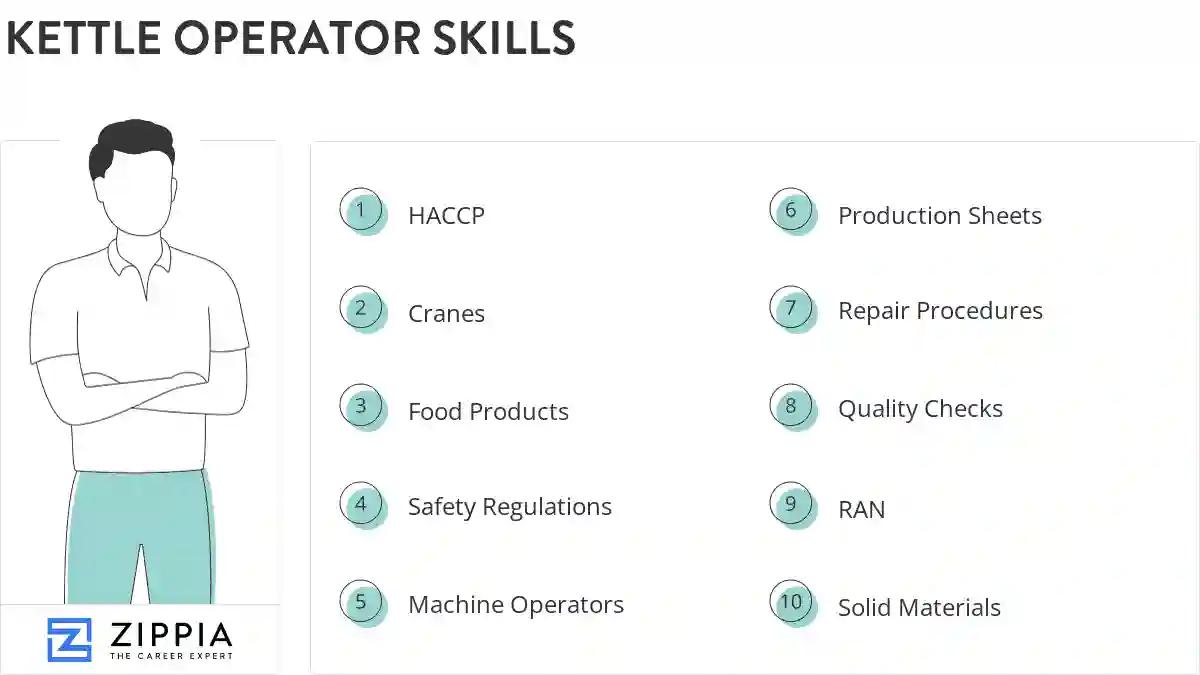
The most important skills for a kettle operator resume and required skills for a kettle operator to have include:
- HACCP
- Cranes
- Food Products
- Safety Regulations
- Machine Operators
- Production Sheets
- Repair Procedures
- Quality Checks
- RAN
- Solid Materials
- Laboratory Analysis
- Assembly Line
- Mix Materials
- Product Quality
Updated January 8, 2025
