
Automatically apply for jobs with Zippia
Upload your resume to get started.
Kiln operator skills for your resume and career
15 kiln operator skills for your resume and career
1. Safety Standards
- Operated heavy machinery Identification and Reporting of Faulty Equipment Adherence to Government/Company Safety Standards Heavy lifting Working in extreme temperature
- Operated mixing machine using company specifications and adhering to Food and Drug administration policies for sanitation and OHSA safety standards.
2. Safety Procedures
Safety procedures are a set of standardized procedures, that ensures minimal to no risk to people, resources, and the work environment. A company follows the step-by-step safety procedures as it they not only keep the customers and the employees safe, but also help in avoiding legal claims.
- Assisted patrons entering and exiting rides, monitored activities to ensure adherence to safety procedures, shut-down and emergency evacuation procedures.
- Created or enhanced new and existing safety procedures to improve quality and safe operating practices in the manufacturing facility.
3. Rail Cars
Rail Cars, also called railroad cars, are large containers set on a railway and pulled by a locomotive. Rail cars are frequently used for shipping large quantities of product or material, such as metal, chemicals, or livestock; however, a rail car may also transport people such as a subway system. A locomotive often pulls numerous cars that attach to each other, which then form a train.
- Moved pallets of raw bricks onto rail cars, then moved the cars into the kiln.
- Make sure product is available for the Brick setters to load Rail Cars.
4. Production Equipment
Production equipment in limited terms is used to define any type of machinery or equipment used in the production of a video or film. Basic production equipment includes a camera, tripod, lighting kit, camera light, short term microphone, light reflector, boom pole, shock mount, audio cables, wireless microphone, headphones, portable digital audio recorder, camera lenses, extra batteries, external hard drive, and DSLR shoulder mount rig.
- Complete knowledge of all production equipment & machinery, assisted in troubleshooting and set up of all pertinent machinery.
- Keep solid and gas fuels supplied to production equipment.
5. RAN
RAN stands for "revenue anticipation note," which refers to a practice where an organization (often the government) borrows money to support a specific project. When these funds are then repaid, the money given to the lenders comes from the profits generated by the business originally funded.
- Treated wood & operated lifts* Ran boilers through computer data system & maintenance on the boilers, kilns, etc.
- Managed and bought lumber, ran the kilns and boughtlumber from all hardwood producing areas.
6. Moisture Content
- Operate steam controls for drying process and measure moisture content to ensure precise moisture standards.
- Take readings of the moisture content of the wood.
Choose from 10+ customizable kiln operator resume templates
Build a professional kiln operator resume in minutes. Our AI resume writing assistant will guide you through every step of the process, and you can choose from 10+ resume templates to create your kiln operator resume.7. Safety Inspections
Safety inspections are a vital procedure for all kinds of businesses. This may be a restaurant to ensure is properly cleaned and stored or a factory to confirm employees are not risking their safety during the manufacturing process. The goal of these inspections is to highlight any potential risks or hazards present that may lead to injuries, damages, or lawsuits.
- Conducted safety inspections and followed safety rules and procedures.
8. Process Specifications
Process Specifications refers to a method of outlining how a decision is made within data structures. By documenting each step in the decision-making process, one can determine how the data inputted changed to the outputted data, which may influence any affected engineering or regulatory requirements.
- Read and interpret work orders and instructions in order to determine work assignments, process specifications, and production schedules.
9. Quality Checks
Quality checks are a component of quality control aimed at ensuring that quality requirements are met. Internally, quality checks provide assurance to managers, and externally, it provides assurance to clients, federal departments, authorities, and certifiers.
- Operate mold press line-Responsible for line changeover/adjustments and start-up-Responsible for minor line repairs-Perform quality checks of finished product
- Review order specifications and perform quality checks that ensure the product is packaged according to customer specifications.
10. Production Schedules
The project plan of a film or a documentary that highlights how a production budget will be spent over a given period until its completion is called a production schedule. The scheduling process starts with writing and analyzing the script, which is then broken down to determine and allocate the budget for each scene. The production schedule also includes several elements of the film including; cast actors, special effects, wardrobe, special equipment, stunts, extras, silent bits, production equipment, and many others.
- Assisted machine operators in adhering to production schedules.
- Read production schedules to determine humidity and temperature required for size and type of product to be dried.
11. General Maintenance
General maintenance is the regular check-up and repairs of machinery, buildings, and other mechanical equipment. General maintenance is performed by repair workers who are skilled to handle the day-to-day defects produced in the machinery. General maintenance aims to make sure the items remain in the best operational conditions. Usually, a set of planned activities are performed regularly by an expert to monitor the maintenance.
- Manage 5+ electric front load kilns daily, kiln programming/general maintenance, efficient with luster/stains/decal/china, quality control
- Performed general maintenance tasks including regular monitoring and repairing interior kiln bricks and fiberglass walls.
12. Equipment Operation
Equipment operation is the process of managing and maintaining industrial equipment. This involves installing, maintaining, testing, modifying, operating, and managing the equipment's life cycle. Examples of specialized equipment include pressure vessels, industrial pipes, and rotating machinery. Engineering associations such as the EEMUA help companies to be well-versed in equipment operations.
- Monitor equipment operation, and panel lights in order to detect deviations from standards.
- Monitor equipment operation, gauges, and panel lights in order to detect deviations from standards.
13. Log Book
- Check the Burning Log Book for current shift instructions.
- Record gauge readings, test results, and shift production in log books.
14. Test Results
- Record gauge readings, test results, and shift production in log books.
- Record gauge readings, test results.
15. End Loaders
- Trained to operate a variety of machinery such as fork lifts, roll grabs, front-end loaders and computerized hoists.
- Maintain and operate heavy construction equipment to include dump trucks, front-end loaders, dozers, and forklifts.
5 Kiln Operator resume examples
Build a professional kiln operator resume in minutes. Browse through our resume examples to identify the best way to word your resume. Then choose from 5+ resume templates to create your kiln operator resume.

What skills help Kiln Operators find jobs?
Tell us what job you are looking for, we’ll show you what skills employers want.
List of kiln operator skills to add to your resume
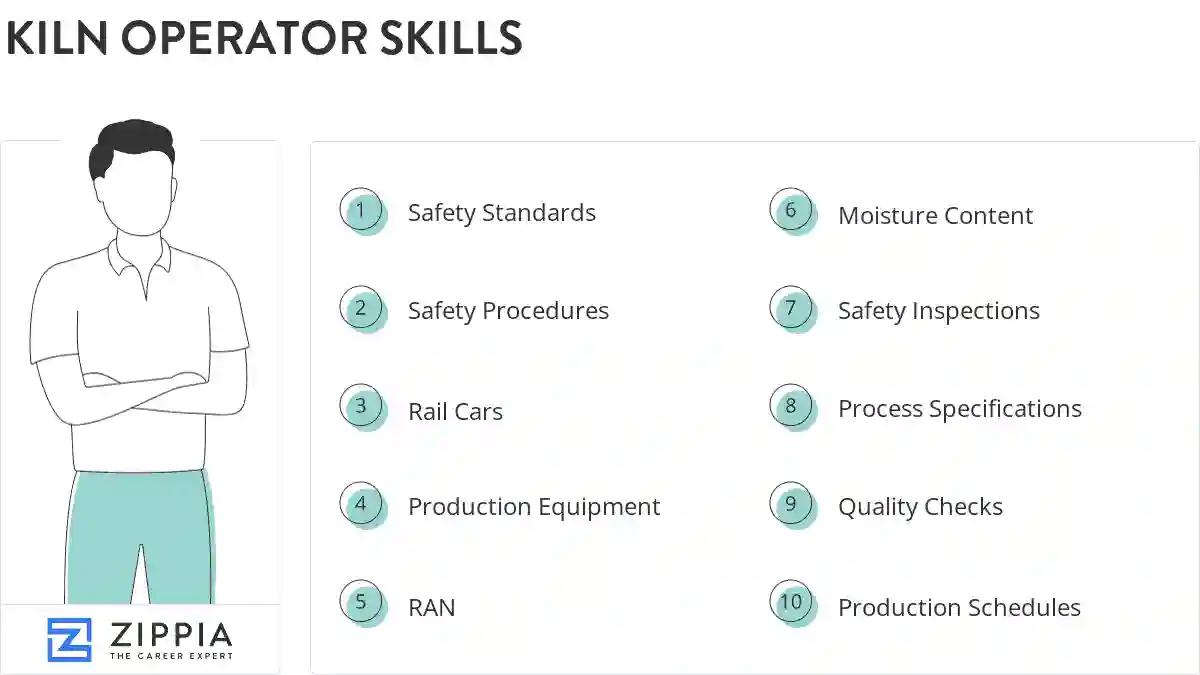
The most important skills for a kiln operator resume and required skills for a kiln operator to have include:
- Safety Standards
- Safety Procedures
- Rail Cars
- Production Equipment
- RAN
- Moisture Content
- Safety Inspections
- Process Specifications
- Quality Checks
- Production Schedules
- General Maintenance
- Equipment Operation
- Log Book
- Test Results
- End Loaders
- Air Flow
- Product Quality
- Machine Operation
- Computer System
- Blowers
- Hoists
- Fan Motors
- Temperature Readings
- Safety Rules
- Production Problems
- Dryers
- Production Lines
Updated January 8, 2025
