What does a kiln operator do?
Kiln operator responsibilities
Here are examples of responsibilities from real kiln operator resumes:
- Manage and buy lumber, run the kilns and boughtlumber from all hardwood producing areas.
- Develop a new and up to date HAZWASTE program for the site
- Close tunnel doors and start blowers and heaters to regulate humidity and temperature within tunnel.
- Transport materials and products to and from work areas, manually or using carts, pallet jacks or hoists.
- Set up and operate an extrusion machine in accordance with establish procedures and guidelines and customer requirements.
- Operate spray dryer to make powder and send parts for pressing.
- Make sure production is running smoothly from holding room to dryer to kiln to packaging.
- Operate ceramic kiln in the manufacture of electronic capacitors.
- Perform repair and preventive maintenance on machinery including cleaning, oiling and adjusting.
Kiln operator skills and personality traits
We calculated that 22% of Kiln Operators are proficient in Safety Standards, Safety Procedures, and Rail Cars. They’re also known for soft skills such as Communication skills, Coordination, and Mechanical skills.
We break down the percentage of Kiln Operators that have these skills listed on their resume here:
- Safety Standards, 22%
Operated heavy machinery Identification and Reporting of Faulty Equipment Adherence to Government/Company Safety Standards Heavy lifting Working in extreme temperature
- Safety Procedures, 15%
Assisted patrons entering and exiting rides, monitored activities to ensure adherence to safety procedures, shut-down and emergency evacuation procedures.
- Rail Cars, 13%
Moved pallets of raw bricks onto rail cars, then moved the cars into the kiln.
- Production Equipment, 7%
Complete knowledge of all production equipment & machinery, assisted in troubleshooting and set up of all pertinent machinery.
- RAN, 5%
Treated wood & operated lifts* Ran boilers through computer data system & maintenance on the boilers, kilns, etc.
- Moisture Content, 5%
Operate steam controls for drying process and measure moisture content to ensure precise moisture standards.
Most kiln operators use their skills in "safety standards," "safety procedures," and "rail cars" to do their jobs. You can find more detail on essential kiln operator responsibilities here:
Communication skills. One of the key soft skills for a kiln operator to have is communication skills. You can see how this relates to what kiln operators do because "material moving machine operators signal and direct workers to load and unload material." Additionally, a kiln operator resume shows how kiln operators use communication skills: "machine operator communication skills work orders produce work routine maintenance on machines strategic thinker"
Coordination. Another essential skill to perform kiln operator duties is coordination. Kiln operators responsibilities require that "material moving machine operators must have steady hands and feet to guide and control heavy machinery precisely." Kiln operators also use coordination in their role according to a real resume snippet: "operated production machinery utilized good communication skill to interact well with co-workers possess good hand-eye coordination ability to perform repetitive tasks"
Mechanical skills. Another skill that relates to the job responsibilities of kiln operators is mechanical skills. This skill is critical to many everyday kiln operator duties, as "material moving machine operators make minor adjustments to their machines and perform basic maintenance on them." This example from a resume shows how this skill is used: "repair mechanical or programming errors on assembly lines. "
Visual ability. A big part of what kiln operators do relies on "visual ability." You can see how essential it is to kiln operator responsibilities because "material moving machine operators must be able to see clearly where they are driving or what they are moving." Here's an example of how this skill is used from a resume that represents typical kiln operator tasks: "packed controlled substances, gmp training, performed samplings and visual inspection and machine operator. "
The three companies that hire the most kiln operators are:
- West Fraser44 kiln operators jobs
- Daltile5 kiln operators jobs
- Porcelain tiles made in USA4 kiln operators jobs
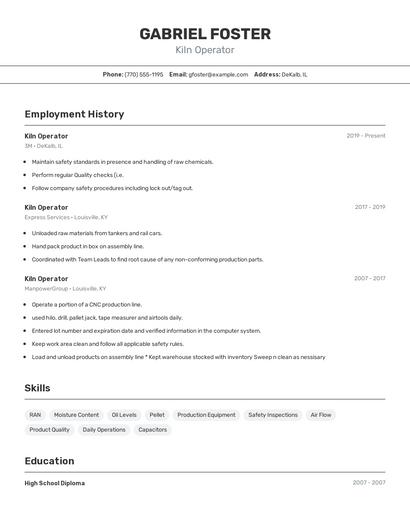
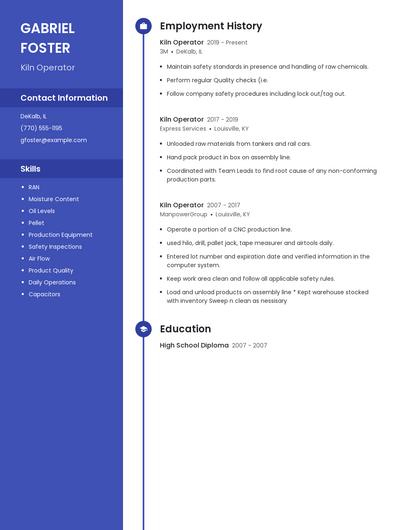
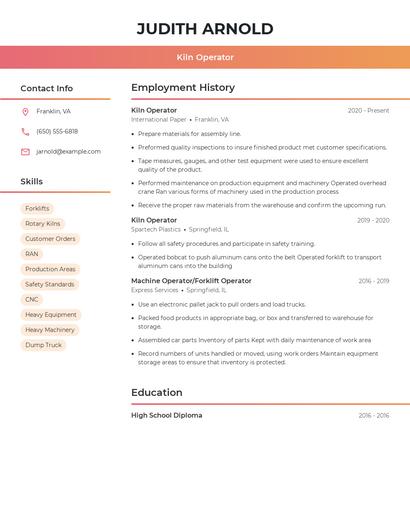
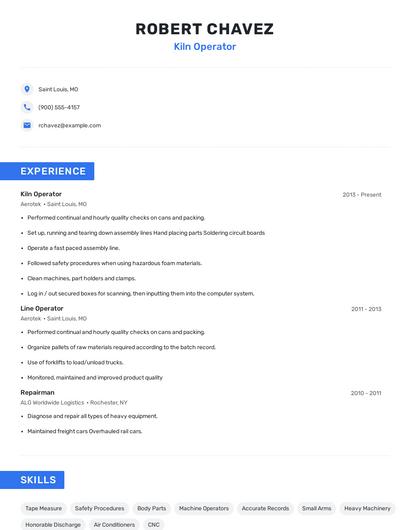
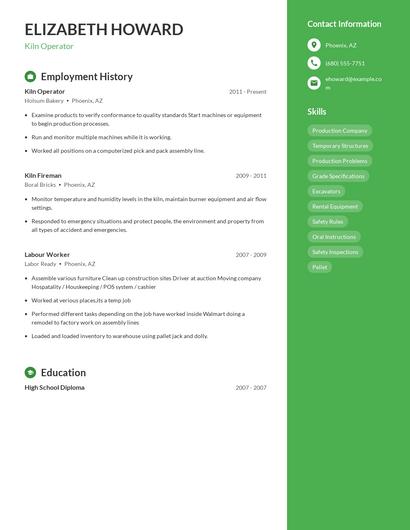
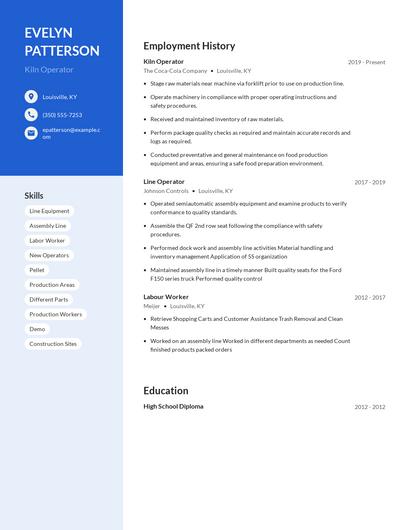
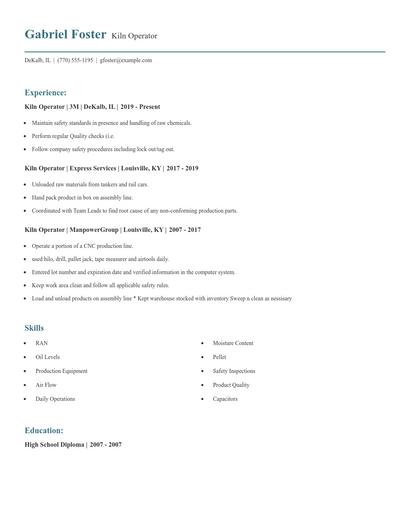
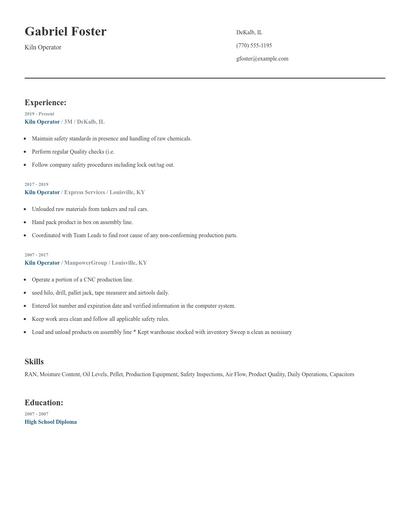
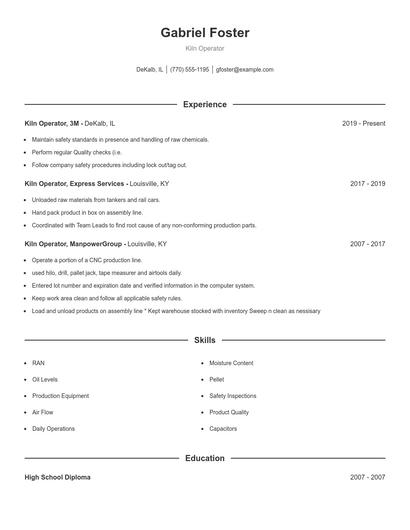
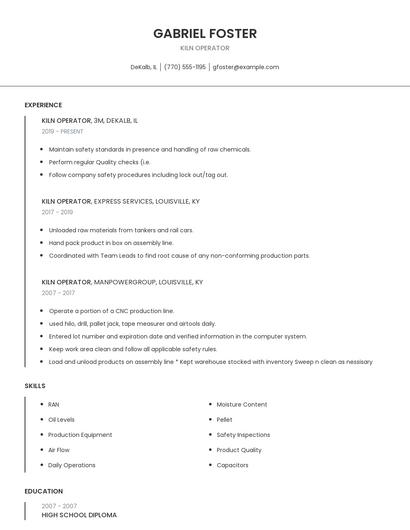
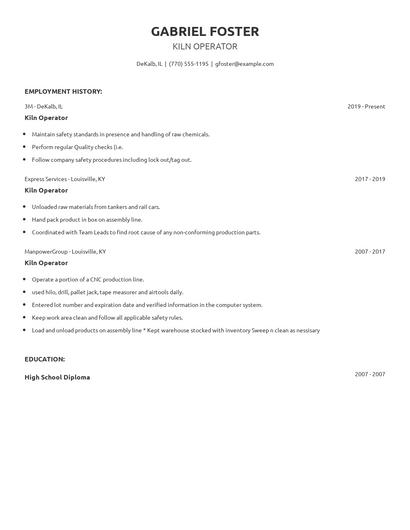
Choose from 10+ customizable kiln operator resume templates
Build a professional kiln operator resume in minutes. Our AI resume writing assistant will guide you through every step of the process, and you can choose from 10+ resume templates to create your kiln operator resume.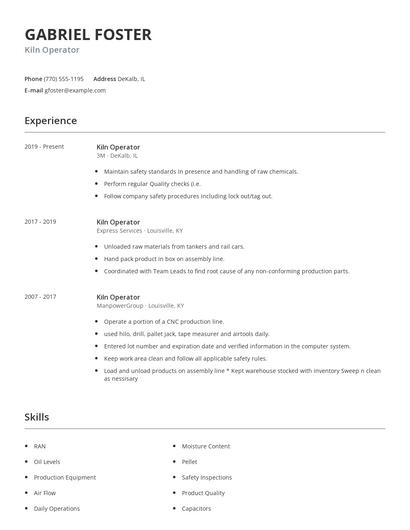
Compare different kiln operators
Kiln operator vs. Rubber tire curer
While similarities exist, there are also some differences between kiln operators and rubber tire curer. For instance, kiln operator responsibilities require skills such as "safety standards," "safety procedures," "rail cars," and "production equipment." Whereas a rubber tire curer is skilled in "asphalt," "invoice," "vas," and "warehouse movements." This is part of what separates the two careers.
Rubber tire curers tend to reach similar levels of education than kiln operators. In fact, rubber tire curers are 3.4% more likely to graduate with a Master's Degree and 0.0% less likely to have a Doctoral Degree.Kiln operator vs. Stoker
In addition to the difference in salary, there are some other key differences worth noting. For example, kiln operator responsibilities are more likely to require skills like "safety standards," "safety procedures," "rail cars," and "production equipment." Meanwhile, a stoker has duties that require skills in areas such as "load trucks," "customer service," "sales floor," and "date product." These differences highlight just how different the day-to-day in each role looks.
Stokers earn similar levels of education than kiln operators in general. They're 1.5% more likely to graduate with a Master's Degree and 0.0% less likely to earn a Doctoral Degree.Kiln operator vs. Flow worker
There are many key differences between these two careers, including some of the skills required to perform responsibilities within each role. For example, a kiln operator is likely to be skilled in "safety standards," "safety procedures," "rail cars," and "production equipment," while a typical flow worker is skilled in "customer service," "patients insurance," "pathology reports," and "ex."
Flow workers typically earn similar educational levels compared to kiln operators. Specifically, they're 1.3% more likely to graduate with a Master's Degree, and 0.0% more likely to earn a Doctoral Degree.Kiln operator vs. Oven tender
Types of kiln operator
Updated January 8, 2025
