What does a knitting machine operator do?
Knitting machine operator responsibilities
Here are examples of responsibilities from real knitting machine operator resumes:
- Record statistics on ISO documentation, and coordinate with machine technicians and electrical technicians to keep machines operating at maximum efficiency.
- Record statistics on ISO documentation, and coordinate with machine technicians and electrical technicians to keep machines operating at maximum efficiency.
Knitting machine operator skills and personality traits
We calculated that 42% of Knitting Machine Operators are proficient in RAN, Doff, and Creel.
We break down the percentage of Knitting Machine Operators that have these skills listed on their resume here:
- RAN, 42%
Creeled, cleaned,inspected quality, ran production.
- Doff, 16%
Doff, Creel, Inspection Reason for Leaving: plant closed
- Creel, 16%
Set up creel with correct yarn, maintain creel by hanging and splicing the yarn.
- Test Runs, 13%
Operate machines for test runs to verify adjustments and to obtain product samples.
- Machine Operation, 13%
Set up and adjusted yarn manufacturing and processing machines using charts, oral instructions and knowledge of machine operations.
Most knitting machine operators use their skills in "ran," "doff," and "creel" to do their jobs. You can find more detail on essential knitting machine operator responsibilities here:
The three companies that hire the most knitting machine operators are:
- Hanesbrands2 knitting machine operators jobs
- Beverly Knits Inc
2 knitting machine operators jobs
- Hanes Companies, Inc.2 knitting machine operators jobs
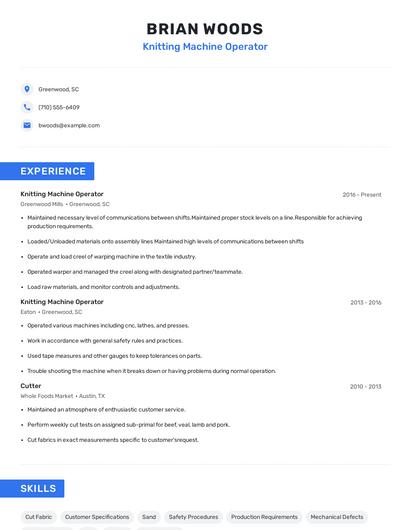
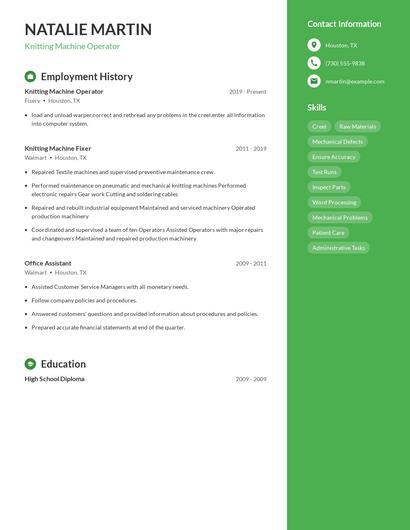
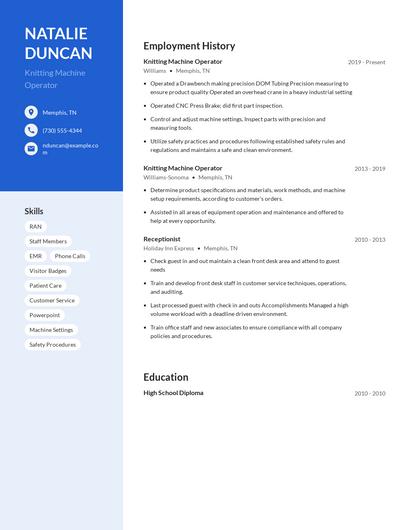
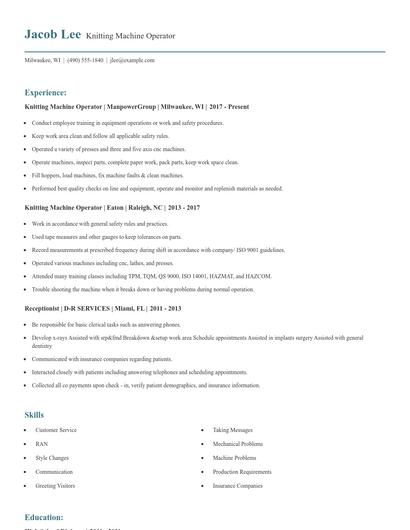
Choose from 10+ customizable knitting machine operator resume templates
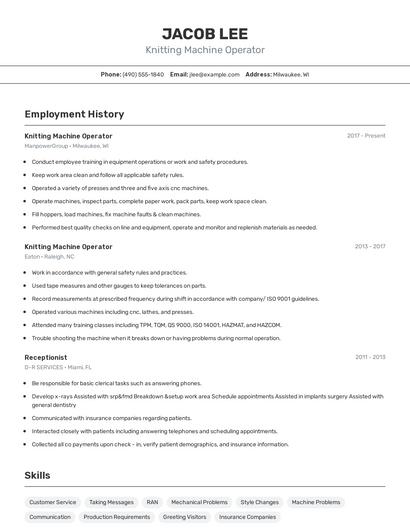
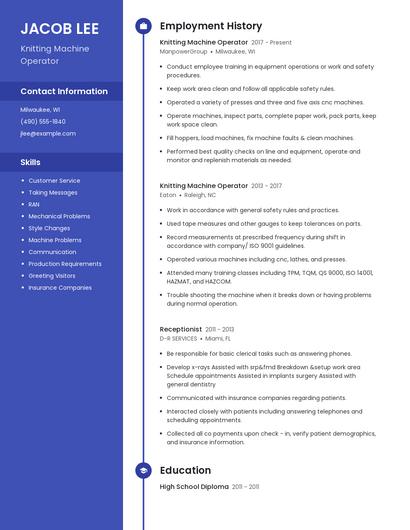
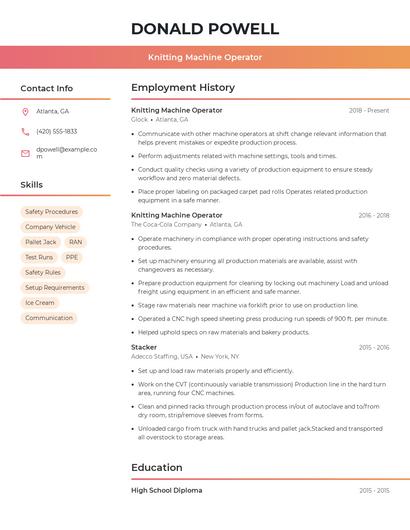
Build a professional knitting machine operator resume in minutes. Our AI resume writing assistant will guide you through every step of the process, and you can choose from 10+ resume templates to create your knitting machine operator resume.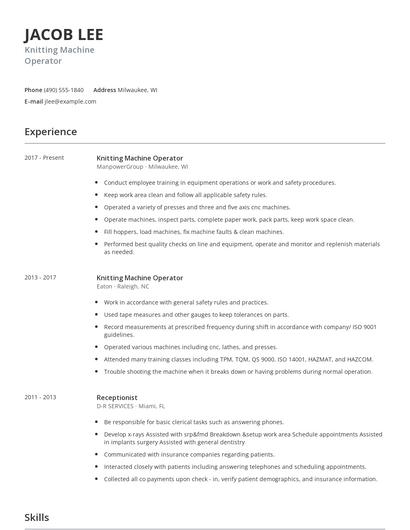
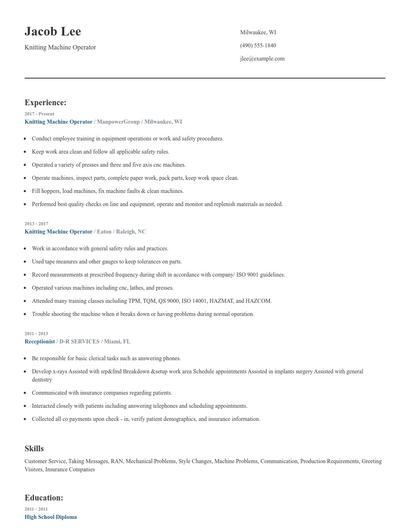
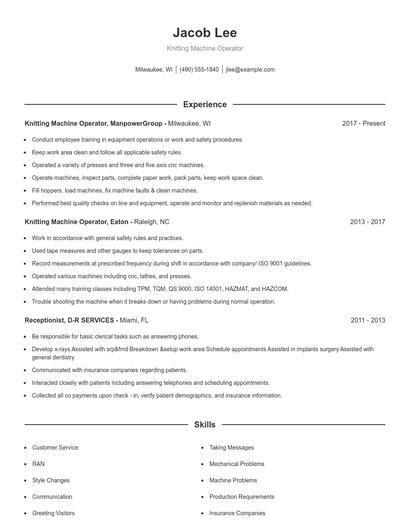
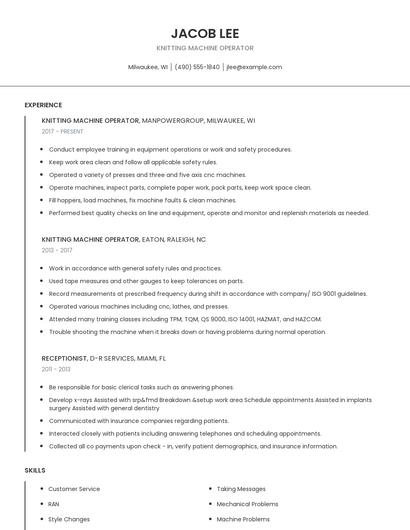
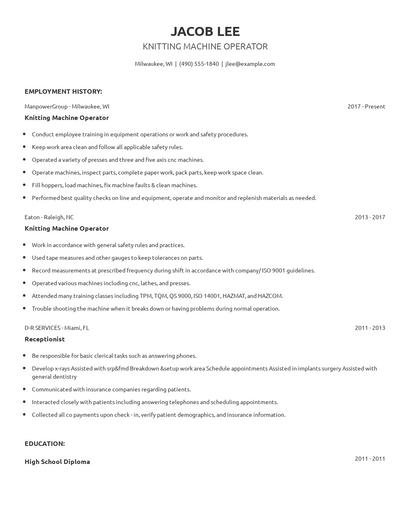
Compare different knitting machine operators
Knitting machine operator vs. Weaver
Operators are skilled workers who are in charge of working on an industrial machine or a specific aspect of the manufacturing business. They are trained to operate machines, learning how to use them. They are also responsible for the maintenance and repair of the machine, and they should be able to troubleshoot problems and provide remedies to them. They must be knowledgeable about the different parts of the machine and how to mitigate any challenges that may arise. Operators should be alert, detail-oriented, and familiar with safety and health guidelines.
While similarities exist, there are also some differences between knitting machine operators and weaver. For instance, knitting machine operator responsibilities require skills such as "ran," "starts machine," "test runs," and "machine operation." Whereas a weaver is skilled in "patrol," "quality defects," "safety procedures," and "quality checks." This is part of what separates the two careers.
On average, weavers reach similar levels of education than knitting machine operators. Weavers are 1.8% more likely to earn a Master's Degree and 0.0% less likely to graduate with a Doctoral Degree.Knitting machine operator vs. Knitter
While some skills are similar in these professions, other skills aren't so similar. For example, resumes show us that knitting machine operator responsibilities requires skills like "ran," "doff," "starts machine," and "test runs." But a knitter might use other skills in their typical duties, such as, "quality checks," "quality standards," "oiling," and "quality inspection."
Knitters earn a lower average salary than knitting machine operators. But knitters earn the highest pay in the retail industry, with an average salary of $27,641. Additionally, knitting machine operators earn the highest salaries in the retail with average pay of $32,878 annually.In general, knitters achieve similar levels of education than knitting machine operators. They're 2.8% more likely to obtain a Master's Degree while being 0.0% less likely to earn a Doctoral Degree.Knitting machine operator vs. Loom operator
Some important key differences between the two careers include a few of the skills necessary to fulfill the responsibilities of each. Some examples from knitting machine operator resumes include skills like "ran," "starts machine," "test runs," and "machine operation," whereas a loom operator is more likely to list skills in "textile," "quality products," "safety standards," and "customer specifications. "
Most loom operators achieve a similar degree level compared to knitting machine operators. For example, they're 0.0% less likely to graduate with a Master's Degree, and 0.0% less likely to earn a Doctoral Degree.Knitting machine operator vs. Operator
Types of knitting machine operator
Updated January 8, 2025
