
Automatically apply for jobs with Zippia
Upload your resume to get started.
Laboratory helper skills for your resume and career
14 laboratory helper skills for your resume and career
1. Laboratory Equipment
- Set up and calibrate laboratory equipment prior to experiments.
- Clean dirty glassware, laboratory equipment and general).
2. Chemistry
Chemistry is the branch of science that tells us about the composition, properties, and structure of elements and compounds. The processes these elements undergo and how they undergo change all come under the branch of chemistry.
- Help Desk assistance to chemistry students at Vanderbilt University PRESENT
- Assist students with organic chemistry lab questions Management of chemicals and lab equipment
3. Lab Equipment
- Prepared chemical solutions, set up lab equipment/materials for general chemistry labs, washed equipment, worked independently, followed instructions.
- Opened/closed student photography lab - Maintained and cleaned photography printing equipment - Assisted students with lab equipment and project critique
4. Laboratory Maintenance
- Synthesize and develop organic small molecules for RNA biology projects Assist with laboratory maintenance and run analytical tests on produced molecules
5. PCR
PCR stands for Polymerase Chain Reaction, a tool to make millions of copies of a target part of DNA. Polymerase chain reaction involves the process of heating and cooling. The process takes place using a machine, which helps in heating and cooling off the substances. The purpose of heating exists to separate the DNA into two single strands.
- Performed PCR purification and ligation.
- Developed PCR procedures for three different medical research laboratories.
6. Chemical Solutions
- Assisted establishing an efficient reference system for chemical solutions and reagents.
- Mixed chemical solutions for laboratory use.
Choose from 10+ customizable laboratory helper resume templates
Build a professional laboratory helper resume in minutes. Our AI resume writing assistant will guide you through every step of the process, and you can choose from 10+ resume templates to create your laboratory helper resume.7. Pipettes
- Clean glassware, pipettes, test tube racks, empty waste containers as required.
- Wrapped and sterilized pipette tips via autoclaving.
8. Centrifuges
- Clean all centrifuges weekly following Universal precaution guidelines.
- Operated various testing equipment such as centrifuges and semi and fully automated liquid transfer instruments.
9. Electrophoresis
- Prepared different experiment techniques such as gel electrophoresis.
- Read experimental protocols and perform experiments following directions (including tissue collection, molecular biology, gel electrophoresis, etc.)
10. DNA
Deoxyribonucleic acid, or only DNA, which is considered the king of molecules, is a macromolecule that contains the main component of chromosomes. Shaped like a double helix, DNA is usually found in the nucleus of a cell. It is a type of material that transports characteristics in many forms, developed in nucleotides around one another.
- Isolated plasmid DNA and purified such plasmids via Cesium Chloride gradients.
- Performed basic molecular processes associated with laboratory tests including DNA extractions of prenatal samples being tested for chromosomal abnormalities.
11. Genotyping
- Established a novel and economical genotyping methodology for a transgenic mouse strain
- Assisted the Principal Investigator with animal husbandry, colony maintenance, genotyping, laboratory representation, facility upkeep and research assistance.
12. Troubleshoot
Troubleshooting is the process of analyzing and fixing any kind of problem in a system or a machine. Troubleshooting is the detailed yet quick search in the system for the main source of an issue and solving it.
- Use internally developed Laboratory Information System to document case status, troubleshoot and ensure prompt turnaround time of specimens.
- Perform immunological, chemical, microbiological, and hematological tests, critically examine results for accuracy, troubleshoot discrepancies.
13. Laboratory Materials
- Demonstrated the ability to clean and prepare laboratory materials such as glassware, pipet tips, and agar plates.
14. Lims
A LIMS - Laboratory Information Management System is a software solution to improve laboratory productivity and efficiency with modern support of laboratory operations to address the challenges of data and sample management, automation, and regulation of laboratories from around the world and thus maintaining workflows and standardized testing and reporting procedures.
- Maintained a LIMS database of client and evidence information.
- Recorded laboratory data into Laboratory Information Management System (LIMS).

What skills help Laboratory Helpers find jobs?
Tell us what job you are looking for, we’ll show you what skills employers want.
What skills stand out on laboratory helper resumes?
Dr. Rainer Glaser
Professor and Chair, Missouri University of Science and Technology
What laboratory helper skills would you recommend for someone trying to advance their career?
Benjamin Ford
Professor and Chair, Indiana University of Pennsylvania
What type of skills will young laboratory helpers need?
John Wilbur Ph.D.
Associate Professor of Practice, University of Arizona
List of laboratory helper skills to add to your resume
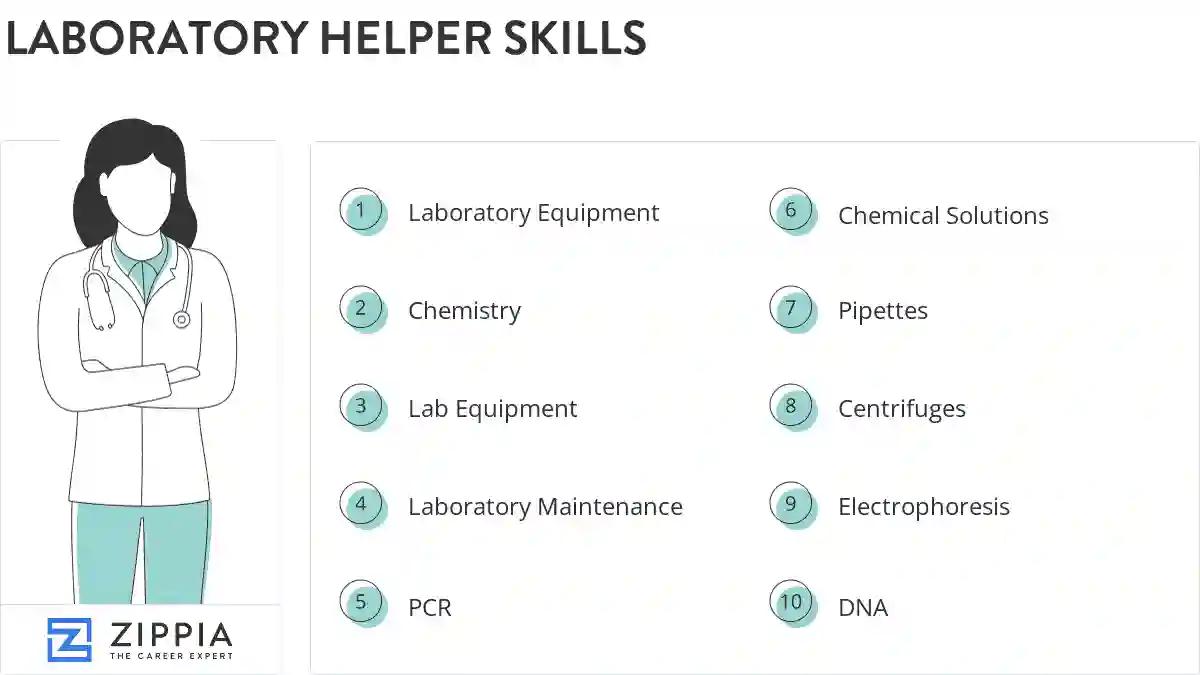
The most important skills for a laboratory helper resume and required skills for a laboratory helper to have include:
- Laboratory Equipment
- Chemistry
- Lab Equipment
- Laboratory Maintenance
- PCR
- Chemical Solutions
- Pipettes
- Centrifuges
- Electrophoresis
- DNA
- Genotyping
- Troubleshoot
- Laboratory Materials
- Lims
Updated January 8, 2025
