
Automatically apply for jobs with Zippia
Upload your resume to get started.
Laboratory instructor skills for your resume and career
15 laboratory instructor skills for your resume and career
1. Lab Procedures
- Position entails instruction and lab procedures, working with students in the 7th-12th grade.
- Create course syllabus and give power point presentations on lab procedures and techniques.
2. Molecular Biology
- Conducted undergraduate molecular biology and biochemistry laboratory activities under guidance of principal course instructors.
- Prepare and deliver lectures to undergraduate students on general or molecular biology.
3. Patient Care
Patient care entails the diagnosis, recovery, and control of sickness as well as the maintenance of physical and emotional well-being through the use of healthcare providers' services. Patient care is described as services provided to patients by health practitioners or non-professionals under guidance.
- Assessed the ability of all students to provide safe transportation and quality patient careering emergency situations.
- Demonstrate and teach patient care skills in the lab setting and in the long-term care clinical setting.
4. Anatomy
Anatomy is the comprehensive study of the internal structure and functions of a thing (living or nonliving). In the body, it's referred to as human anatomy which is the study of the body's internal structure and how they function with one another. There's also plant anatomy and animal anatomy for studying the structures of both.
- Instructed laboratory procedures for Biology/Human Anatomy and Physiology/Botany.
- Lectured classes of 24 undergraduates in lab setting on various topics including comparative anatomy, plant physiology and molecular cloning techniques
5. Student Performance
- Evaluated student performance in the classroom and laboratory setting using outcomes-based assessments.
- Prepared and administered appropriate test questions, and evaluated student performance.
6. Organic Chemistry
- Provided instruction and evaluated student reports and assignments for Organic Chemistry II Laboratory Experiential Training
- Offered and evaluated General Chemistry and Organic Chemistry laboratory tests.
Choose from 10+ customizable laboratory instructor resume templates
Build a professional laboratory instructor resume in minutes. Our AI resume writing assistant will guide you through every step of the process, and you can choose from 10+ resume templates to create your laboratory instructor resume.7. Lab Equipment
- Trained in using lab equipment including various computer controlled machines, powered manual machines, and electronics equipment
- Prepare clinical/lab equipment for demonstration and lectures; grading of weekly clinical evaluations.
8. Physiology
Physiology is a branch of biology focused on studying living things, other parts, and the functions of these parts. It studies the functions of living things, especially the human body, and the effects of different processes and actions on the well-being of the body.
- Exercise Physiology Laboratory Lab experiences provided hands-on application of lessons covered during Exercise Physiology lectures.
- Prepared physiology equipment and dissection demonstration cats for other teaching assistants to follow.
9. Scientific Methods
- Developed instructional materials for wet labs and adapted computer simulation software for virtual labs to reinforce application of the scientific method.
- Discussed and enforce the use of scientific methodology.
10. Mathematics
- Provided teaching and administrative assistance in the department of Continuing Education -Adult Ed specializing in mathematics.
- Provided both Reading and Mathematics Interventions daily.
11. Lab Reports
- Grade lab reports for approximately seventy students.
- Reviewed and graded laboratory quizzes, exams, lab reports, lab notebooks and presentations and reported results to lecture professors.
12. EMT
Emergency Medical Technicians (EMTs) provide urgent and emergent patients who enter the emergency medical services (EMS) system for out-of-hospital emergency medical treatment and transportation. EMTs are trained to stabilise and evacuate patients in a variety of situations, from non-emergency to regular hospital transports to life-threatening emergencies. Under the supervision of a physician, EMTs work as part of a robust EMS response scheme.
- Assist in instructing students on the skills needed to successfully complete the NYS Department of Health Basic EMT Course.
- Work with EMT Basic and Paramedic students in lab skills and scenarios, and advanced simulation programs.
13. Syllabus
- Developed, implemented and evaluated skills and simulation learning experiences based on a course syllabus and in collaboration with faculty.
- Prepared syllabus and arranged teaching materials.
14. Course Content
- Facilitated weekly meetings with lab instructors and advising professors to ensure consistency of course content.
- Streamlined/standardized course content by originating lab reference materials, student skills checklists, and related clinical scenarios for all lab sessions.
15. Lab Techniques
- Developed and taught lab techniques related to forensic analysis.
- Worked with middle school students in the lab teaching lab techniques as well as theories and mechanisms of biological processes
5 Laboratory Instructor resume examples
Build a professional laboratory instructor resume in minutes. Browse through our resume examples to identify the best way to word your resume. Then choose from 5+ resume templates to create your laboratory instructor resume.

What skills help Laboratory Instructors find jobs?
Tell us what job you are looking for, we’ll show you what skills employers want.
What laboratory instructor skills would you recommend for someone trying to advance their career?
Helen Callus
Professor of Viola, Northwestern University
What type of skills will young laboratory instructors need?
Dr. Lori Gray
Associate Professor: Director of Music Education, Boise State University
I would add that graduates need a strong work ethic, an understanding of professionalism and respect in the workplace, and self-awareness and an understanding of personal needs and limitations both at work and in their personal lives. In these current living conditions during a global pandemic (COVID-19), graduates also need resilience, perseverance, adaptability, and flexibility. These are all skills I would want for our Music Education majors to cultivate, as the climate in K-12 Education is ever-changing. However, I believe these are all skills that would be useful in any new career path.
List of laboratory instructor skills to add to your resume
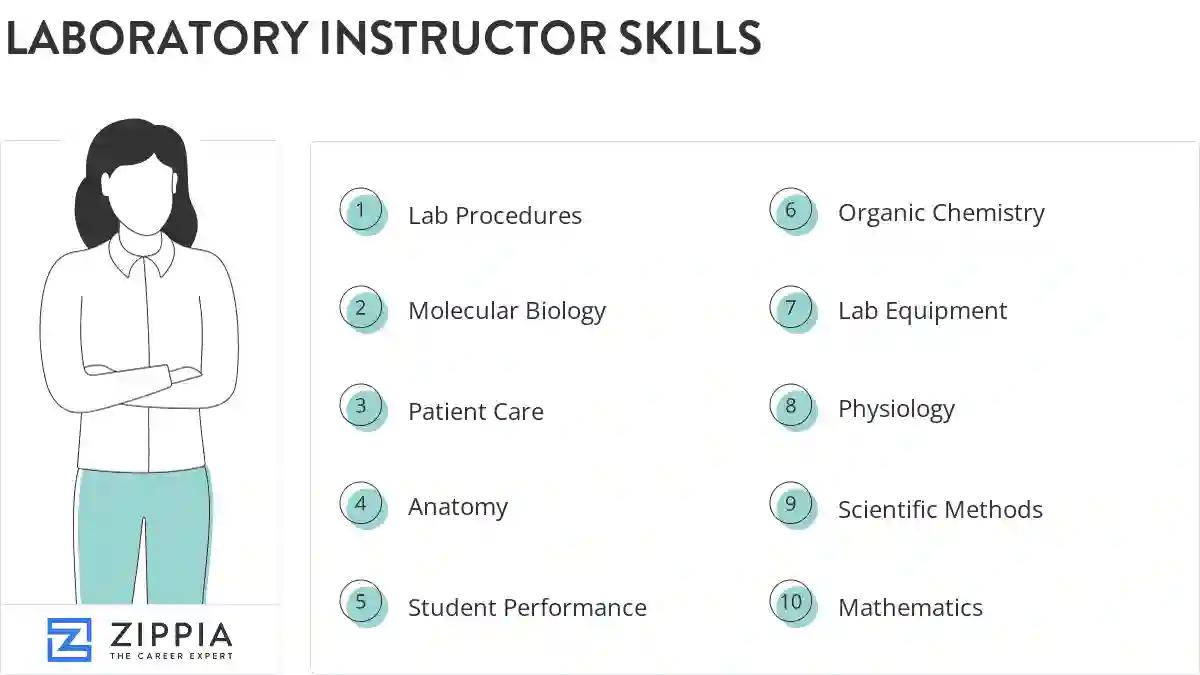
The most important skills for a laboratory instructor resume and required skills for a laboratory instructor to have include:
- Lab Procedures
- Molecular Biology
- Patient Care
- Anatomy
- Student Performance
- Organic Chemistry
- Lab Equipment
- Physiology
- Scientific Methods
- Mathematics
- Lab Reports
- EMT
- Syllabus
- Course Content
- Lab Techniques
- Lab Sessions
- Lab Assignments
- Laboratory Experiments
- Course Materials
- Cell Biology
- C++
- Lab Experiments
- Laboratory Techniques
- Laboratory Sections
- Lab Sections
- Laboratory Equipment
- PowerPoint
- Introductory Biology
- Laboratory Procedures
- Advanced Life Support
- Vital Signs
- Laboratory Sessions
- Laboratory Reports
- Laboratory Exercises
- Computer Lab
- Research Projects
- Astronomy
- Genetics
- EKG
- SPSS
- Lab Materials
- Electrophoresis
- Laboratory Assignments
- PCR
- DNA
- Laboratory Classes
- Lab Exercises
- Lecture Material
Updated January 8, 2025
