
Automatically apply for jobs with Zippia
Upload your resume to get started.
Laboratory scientist skills for your resume and career
15 laboratory scientist skills for your resume and career
1. Chemistry
Chemistry is the branch of science that tells us about the composition, properties, and structure of elements and compounds. The processes these elements undergo and how they undergo change all come under the branch of chemistry.
- Designed and conducted experiments at a chemistry lab in order to monitor the continuous growing of a genetically modified bacterium.
- Performed tests in all sections of the clinical laboratory including chemistry, hematology and microbiology.
2. ASCP
- Obtained ASCP certification as a Technologist in Microbiology, M(ASCP)
- Advanced hematology from ASCP in 2011 5.
3. Laboratory Procedures
- Train chemists on laboratory procedures and tests as required by laboratory management.
- Perform both routine and non-routine laboratory procedures in sample preparation.
4. Test Results
- Perform quality control procedures to ensure accuracy of clinical data and validate test results through correlation with test parameters.
- Provide consultation regarding the appropriateness of the testing ordered and interpretation of test results.
5. Data Collection
Data collection means to analyze and collect all the necessary information. It helps in carrying out research and in storing important and necessary information. The most important goal of data collection is to gather the information that is rich and accurate for statistical analysis.
- Create new/update existing data collection forms and worksheets to monitor Quality Control/Quality Assurance.
- Developed new synthesis routes, provide reliable and repeatable synthesis procedures, and maintained an organized and readable data collection.
6. Molecular Biology
- Perform experiments including immunohistochemistry method development, tissue culture and molecular biology (cloning, PCR and transfection).
- Created/established molecular biology laboratory within department.
Choose from 10+ customizable laboratory scientist resume templates
Build a professional laboratory scientist resume in minutes. Our AI resume writing assistant will guide you through every step of the process, and you can choose from 10+ resume templates to create your laboratory scientist resume.7. CLIA
- Facilitated in validation/verification of in-house projects and IVD assays following compliance protocols in CLIA.
- Performed studies according to CLIA regulations, quality assurance and quality control guidelines.
8. Proficiency Testing
- Trained and conducted NAI assay proficiency testing of two laboratory technicians to build additional capacity in preparation for future Influenza Seasons.
- Planned, coordinated, monitored and controlled proficiency testing to satisfy compliance requirements.
9. Immunology
Immunology is a branch of medical service that deals with studying the immune system of a person. This particular specialization focuses on the function of the immune system and how it affects the entire body. It is usually an activity where it develops a mechanism that helps prevent and susceptibility of bacteria, infection, and other viruses that can enter the body.
- Focus in Hematology, Coagulation, Urinalysis, Immunology, and Blood Bank.
10. Stem Cells
- Analyzed UC-derived stem cells for cartilage tissue engineering application.
- Manipulated pluripotent cord blood stem cells in order to drive towards functional red blood cells.
11. Public Health
- Performed culture and sensitivity on clinical samples from public health clinics and physicians.
- Worked on Public Health Research Biotechnologies project.
12. Data Analysis
- Performed extensive mathematical and physics calculations and statistical data analysis.
- Developed strong data analysis foundations.
13. Flow Cytometry
Flow cytometry (FC) is a procedure used to recognize and gauge the physical and compound attributes of a populace of cells or particles. In this cycle, an example containing cells or particles is suspended in a liquid and infused into the stream cytometer instrument. Stream cytometry is a research center technique used to recognize, distinguish, and check explicit cells. This technique can likewise distinguish specific parts inside cells. This data depends on actual attributes and additionally markers called antigens on the phone surface or inside cells that are special to that phone type.
- Lead Scientist for flow cytometry acquisition and analysis.
- Established and managed a flow cytometry facility.
14. Lab Equipment
- Perform preventive maintenance and interim calibration on lab equipment as requires.
- Inspected condition of lab equipment, inventory of supplies and the budget.
15. Next-Generation Sequencing
- Project manager for next-generation sequencing and genomics technologies with contract research organizations.
- Led execution of research evaluation study to prepare Small-RNA sequencing libraries from clinical samples for Next-Generation sequencing.
5 Laboratory Scientist resume examples
Build a professional laboratory scientist resume in minutes. Browse through our resume examples to identify the best way to word your resume. Then choose from 5+ resume templates to create your laboratory scientist resume.

What skills help Laboratory Scientists find jobs?
Tell us what job you are looking for, we’ll show you what skills employers want.
What skills stand out on laboratory scientist resumes?
Dr. Rainer Glaser
Professor and Chair, Missouri University of Science and Technology
What soft skills should all laboratory scientists possess?
Kyle DiVito Ph.D.
Associate Director of Biotechnology, Assistant Professor, Georgetown University School of Medicine
What hard/technical skills are most important for laboratory scientists?
Kyle DiVito Ph.D.
Associate Director of Biotechnology, Assistant Professor, Georgetown University School of Medicine
What laboratory scientist skills would you recommend for someone trying to advance their career?
Michelle McEliece Ph.D.
Associate Professor, Gwynedd Mercy University
The best thing to do is to try to gain skills working in a lab. There are lots of options for this. They could look to the industry or look to academic labs that might be looking for someone for a year. If a student needs to enhance their resume for acceptance into a program, the gap year can be used to take a graduate course or two to demonstrate they can handle that level of study. Students interested in a professional program where they are either required or recommended to have patient contact (PA programs, medical school) can look for those opportunities during a gap year, as well. The most important thing about a gap year is to do SOMETHING and have that something contribute to aiming for a future goal.
What type of skills will young laboratory scientists need?
Dr. Douglas Capone Ph.D.
Professor, University of Southern California
What technical skills for a laboratory scientist stand out to employers?
Dr. Joey Neilsen
Assistant Professor, Villanova University
List of laboratory scientist skills to add to your resume
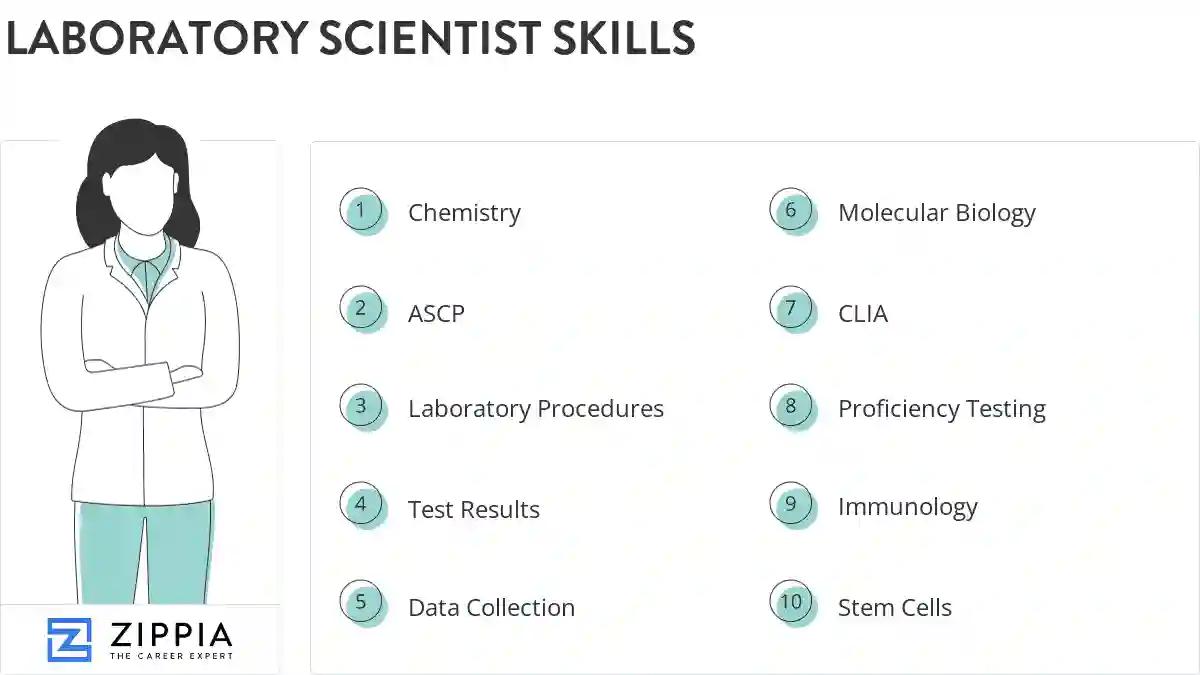
The most important skills for a laboratory scientist resume and required skills for a laboratory scientist to have include:
- Chemistry
- ASCP
- Laboratory Procedures
- Test Results
- Data Collection
- Molecular Biology
- CLIA
- Proficiency Testing
- Immunology
- Stem Cells
- Public Health
- Data Analysis
- Flow Cytometry
- Lab Equipment
- Next-Generation Sequencing
- Sample Preparation
- Method Development
- Hematology
- Extraction
- Elisa
- Data Entry
- Western Blotting
- Cell Lines
- Instrument Maintenance
- Patient Samples
- Analytical Methods
- OSHA
- Lims
- Profiling
- Technical Reports
- GLP
- Liquid Chromatography
- Standard Operating Procedure
- FDA
- RT-PCR
- HPLC
- Immunoassay
- Tissue Culture
- ISO
- EPA
- Analytical Instrumentation
- Assay Development
- Routine Maintenance
- R
- Cell-Based Assays
- Test Methods
- Technical Support
- Quality Control Procedures
- Various Testing
Updated January 8, 2025
