
Automatically apply for jobs with Zippia
Upload your resume to get started.
Laboratory supervisor and technician skills for your resume and career
15 laboratory supervisor and technician skills for your resume and career
1. Clinical Laboratory
- Assisted in hiring, training, and management of a team of 15 lab technicians in the clinical laboratory.
- Developed and presented scale up plans for the clinical laboratory based on sample volume projection.
2. Patients
- Worked closely with other clinical personnel, nurses, physicians and administration to facilitate optimum care of patients
- Resolved patients inquiries regarding their explanation of insurance benefits.
3. Laboratory Procedures
- Provide day-to-day supervision of personnel ensuring the proper performance of all laboratory procedures and reporting and technology development.
- Monitor production of other laboratory procedures and personnel and comply with laboratory standards of operations and procedures.
4. Lab Equipment
- Interview vendors for additional lab equipment and Laboratory Information System.
- Set parameters of all lab equipment used such as HPLC, ICP, and GPC.
5. OSHA
- Facilitate OSHA, CAP, CLIA, and Texas Department of Health inspections.
- Ensured compliance with OSHA standards in production and waste removal.
6. PT
PT which stands for Prothrombin Time is a test to evaluate the body's ability to properly form blood clots using one's blood sample. PT results are used to calculate the International Normalized Ratio (INR) which detects the effectiveness of blood-thinning medications like Warfarin taken by patients that have blood-clotting disorders.
- Maintain a Proficiency Testing (PT) program including deployment of detailed corrective action plans for unacceptable findings.
Choose from 10+ customizable laboratory supervisor and technician resume templates
Build a professional laboratory supervisor and technician resume in minutes. Our AI resume writing assistant will guide you through every step of the process, and you can choose from 10+ resume templates to create your laboratory supervisor and technician resume.7. Chemistry
Chemistry is the branch of science that tells us about the composition, properties, and structure of elements and compounds. The processes these elements undergo and how they undergo change all come under the branch of chemistry.
- Performed toxicology screening of blood, urine, and gastric contents by HPLC, GC, ToxiTubeTM, wet chemistry methods.
- Cross trained in Hematology, Chemistry, Blood Bank, Microbiology, Immunology, and Urinalysis.
8. Patient Care
Patient care entails the diagnosis, recovery, and control of sickness as well as the maintenance of physical and emotional well-being through the use of healthcare providers' services. Patient care is described as services provided to patients by health practitioners or non-professionals under guidance.
- Reviewed and confirmed all patient results, and ensured the accurate and efficient delivery of results to patient caretakers.
- Provided administration with information to support new equipment and technology which produced better patient care and increased revenue.
9. Performance Evaluations
Performance evaluation is a formal and productive process to measure an employee's work and results based on their job responsibilities over a defined period of time and to properly measure an employee's contribution to the workforce and employers and achieve a high level of quality and quantity of work produced. The evaluation also helps employees provide information about deficiencies in job performance and the company's expectations for the future.
- Prepared and Conducted Annual Performance Evaluations and Represented Employer at State Unemployment Hearings.
- Managed project development, occurrence management, employee hiring/retention, performance evaluations, competency and staff scheduling.
10. CLIA
- Ensured the laboratory personnel followed proper protocol and regulations according to CLIA.
- Supervised laboratory based on responsibilities outlined by COLA and CLIA.
11. Blood Bank
A blood bank is a place where blood is gathered, stored, and preserved for later use for blood transfusion. A blood bank is also referred to a department of a hospital where blood and plasma are stored after testing it. It is also responsible for separating blood components like platelets, red blood cells and plasma from that blood and returning the remaining components to the donor.
- Continue to actively work on bench one day per week in Hematology, Coagulation, Urinalysis, Coagulation, Blood Bank.
- Analyze blood samples for blood typing, cross matching in blood bank dept.
12. Microbiology
- Trained extensively in the microbiology department and worked independently at a micro workstation.
- Evaluate rapid testing and automated testing methods in microbiology.
13. Employee Training
- Sampled water and Coal for Analysis Keep employee training records up too date.
- Coordinated employee training and competency activities and ensured that the appropriate training and competency records are completed.
14. Proficiency Testing
- Maintained enrollment in proficiency testing program(CAP); ensured laboratory quality control procedures met accreditation requirements.
- Performed proficiency testing and collected and filed data results.
15. Test Results
- Interacted with various departments and production personnel concerning test results, asphalt production issues, and raw material management issues.
- Implement and monitor laboratory information system for tracking testing requisitions, patient collections, test results and client reporting.
5 Laboratory Supervisor And Technician resume examples
Build a professional laboratory supervisor and technician resume in minutes. Browse through our resume examples to identify the best way to word your resume. Then choose from 5+ resume templates to create your laboratory supervisor and technician resume.

What skills help Laboratory Supervisors And Technician find jobs?
Tell us what job you are looking for, we’ll show you what skills employers want.
What skills stand out on laboratory supervisor and technician resumes?
Dr. Rainer Glaser
Professor and Chair, Missouri University of Science and Technology
What soft skills should all laboratory supervisor and technicians possess?
Patrick Tracy
MLT Program Coordinator, Wenatchee Valley College
-Work well alone
-Communicate calmly and clearly
What laboratory supervisor and technician skills would you recommend for someone trying to advance their career?
Gerald Bergtrom Ph.D.
Professor of Biological Sciences (Emeritus) & Teaching & Learning Consultant, University of Wisconsin-Milwaukee
- Thinking about a whole gap year, the student should make a long-term commitment to skills improvement and fill in gaps in a resume or job application.
-If the new graduate can afford it, spend some time traveling, to be exposed to different cultures and languages. If the student lives in an area with a growing LatinX population, learning some Spanish would be useful.
-If it looks like the gap year will not include activities related to the job they hope to get at the end of the year, then take at least one STEM course in their area of interest so as not to lose their edge. This could be an online course (for example, a MOOC). Do it for credit if necessary, to prove (to themselves and others) that they still love and want to succeed in science.
What type of skills will young laboratory supervisor and technicians need?
John Wilbur Ph.D.
Associate Professor of Practice, University of Arizona
What hard/technical skills are most important for laboratory supervisor and technicians?
Dr. Luis Rogelio Cruz-Vera
Associate Professor, University of Alabama in Huntsville
List of laboratory supervisor and technician skills to add to your resume
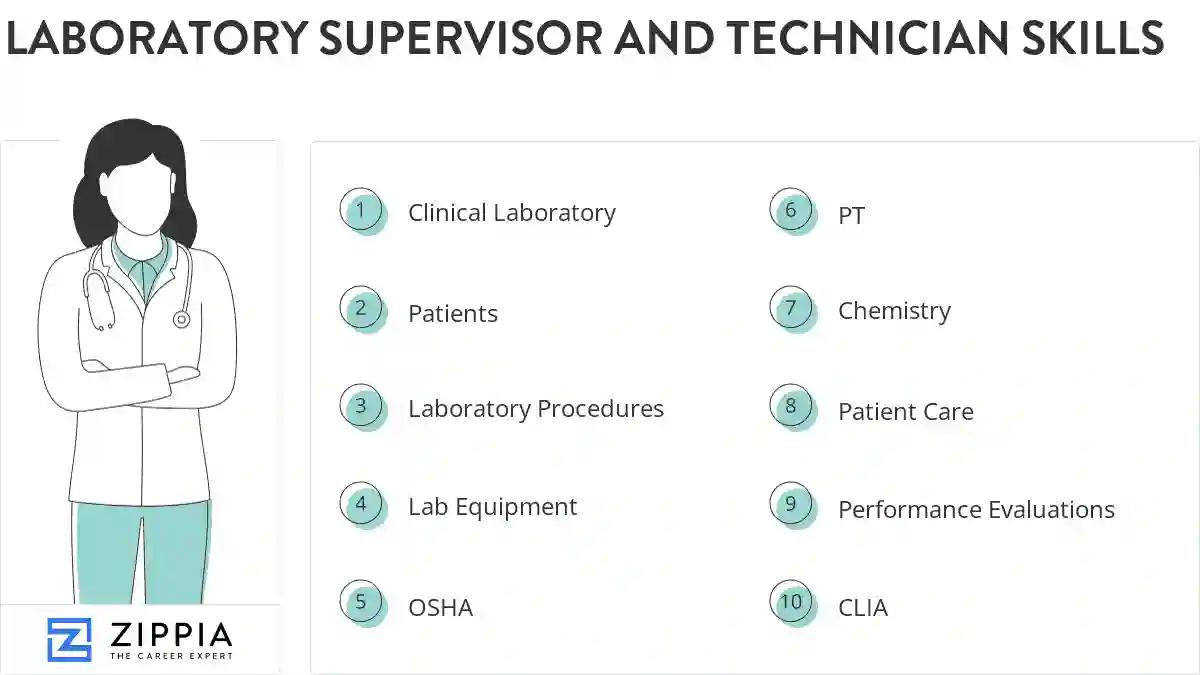
The most important skills for a laboratory supervisor and technician resume and required skills for a laboratory supervisor and technician to have include:
- Clinical Laboratory
- Patients
- Laboratory Procedures
- Lab Equipment
- OSHA
- PT
- Chemistry
- Patient Care
- Performance Evaluations
- CLIA
- Blood Bank
- Microbiology
- Employee Training
- Proficiency Testing
- Test Results
- Hematology
- Pathogens
- LIS
- Urinalysis
- Laboratory Policies
- Technical Problems
- Laboratory Compliance
- Test Procedures
- Patient Results
- FDA
- Patient Samples
- Specimen Handling
- GMP
- R
- EPA
- Equipment Maintenance
- Lims
- Regulatory Agencies
- Laboratory Operations
- Inventory Control
- Immunoassay
- Lab Results
- PCR
- Technical Troubleshooting
- Troubleshoot
- ISO
- State Regulations
- HPLC
- Technical Issues
- Lab Assistants
- Test Equipment
- Cola
Updated January 8, 2025
