Explore jobs
Find specific jobs
Explore careers
Explore professions
Best companies
Explore companies
Job outlook for laboratory support technicians in the United States
Laboratory support technician job and salary trends over time
Laboratory support technician jobs over time
Laboratory support technician job growth rate over time
| Year | # of jobs | % of population |
|---|---|---|
| 2021 | 14,536 | 0.00% |
| 2020 | 14,875 | 0.00% |
| 2019 | 14,866 | 0.00% |
| 2018 | 14,647 | 0.00% |
| 2017 | 14,700 | 0.00% |
Average laboratory support technician salary over time
Laboratory support technician salary by year
| Year | Avg. salary | Hourly rate | % Change |
|---|---|---|---|
| 2026 | $36,799 | $17.69 | +2.8% |
| 2025 | $35,799 | $17.21 | --0.7% |
| 2024 | $36,057 | $17.33 | +2.5% |
| 2023 | $35,161 | $16.90 | +2.0% |
| 2022 | $34,484 | $16.58 | --0.1% |
Laboratory support technician jobs by state
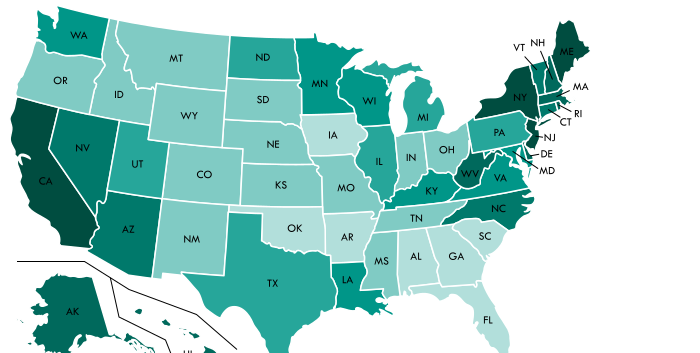
Most common states for laboratory support technicians
| Rank | State | Population | # of jobs | Employment/ 1000ppl |
|---|---|---|---|---|
| 1 | Vermont | 623,657 | 310 | 50% |
| 2 | New Hampshire | 1,342,795 | 637 | 47% |
| 3 | South Dakota | 869,666 | 358 | 41% |
| 4 | Nebraska | 1,920,076 | 615 | 32% |
| 5 | Washington | 7,405,743 | 2,237 | 30% |
| 6 | Arkansas | 3,004,279 | 841 | 28% |
| 7 | Alaska | 739,795 | 207 | 28% |
| 8 | Massachusetts | 6,859,819 | 1,756 | 26% |
| 9 | Iowa | 3,145,711 | 781 | 25% |
| 10 | Maine | 1,335,907 | 331 | 25% |
| 11 | Missouri | 6,113,532 | 1,458 | 24% |
| 12 | District of Columbia | 693,972 | 166 | 24% |
| 13 | Alabama | 4,874,747 | 1,133 | 23% |
| 14 | New Mexico | 2,088,070 | 476 | 23% |
| 15 | North Dakota | 755,393 | 175 | 23% |
| 16 | California | 39,536,653 | 8,670 | 22% |
| 17 | South Carolina | 5,024,369 | 1,130 | 22% |
| 18 | Arizona | 7,016,270 | 1,489 | 21% |
| 19 | Montana | 1,050,493 | 223 | 21% |
| 20 | Delaware | 961,939 | 204 | 21% |
Most common cities for laboratory support technicians
| Rank | City | # of jobs | Employment/ 1000ppl | Avg. salary |
|---|---|---|---|---|
| 1 | Joplin | 3 | 6% | $28,875 |
| 2 | Rogers | 3 | 5% | $27,918 |
| 3 | Springfield | 5 | 3% | $28,961 |
| 4 | Fort Smith | 3 | 3% | $27,686 |
| 5 | Lowell | 3 | 3% | $40,935 |
| 6 | Saint Louis | 6 | 2% | $29,896 |
| 7 | Boston | 4 | 1% | $41,256 |
| 8 | Oklahoma City | 4 | 1% | $27,032 |
| 9 | Aurora | 2 | 1% | $30,866 |
| 10 | Fort Wayne | 2 | 1% | $31,069 |
| 11 | Cambridge | 1 | 1% | $41,215 |
| 12 | Atlanta | 2 | 0% | $28,500 |
| 13 | Albuquerque | 1 | 0% | $30,153 |
| 14 | Des Moines | 1 | 0% | $28,518 |
Laboratory Support Technician job outlook: Expert opinions
Our panel of laboratory support technician experts
Northern Michigan University
Bloomsburg University of Pennsylvania
University of Alabama in Huntsville

Saint Cloud State University

Saint Cloud State University

Wenatchee Valley College

Agnes Scott College
Old Dominion University

The University of Akron

Siena College

Rutgers University - New Brunswick

Houston Baptist University

Adelphi University

University of North Carolina at Greensboro

Bay Path University

Kettering University

Pennsylvania State University

Kutztown University of Pennsylvania

Weber State University

University of Louisiana at Lafayette
Martin Renaldi MT (ASCP), MPA
Assistant Professor / MLS Program DirectorNorthern Michigan University
Allied Health Diagnostic, Intervention, And Treatment Professions
What general advice would you give to a Laboratory Support Technician?
Martin Renaldi MT (ASCP), MPA: Experience. I have found through my time in the realm that an experienced lab tech is going to be highly sought after and henceforth will have optimal pay opportunities. As the word implies, experience can only be achieved through 'time in the lab' which means you have to put in your time to gather that resume boosting element, experience. Once that happens, then even more doors open up in the profession.
What Laboratory Support Technician skills would you recommend for someone trying to advance their career?
Martin Renaldi MT (ASCP), MPA: The skills that will be required in the lab tech milieu over the next 3-5 years are the same ones that are necessary now, which is what makes the lab tech profession so lucrative. Foundational laboratory skills are a must now and will be must in the future. Once the aspiring lab tech learns and masters the foundational work, such as lab math, pipetting, dilution schemes, titrating, proper glassware use and application, basic spectrophotometry, transformational weights and measures, microscopy, etc. then they'll be readily adaptable for employment in any laboratory setting.
What will help Laboratory Support Technicians increase their earning potential?
Martin Renaldi MT (ASCP), MPA: I would highly recommend that the newly graduated lab tech does not limit themself to a specific location or a specific vocation. The places to work and the types of jobs available are nearly limitless. If one thinks outside of the box, outside of the mainstream lab tech opportunities, they'll find a whole host of other intriguing possibilities. So, do not limit yourself, the world is your oyster, .......so to speak.
Ethan Kentzel MS, MLS ASCPcm
Program Director, Medical Laboratory Science and Phlebotomy ProgramsBloomsburg University of Pennsylvania
Biology
What general advice would you give to a Laboratory Support Technician?
Ethan Kentzel MS, MLS ASCPcm: You completed an MLS program and you have learned a ton of information in a short span of time. However, there is still so much to learn for Medical Laboratory Science! We recommend that you do your best to grow into the role, practice with a questioning attitude, participate and advocate for the field, consider joining our advocacy group - the American Society for Clinical Laboratory Science (ASCLS). If you have not taken your ASCP MLS BOC exam, we highly recommend that you do as a way to validate your learning experiences and to optimize your long term career growth.
Dr. Luis Rogelio Cruz-Vera
Associate ProfessorUniversity of Alabama in Huntsville
Department of Biological Sciences
What soft skills should all Laboratory Support Technicians possess?
Dr. Luis Rogelio Cruz-Vera: Planification.
What hard/technical skills are most important for Laboratory Support Technicians?
Dr. Luis Rogelio Cruz-Vera: Pipetting, quantitative analysis, computer writing.
Patricia Ellinger
Medical Laboratory Science FacultySaint Cloud State University
Medical Laboratory Science
What hard/technical skills are most important for Laboratory Support Technicians?
Patricia Ellinger: -Careful work: Precision, accuracy, reproducibility
-Knowledge of quality control, ability to recognize when a test result looks wrong and what to do about it
Louise Millis
Medical Laboratory Science and Histotechnician Program Director, Associate Professor of BiologySaint Cloud State University
Medical Laboratory Science
What skills will help Laboratory Support Technicians earn the most?
Louise Millis: -Problem solving gives you the ability to see opportunities, to take on additional tasks or projects
-Careful work: Precision, accuracy, reproducibility
-Ability to work with others
-Work experience with the above and also furthering your education
-Work experience which enhance base knowledge and technical skills
-Educational
-MBA for some positions (depends on the size of the hospital), management
-MS/Ph.D. for some positions
-Depends on the size of the hospital
-Also, needed for an academic position, MS for some, others require PhD
What skills stand out on Laboratory Support Technician resumes?
Patrick Tracy: -Good critical-thinking skills
-Good problem-solving skills
-Able to prioritize tasks
-Pay attention to detail
-Take a process from beginning to end
-Maintain focus for periods
Jennifer Larimore Ph.D.
Associate ProfessorAgnes Scott College
Biology and Neuroscience Department
What soft skills should all Laboratory Support Technicians possess?
Jennifer Larimore Ph.D.: Teamwork, leadership, working with a diverse team.
Will there be an enduring impact of the coronavirus pandemic on Laboratory Support Technicians?
John Cooper Ph.D.: One of the most amazing impacts of the pandemic was the rapidity to which students and employees had to adapt to new online modes of communications and scheduling for large interactive groups. This was already a trend in the sciences where multi-disciplinary teams were geographically dispersed, but now it is a universally expected skill set, and this adoption took place in less than a year. Students who took classes during the pandemic were exposed to a wide-range of teaching and training pedagogies. Virtual labs, at home delivered lab kits, hybrid labs with students both in person and online, and every possible delivery method that can be imagined for lectures became the norm. Our students were unintentionally part of a great experiment where they were able to evaluate what works well and what does not work so well. Whether they know it or not, this knowledge will guide them as they make future decisions in their careers about the best ways to communicate, train, and interact with their peers, employees, and employers. Our graduates are the leaders of the future, and the successful ones will find this experience to have been invaluable.
What experience really stands out on Laboratory Support Technician resumes?
John Cooper Ph.D.: Employers want experience. In the sciences, research is one of the most important experiences that students can obtain. Research allows students to get in-depth hands-on training solving real world problems by putting into practice what they have learned in their labs and lectures. It also allows students to communicate their findings both in peer-reviewed publications and scientific conferences. Research experience is not only a top priority for employers, it is also required for admission to top medical schools and graduate schools in the sciences.
What type of skills will young Laboratory Support Technicians need?
John Cooper Ph.D.: Although many skill sets are required of our successful graduates, most of these skills take a second seat to communication. The ability to communicate your skills, ideas, work product, and your vision for your area of responsibility to others are paramount to success. During the pandemic, these skills were brought into sharp focus as written communication took precedence over face-to-face discussions, and online verbal communications between large groups demanded a new set of skills for replacing the polite in-person human ques that we have taken for granted but which were developed from early childhood.
Equally as important as the ability to communicate is the ability to think analytically. As both knowledge and data has become democratized over the past decade, success requires that our graduates not only assimilate knowledge, but have the ability to use that knowledge to analyze problems and extrapolate their knowledge in new and useful ways. In the sciences this is encapsulated within the framework of The Scientific Method and is the cornerstone of the research which both our undergraduate and graduate students participate in.
What's a good job out of college for Laboratory Support Technicians?
Dr. Ajay Mahajan: Professional areas, such as engineering, medical, law, business, etc., should not see much change except the requirement of new skills that allow them to work with less social interaction. What may change are jobs in some areas such as hospitality, entertainment, transportation, etc., as many of these jobs will be lost to automation. Hence, any job that resists automation should do fine. Certain areas that have to do with climate change, advanced manufacturing, sustainability, health care, etc will do better than others based on the new administration priorities.
Will there be an enduring impact of the coronavirus pandemic on Laboratory Support Technicians?
Dr. Ajay Mahajan: I think the COVID-19 pandemic will have an enduring effect on graduates, and everyone in the workforce. Graduates will enter a workforce that will be fundamentally changed from the pre-pandemic era. Even after herd immunity, and after we go back to what we will call the new normal, life will not mirror the past. Industry will remain lean, cost-effective and risk-averse for some time. Whatever can be done from home, or remote platforms will be encouraged. Business meetings, interactions, and even negotiations may continue mostly on the remote platforms with some face-to-face meetings. Graduates will need to accept this as the new normal at least for some time.
What will help Laboratory Support Technicians increase their earning potential?
Dr. Ajay Mahajan: Anyone that can and has adapted to remote working will do fine. Remote working also comes with the caveat that you have to sometimes work alone, without supervision, make decisions on your own, and yet be a team player. Learning new platforms for meetings, business operations, project management and effective leadership will help in increased earning potential. In engineering, being involved in robotics, automation, sustainability, advanced manufacturing, Industry 4.0, smart systems, cyber-security, biomedical innovation, etc., is a plus.
Will there be an enduring impact of the coronavirus pandemic on Laboratory Support Technicians?
Lucas Tucker Ph.D.: The coronavirus pandemic will almost certainly have some impact on student learning. Much of this gap will be closed in the first few years of employment if students work in fields directly using skills learned in the classes affected directly by the pandemic. This will affect skills, especially lab skills, from schools who stayed virtual. This is why we pushed for in-person lab experiences. Schools will work to close these gaps with students who are in the earlier parts of their education.
What certifications/licenses/courses can have the biggest impact for Laboratory Support Technicians?
Lucas Tucker Ph.D.: College students are well served to spend time trying to find ways to differentiate their college degree. This can be accomplished by taking additional classes, participating in additional experiences, and providing service to their community. In chemistry, internships and experience in research are excellent examples of high impact practices that allow scientific maturation. Relationships with your professors and other students and community members can have a real networking benefit. Introducing students to scientific community members can help advance job prospects.
What will help Laboratory Support Technicians increase their earning potential?
Lucas Tucker Ph.D.: The business of chemistry is a $797 Billion enterprise and a key element of the nation's economy. Over 26% of U.S. GDP is generated from industries that rely on chemistry, ranging from agriculture to oil and gas production, from semiconductors and electronics to textiles and vehicles, and from pharmaceuticals to residential and commercial energy efficiency products.www.americanchemistry.com
Having a degree in chemistry or biochemistry is a good way to have good earning potential. To increase this potential, participation in internships and research experiences are valuable. Often students choose to go on and further their education with graduate degrees. This can also increase earning potential. Students with a degree in chemistry or biochemistry are expected to have strong data skills and this is an area with large growth in industry presently.
What will help Laboratory Support Technicians increase their earning potential?
Xenia Morin Ph.D.: Helping new farmers have access to good mentors, facilities, infrastructure, and land as well as easy access to on-going training to incorporate more sustainable practices and build business skills.
Will there be an enduring impact of the coronavirus pandemic on Laboratory Support Technicians?
Xenia Morin Ph.D.: Yes. Food systems are changing and people have realized that there is a need for local and regional food systems. I expect that people will continue to buy more food locally, when food is available, for the near future. Others will start their own businesses and gardens and try producing some food at home and for their community.
What's a day at work look like for a Laboratory Support Technician?
Xenia Morin Ph.D.: Students who are interested in producing food will find themselves in indoor cultivation facilities as well as out in the field. Others will find themselves helping to bring more sustainable practices and awareness to the state.
Matthew Blank Ph.D.
Assistant Professor of BiologyHouston Baptist University
College of Science & Engineering
Will there be an enduring impact of the coronavirus pandemic on Laboratory Support Technicians?
Matthew Blank Ph.D.: The coronavirus pandemic will absolutely impact 2021 biology graduates and their potential to secure degree-related employment. However, the impact is oftentimes dependent on available resources in their prospective city. For instance, graduates of HBU are fortunate enough to be in a large city which includes a world-class medical center with significant research and biotech opportunities. If one of our students is hoping to go elsewhere, the number of positions that offer relocation assistance, signing bonuses, and travel expenses are cautiously dwindling during the pandemic. On a positive note, graduates have been forced to learn and master new virtual technologies that are now commonplace in all employment sectors which provide them with an increased professional edge that might have been weaker prior to the pandemic.
What will help Laboratory Support Technicians increase their earning potential?
Matthew Blank Ph.D.: Earning potential is always directly related to qualities that make an applicant well-rounded. It helps to pick up additional opportunities like serving on a committee, participating in research, helping as a teaching assistant, etc. These provide students with additional skills that make them more competitive.
What's a good job out of college for Laboratory Support Technicians?
Matthew Blank Ph.D.: While a degree in biology provides our students with the background to excel in entry-level research, biotech, and educational positions, students oftentimes land positions that prepare themselves for advanced degree programs such as M.S., Ph.D., M.D., D.D.S, M.Ed., etc. A great position out of college is first of all, a position that the graduate finds rewarding and challenging. We encourage our graduates to consider research positions, project and/or grant management administrative jobs, STEM teaching/outreach positions, clinical and/or veterinary assistance, etc. Any position where the student utilizes their skills (both hard and soft) and is challenged is truly what matters most.
Will there be an enduring impact of the coronavirus pandemic on Laboratory Support Technicians?
Tandra Chakraborty: The pandemic has hit hard, very hard on students in higher-ed. Due to COVID-19, 13% of students have delayed graduation, 40% have lost a job, internship, or job offer, and 29% expect to earn less at age 35. But, I still think that the pandemic era graduates will come out stronger within the next two years and will have a great vision for future years. We have all learned how to live minimalistically, acknowledge social norms, and have grown to understand the importance of college and university lives.
What will help Laboratory Support Technicians increase their earning potential?
Tandra Chakraborty: I consider two things to help with earning potential: hard work and the other is vigilance. Even in this pandemic, some students have made a ton of money. You have to think outside of the box. Try to find ways to shape your credentials so that you make a path for future earnings.
What's a good job out of college for Laboratory Support Technicians?
Tandra Chakraborty: Good job' is a very relative term. One student may find one job as good and the other not. As far as I am concerned about a good job (not a dream job), I can afford livelihood and still be passionate about the work-a delicate balance.
Will there be an enduring impact of the coronavirus pandemic on Laboratory Support Technicians?
Nicholas Oberlies Ph.D.: The entire world is affected by COVID. I'm sure that is true for Chemistry and Biochemistry majors. In the short term, it likely means that the students may be behind a semester. In addition, students likely lost opportunities for networking via canceled conferences. While virtual conferences were a nice bandaid, nothing replaces meeting people in person. This is probably especially true for graduate students.
For the long term, however, I believe the world is starting to recognize that science matters. Recently, I just read an article about one of the first biologists (Professor Tom Brock) to study bacteria in hydrothermal vents. He was doing this in the 1960s, and his basic research helped pave the way for the Nobel Prize winning work in the PCR and the life-saving work that is needed for COVID screening. This was an article about a basic scientist but published in USA Today. Not only does the public need to know more about what scientists are doing, I believe that the public seems to have a hunger for such knowledge. So, while the short term might look a little messy and less than ideal, perhaps the long term horizon for science will be improving.
What will help Laboratory Support Technicians increase their earning potential?
Nicholas Oberlies Ph.D.: I think the ability to communicate your science, either/both in writing or in speaking, is critically important. It is no trick to talk over someone's head. It is easy to rattle off a bunch of abbreviations and confuse someone. The real skill is the ability to convey your science in a manner that allows people to understand. Even if the nuts and bolts of day-to-day research work is over their heads, conveying what you are doing and why it's important is critical. The most successful scientists work on honing such communication skills daily.
Will there be an enduring impact of the coronavirus pandemic on Laboratory Support Technicians?
Yadilette Rivera-Colon Ph.D.: Yes, I believe graduates who start jobs during the pandemic will have many unexpected challenges that will allow them to grow in ways that others did not have to. They will be able to talk about overcoming obstacles that will be specific and they will be better prepared for anything that comes their way.
How have salaries changed over time for Laboratory Support Technicians?
Yadilette Rivera-Colon Ph.D.: Salaries in biotechnology are on the rise by 4% to 8% (Northeastern Univ.). Most of our graduates get jobs right away and they are well paid. Specific positions like biomanufacturing, now with the great need of vaccines all over the world will have great growth in the near future.
What certifications/licenses/courses can have the biggest impact for Laboratory Support Technicians?
Yadilette Rivera-Colon Ph.D.: Actually, more than specific certifications/licenses/courses the biggest impact comes from being computer savvy, being responsible and having a good presence whether it is in person or remote. Of course, hands-on biotechnology courses are important as well as learning and knowing the most common techniques used in biotechnology. Not so much being proficient at them which is very important but also being able to read a protocol and perform it independently.
What are the biggest trends we'll see in the Laboratory Support Technician job market given the pandemic?
Daniel Ludwigsen: In responding to this and other questions, I'm considering the perspective of graduates from my programs, with a bachelor's degree in Engineering Physics or Applied Physics. Most of our grads are looking at full-time positions in engineering, particularly R&D and product development, or consulting/project engineering directly with their employers' customers. In sectors that are in demand, these positions are seeing an accelerated shift in the ways of working-just like we see in most professions. Working at least a portion of the week at home, less travel, more video conferencing, all force employees to sharpen their essential skills in communication, project management, and basically, working with diverse teams.
What Laboratory Support Technician skills would you recommend for someone trying to advance their career?
Daniel Ludwigsen: Graduates from our programs often find that graduate degrees, masters, or even doctorates, fit into their career trajectories well. If I were advising a graduating senior considering a gap year, I would suggest a certificate program in a relevant field, such as programming, data science, or similar areas. While these incorporate broadly applicable skills as well as valuable disciplinary perspective, these certificate programs often offer credit that can later be applied toward a graduate degree.
What general advice would you give to a Laboratory Support Technician?
Daniel Ludwigsen: If I'm talking with a graduate that is in the fortunate position to be weighing multiple opportunities, I emphasize the importance of work culture. This applies to graduate schools as well! If you are interviewing, and have a chance to evaluate the environment in which you'll be spending so much of your time and energy, try to pick up on the nonverbal "feel" of the place and the people there.
What are the biggest trends we'll see in the Laboratory Support Technician job market given the pandemic?
Patrick Drohan Ph.D.: The market will rebound in a way similar to the 1920s following the Spanish Flu pandemic. Coupled with the administration shifts, students in science fields especially will be well-placed for quick hires. There is also an age cohort now moving in retirement that occupied a pretty large percentage of positions and those jobs are opening up to entry-level hires. We are starting to see some of that now.
What skills stand out on Laboratory Support Technician resumes?
Patrick Drohan Ph.D.: The academic skills are very important, experience in academic clubs like soil judging or weed judging (your niche), but more important is a diversity of experience with working in labs while in school, having summer jobs tied to your career, etc. - working at Dairy Queen in your home town may not be the best idea anymore if you are trying to out-compete others for entry-level work, and frankly, there is plenty of work out there if you are willing to move.
Are there any particularly good places in the United States for Laboratory Support Technicians to find work opportunities?
Patrick Drohan Ph.D.: Depends on what they want to do, are they single, etc. If you are flexible and qualified you can land a job anywhere. If you are social, then moving to remote parts of Alaska might not be the best idea. If you are looking for a niche, having relative experience prior to applying will be important. There are lots of qualified candidates today who have impressive entry-level resumes. Women tend to be more qualified than men too.
Dr. Justin Smoyer Ph.D.
Associate Professor of Experimental Physics & EngineeringKutztown University of Pennsylvania
Department of Physical Sciences
Will there be an enduring impact of the coronavirus pandemic on Laboratory Support Technicians?
Dr. Justin Smoyer Ph.D.: Yes. Where I think graduates will see a lasting impact of the coronavirus pandemic will be in the expectation of employers. While not all meetings will take place over video after the pandemic, I think you will find that employers will have certain expectations in terms of the flexibility of their employees. Graduates will be expected to have the ability to work in a lab, work from home, work on the road, etc. This means that graduates will have to be versed in technology particularly in terms of communication tools. In general, the professional world will be smaller. Meetings, conferences, workshops, etc., will be able to take place without the need to travel. While this ability to share and gain knowledge without having to travel long distances will be a benefit to graduates, this also means that as employers look for job candidates, they will be able to consider applications from all over the world and the competition for jobs will be fierce.
Matthew Nicholaou
Associate Professor and ChairWeber State University
Department of Medical Laboratory Sciences
What experience really stands out on Laboratory Support Technician resumes?
Matthew Nicholaou: I think the thing that looks best on a resume of a new professional is experience actually working in the clinical laboratory. The coursework and certification exam can ensure the basic knowledge but that doesn't necessarily make a student a good technologist/scientist. There are numerous physical skills that need to be honed to become an efficient and quality laboratorian. Our program focuses on creating as many simulated clinical environments in our laboratory courses, along with a dedicated clinical simulation course, and real-world clinical rotations. Additionally students need to be problem solvers and critical thinkers; automation does so much in the clinical laboratory but you can never automate a knowledge laboratorian with a critical mind.
Dr. Mark Zappi Ph.D.
Professor of Chemical EngineeringUniversity of Louisiana at Lafayette
Department of Chemical Engineering
Will there be an enduring impact of the coronavirus pandemic on Laboratory Support Technicians?
Dr. Mark Zappi Ph.D.: It is difficult to assess the enduring impacts at this time given that we are still in the middle of the pandemic. I do think that students will remember this event and keep planning and being prepared for the unknown at the forefront of their minds. It is interesting to ask professionals who were working in the late-sixties about the pandemic in 68 and 69 - very few remember the event. Albeit, the 1968/69 event was not as large, it was a serious event. Thus, I expect job opportunities will rebound and students will find employment.