
Automatically apply for jobs with Zippia
Upload your resume to get started.
Laboratory tester skills for your resume and career
15 laboratory tester skills for your resume and career
1. Lab Equipment
- Assisted and advised other lab workers, performed maintenance/repair of lab equipment and ordered laboratory supplies as required.
- Prepared lab chemicals, performed preservative analysis using HPLC, prepared reports and calibrated lab equipment.
2. Test Data
- Prepared Test Data for positive and negative Test Scenarios as per application specifications and application requirements and wrote Test Plans.
- Record documenting information useful in debugging process, evaluating test data including reporting and tracking bug and generating reports.
3. ASTM
- Well-versed in all relative methods for architectural coatings including AAMA specifications and ASTM methodology.
- Followed ASTM analysis and reporting guidelines.
4. Lims
A LIMS - Laboratory Information Management System is a software solution to improve laboratory productivity and efficiency with modern support of laboratory operations to address the challenges of data and sample management, automation, and regulation of laboratories from around the world and thus maintaining workflows and standardized testing and reporting procedures.
- Experienced with Microsoft Word, Office, Outlook and Access also have used LIMS.
- Review sample and any attached documentation to assign identification number and enter information into Laboratory Information Management System (LIMS).
5. Distillation
- Composed the manual for the Midi Dist Cyanide distillation apparatus.
6. Customer Specifications
A Customer Specification is a document that describes the general requirement of an expected service from a contractor. It outlines the key requirements of the customer. Customer specifications should be written in simple and general language so that the contractor clearly understands the expectations of the customer. It is also known as a User Specification.
- Tested samples from steel tubing to ensure that customer specifications were met.
- Evaluated and refined current test procedures to ensure compliance to the intent of customer specifications for mechanical and environmental testing.
Choose from 10+ customizable laboratory tester resume templates
Build a professional laboratory tester resume in minutes. Our AI resume writing assistant will guide you through every step of the process, and you can choose from 10+ resume templates to create your laboratory tester resume.7. PH Meter
- Managed and calibrated laboratory equipment, including pH meters, autoclaves and media dispensers.
- Performed equipment apparatus calibration utilizing pH meters to test and prepare release media.
8. Communicate Test Results
- Developed and refined sensory evaluation skills to better communicate test results to Product Development.
9. RAN
RAN stands for "revenue anticipation note," which refers to a practice where an organization (often the government) borrows money to support a specific project. When these funds are then repaid, the money given to the lenders comes from the profits generated by the business originally funded.
- Performed high pressure fluid and pneumatic pressure and leak testing.Set-up and ran production and overhauled f-16 Emergency Power Units.
- Maintained and calibrated lab and field equipment and documented calibration to ensure equipment ran optimal.
10. GC
- Improved procedures for pot analysis Phosphate, Iron Concentration, & Titration/Concentrationtest for washer on GC line.
- Prepared samples for GC analysis using assorted liquid-liquid and liquid-solid extraction methods.
11. Test Equipment
Test equipment is a mechanical tool or a device which is used create signals and gather response from an electronic device under test. It helps in detecting any faults in the device and it also proves the proper operation of the electronic device.
- Create and maintain all test equipment, Calibration of all tooling and equipment used in manufacturing processes.
- Set up and operate test equipment to evaluate performance of developmental parts and assemblies under simulated operating conditions and record results.
12. FTIR
- Worked with staff to transfer IR identifications to FTIR technology.
- Created raw material library on FTIR.
13. API
- Created test cases, test plans, tested API's, executed code coverage, wrote automation scripts using Selenium WebDriver.
- Generated, parsed and validated JSON and XML formatted data using Groovy Script that received in response from REST API calls.
14. Titration
- Conducted in-process QC testing of manufacturing materials as it relates to qualifications, quality inspections and titration.
- Utilized instrumental and titration analysis on various chemical baths to maintain control of processes and insure product quality.
15. Quality Standards
Quality standards are a specific level of standards of products that are set by the companies for the customers that have to be met and maintained throughout the process until the time of delivery. Quality standards are information that includes the customer's requirements, guidelines, and characteristics for the needed final product or service.
- Created Test procedures to insure Quality standards were met.
- Develop or conduct programs of sampling and analysis to maintain quality standards of raw materials, chemical intermediates, or products.
5 Laboratory Tester resume examples
Build a professional laboratory tester resume in minutes. Browse through our resume examples to identify the best way to word your resume. Then choose from 5+ resume templates to create your laboratory tester resume.

What skills help Laboratory Testers find jobs?
Tell us what job you are looking for, we’ll show you what skills employers want.
List of laboratory tester skills to add to your resume
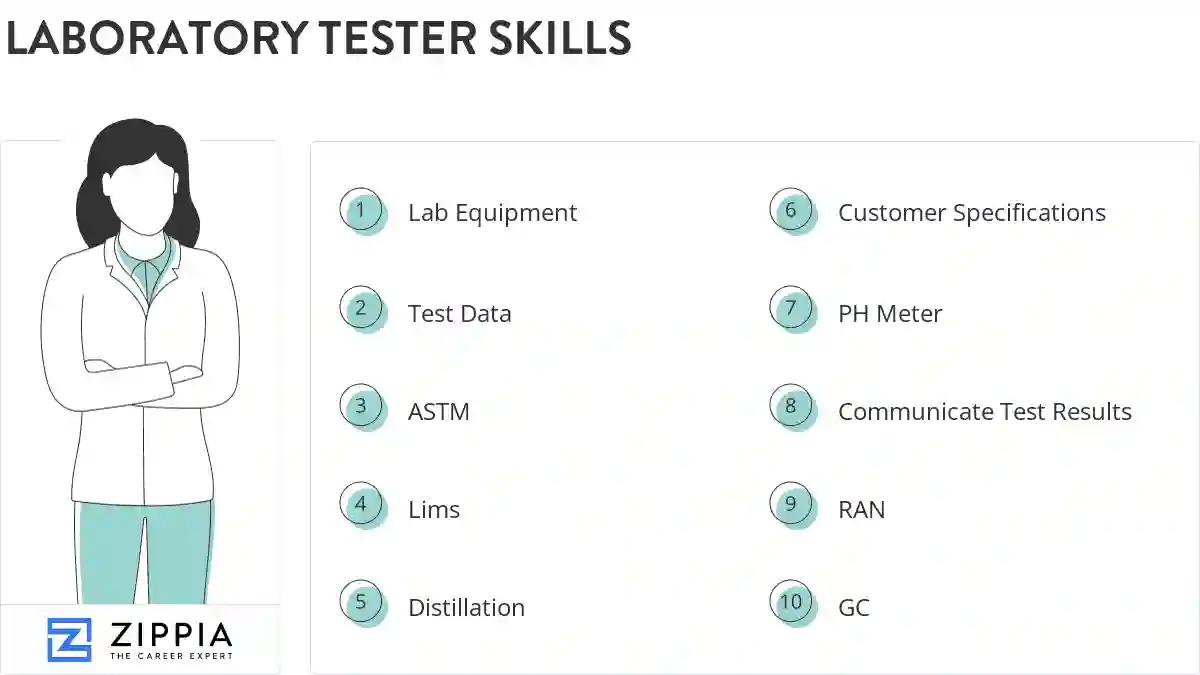
The most important skills for a laboratory tester resume and required skills for a laboratory tester to have include:
- Lab Equipment
- Test Data
- ASTM
- Lims
- Distillation
- Customer Specifications
- PH Meter
- Communicate Test Results
- RAN
- GC
- Test Equipment
- FTIR
- API
- Titration
- Quality Standards
- Windows
- Product Quality
Updated January 8, 2025
