
Automatically apply for jobs with Zippia
Upload your resume to get started.
Lan analyst skills for your resume and career
15 lan analyst skills for your resume and career
1. Windows Server
- Provided desktop, server and maintenance support in Windows Server 2003 environment, using Windows XP and Windows 2000 OS.
- Performed server installations, migrations, and upgrades, including Windows Server, Exchange, SQL, and Unified Messenger.
2. Network Hardware
- Configured and installed network hardware.
- Maintained network hardware such as Token Ring and Ethernet adapters on Windows 95 client workstations, servers and backup utilities.
3. PC
- Installed and supported all mobile devices (Blackberry, Palm Pilots, and Pocket PC).
- Support local news media, ESPN, public relations and owners PC's during actual draft.
4. Linux
Linux is a Unix-like operating system. Just like Windows, Mac OS, and IOS, Linux is an operating system used by millions across the globe. Android itself is powered by the Linux operating system. Linux manages all the hardware resources that are associated with your computer. The software is famous because of the protection it grants from viruses, malware, and crashes. The Linux operating system is entirely free and is an open-source software meaning it can be altered by those equipped with the knowledge to code.
- Managed port security and network switches and maintained Linux scripting of FTP jobs.
- Managed UNIX, Win 2003/2k, Novell, Linux with Novell clustering, file and print share.
5. Desktop Support
- Provided desktop support for Microsoft XP Operating System for 100+ users on commonly used software packages including Microsoft Office and Adobe.
- Provided on-site technical support for employees at local site, as well as remote desktop support.
6. Switches
- Administered the installation of Cisco routers and switches, while connecting WAN links and managing patch panels.
- Supported assorted network devices such as routers, switches, servers, and printers.
7. Troubleshoot
Troubleshooting is the process of analyzing and fixing any kind of problem in a system or a machine. Troubleshooting is the detailed yet quick search in the system for the main source of an issue and solving it.
- Support and troubleshoot complex network problems and implemented solutions.
- Support and troubleshoot 15,000 desktop, laptop and server computers running Windows NT 4.0, 2000 and XP.
8. Windows NT
- Monitored Windows NT server for performance and availability.
- Provide Network Administration Support for 23 Windows NT Servers and backup support of 10 Windows 2000 Server in the Administration Center.
9. Technical Support
Technical support or tech support are the services provided by any hardware or software company to users. They help in solving the technical difficulties the customers face with their products or services. Moreover, the tech support employees maintain, manage, and repair the IT faults. They are also responsible for resolving the network problems, installing and configuring hardware and software.
- Monitored Microsoft WindowsNT 4.0 server-based environment and provided technical support to end users.
- Provide engineering and technical support services.
10. Lan Wan
- Design, build and maintains LAN WAN for customers and for the company.
11. Routers
A router is a device that gives a computing device the capability to connect to the internet and transfer data between different devices whether at a home or office. It may include several network ports to connect many devices at one go.
- Configured network equipment including a variety of Cisco router platforms 831, 2611, 2621, 2651XM, and 2800-series routers.
- Installed and configured system expansion and upgrades for routers, modem pools, remote dial-in, and network fax hubs.
12. Lan
- Added two domain controllers to LAN and configured replication to secondary location using SonicWall devices.
- Performed domain administrator functions in central LAN administration department.
13. Unix
UNIX is a computer operating system that was first created in the 1960s and has been constantly updated since then. The operating system refers to the set of programs that enable a machine to function. It is a multi-user, multi-tasking device that works on computers, laptops, and servers. UNIX systems also have a graphical user interface (GUI), similar to Microsoft Windows, that makes it simple to use.
- Provided user support for customers accessing multiple mainframe and Unix hosts.
- Coordinate design, implementation and support of a variety of server platforms including Microsoft, Novell and UNIX systems.
14. Disaster Recovery
The ability or procedure by which an organization regains its access and control over its IT framework after an unwanted disaster such as natural calamity or a cyberattack.
- Implemented and supported an enterprise backup solution with ARCSERVE for Windows environment, disaster recovery and virus protection/prevention.
- Improved backup strategies, security, disaster recovery and system redundancy.
15. DHCP
- Configured and maintained FTP, DNS, DHCP, servers.
- Supported and troubleshot DNS, DHCP and Win Issues.

What skills help LAN Analysts find jobs?
Tell us what job you are looking for, we’ll show you what skills employers want.
What lan analyst skills would you recommend for someone trying to advance their career?
Kate Marek Ph.D.
Director and Professor, Dominican University
What type of skills will young lan analysts need?
George Miller
Associate Professor Computer Science, Tiffin University
Going back to the previous answer I believe graduates in all fields of study will need a better knowledge of technology and easier adaptability to changing technology. Again, an IS degree is already preparing students for this.
What technical skills for a lan analyst stand out to employers?
Chirag Parikh Ph.D.
Computer Engineering Chair, Grand Valley State University
As a Computer Engineering professor, I would say the job opportunities are tremendous for students out of college as they can venture into hardware field (technical support, hardware engineer, test engineer and much more) as well as software field (software engineer, software developer, software tester and much more). The possibilities are endless.
With COVID and employees working remotely there is still ample opportunity to enhance your technical and interpersonal skills as I believe remote working might stay for a while till things get back to normal.
What soft skills should all lan analysts possess?
Robert Vinaja Ph.D.
Assistant Professor of Computer Information Systems, Texas A&M University San Antonio
-Attention to detail.
-Problem-solving and analytical skills.
List of lan analyst skills to add to your resume
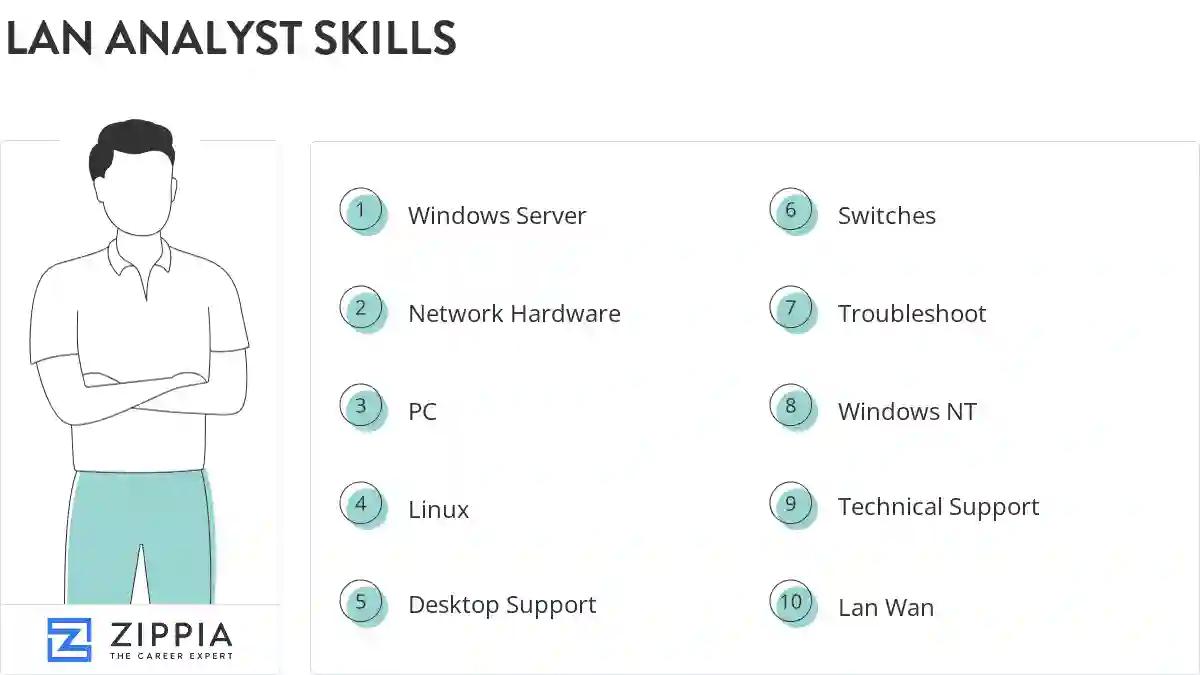
The most important skills for a lan analyst resume and required skills for a lan analyst to have include:
- Windows Server
- Network Hardware
- PC
- Linux
- Desktop Support
- Switches
- Troubleshoot
- Windows NT
- Technical Support
- Lan Wan
- Routers
- Lan
- Unix
- Disaster Recovery
- DHCP
- Lotus Notes
- DNS
- Workstations
- Microsoft Windows
- OS
- Citrix
- TCP/IP
- VPN
- SQL
- User Accounts
- Ethernet
- McAfee
- SAN
- Microsoft Exchange
- Windows XP
- Trouble Tickets
- SCCM
- Mainframe
- Capacity Planning
- Level Support
- Compaq
- IIS
- Blackberry
- Software Applications
- Remote Sites
- SMS
- VoIP
- Network Support
- Software Packages
- Network Issues
- Network Equipment
- End User Support
- Patch Management
- Software Upgrades
Updated January 8, 2025
