
Automatically apply for jobs with Zippia
Upload your resume to get started.
Lathe operator skills for your resume and career
15 lathe operator skills for your resume and career
1. CNC Lathes
- Finish Lathe Responsibilities: Prep Barrels for CNC Lathes such as: machine counter-bores and cut to length.
- Proposed the concept of using bar feeder on CNC lathes for high volume products.
2. Micrometers
A micrometer is a measuring instrument used in various laboratories to measure even the tiniest components in-depth with great precision and accuracy and to make precise linear measurements of dimensions such as diameters, thicknesses, and lengths of solid bodies. They are essential measuring instruments used by mechanical engineers, machinists, and workers in other technical professions. They allow workers to take extremely precise measurements, which can be viewed either in imperial or metric format. Most micrometers are designed to measure within one-thousandth of an inch! It's a snug fit. Accurate measurements like this are needed when even the smallest distance between objects can cause problems or difficulties.
- Operate a metal lathe to machine gears and Inspect parts with micrometers and calipers to assure proper dimensions.
- Use calipers, micrometers, and other various measuring devices to ensure quality of parts according to blueprints.
3. Manual Lathes
- Set up of manual lathe, change tooling, welding bits, machining to specified prints and specifications.
- Use manual Lathe to clean, polish, buff and repair parts as needed.
4. Hand Tools
- Advanced knowledge of hand tools, powered tools, and their proper uses and functions.
- Assembled small to mid size course fixtures using hand tools.
5. Calipers
- Used Mics Calipers and Bore Gauges.
- Use Gauges, In /Out /deep micrometer, calipers, in size dial bore gauge.
6. Math
- Ensured machinery parts met specification requirements using machine shop math.
- Calculated and computed machine specifications using shop math.
Choose from 10+ customizable lathe operator resume templates
Build a professional lathe operator resume in minutes. Our AI resume writing assistant will guide you through every step of the process, and you can choose from 10+ resume templates to create your lathe operator resume.7. Print Specifications
- Machined parts according to print specifications on a manual lathe.
- Set up lathe with blue print specifications.
8. Routine Maintenance
- Do routine maintenance on lathes, general housekeeping, and organize work area.
- Performed routine maintenance on lathes and removed wasted metal from all work areas.
9. Lathe Machines
- Trained ten (10) new associates/ supervised in Lathe Machines to ensure they would be efficient in their daily tasks.
- Operate hand lathe machinery and consistently change machine parts to acquire the specifications of appropriate finishes and products.
10. Perform Routine Maintenance
- Perform routine maintenance on the CNC lathes, including filling coolant, oil, and replacing inserts as needed/required.
- Complete changeovers from one product to another, perform routine maintenance to assist the lines continue to run.
11. Machine Operation
- Monitored machine operation and control panel displays and compare readings to specifications to detect malfunctions.
- Developed programs from blueprints for machine operation.
12. Machine Tools
- Maintain machine tools in proper operational condition.
- Design parts to specifications using machine tools such as lathes, milling machines, shapers, or grinders.
13. Quality Checks
Quality checks are a component of quality control aimed at ensuring that quality requirements are met. Internally, quality checks provide assurance to managers, and externally, it provides assurance to clients, federal departments, authorities, and certifiers.
- Operated precision equipment such as calibers to help properly set up machines and to perform quality checks on parts produced.
- Inspect and quality check parts.
14. Dial Indicators
- Do precision setup with dial indicators daily.
- Used dial indicator inside diameter gage.
15. Reference Points
Reference points serve as a guide for an apprentice carpenter when cutting, assembling, or attaching construction materials such as wood and metal. Reference points come in many forms depending on the project one is involved in.
- Measured, marked, and scribed dimensions and reference points on materials and work pieces as guides for subsequent machining.
- Measured and marked dimensions and reference points accurately.
5 Lathe Operator resume examples
Build a professional lathe operator resume in minutes. Browse through our resume examples to identify the best way to word your resume. Then choose from 5+ resume templates to create your lathe operator resume.

What skills help Lathe Operators find jobs?
Tell us what job you are looking for, we’ll show you what skills employers want.
What type of skills will young lathe operators need?
Miles Free
Director, Industry Affairs, Precision Machined Products Association
Needs - people that can communicate an issue verbally and in writing.
That's where we see it. Critical thinking, ability to understand problems and their potential causes, ability to work well with others, without this, even a super-competent technically skilled person will probably find themselves changing jobs many times.
List of lathe operator skills to add to your resume
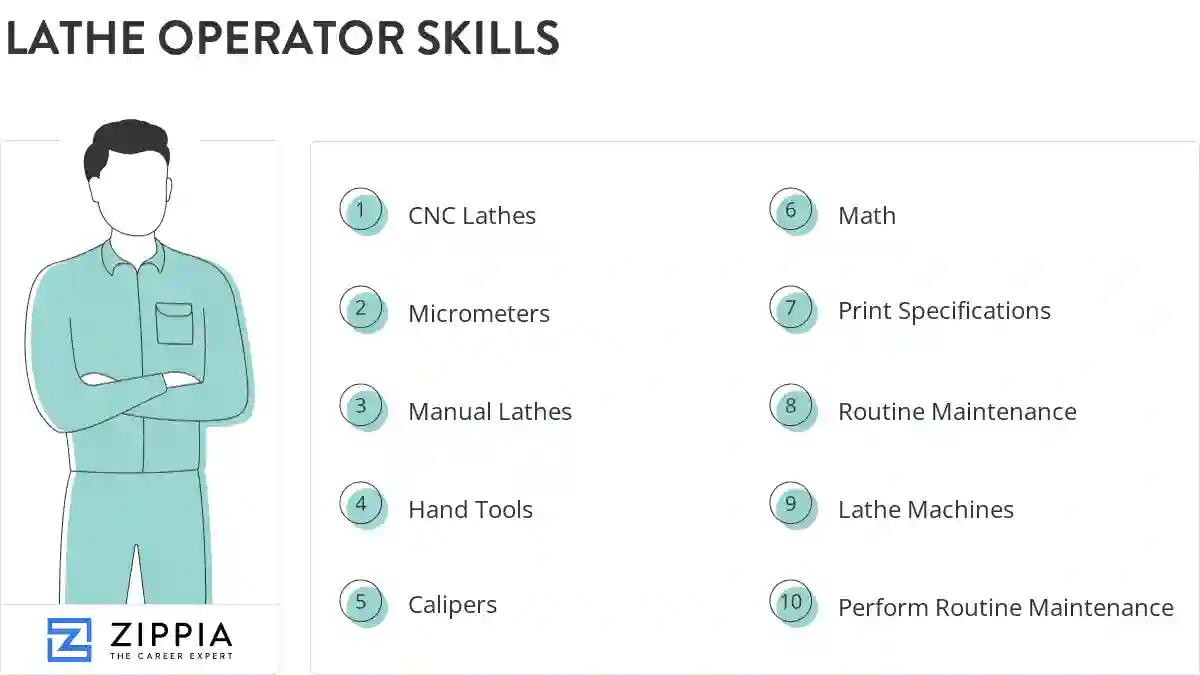
The most important skills for a lathe operator resume and required skills for a lathe operator to have include:
- CNC Lathes
- Micrometers
- Manual Lathes
- Hand Tools
- Calipers
- Math
- Print Specifications
- Routine Maintenance
- Lathe Machines
- Perform Routine Maintenance
- Machine Operation
- Machine Tools
- Quality Checks
- Dial Indicators
- Reference Points
- Mazak
- Haas
- Drill Press
- FANUC
- Hoists
- Lathe Operation
- Okuma
- Comparators
- Grinding Machines
- Process Sheets
- Jigs
- Shop Mathematics
- ID
- Production Process
- Quality Standards
- Stainless Steel
- MIG
- OD
- Troubleshoot
- Precise Measurements
- Disk
- Customer Specifications
- Turning Machines
- Spindles
- Product Specifications
- G Code
- Tig Welding
- Position Tools
- Quality Inspection
- ISO
- Extrusion
- Hydraulic Cylinders
Updated January 8, 2025
