Explore jobs
Find specific jobs
Explore careers
Explore professions
Best companies
Explore companies
Job outlook for launch managers in the United States
Are launch manager jobs in demand?
Launch manager job and salary trends over time
Launch manager jobs over time
Launch manager job growth rate over time
| Year | # of jobs | % of population |
|---|---|---|
| 2021 | 199 | 0.00% |
| 2020 | 193 | 0.00% |
| 2019 | 189 | 0.00% |
| 2018 | 172 | 0.00% |
| 2017 | 156 | 0.00% |
Average launch manager salary over time
Launch manager salary by year
| Year | Avg. salary | Hourly rate | % Change |
|---|---|---|---|
| 2025 | $111,309 | $53.51 | +3.9% |
| 2024 | $107,144 | $51.51 | +1.9% |
| 2023 | $105,139 | $50.55 | +1.6% |
| 2022 | $103,527 | $49.77 | +0.8% |
| 2021 | $102,704 | $49.38 | +1.9% |
Launch manager jobs by state
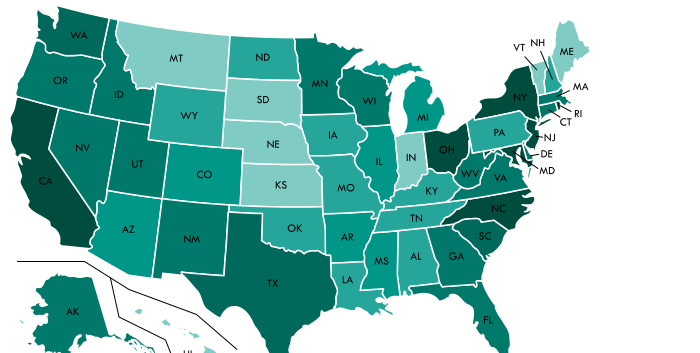
Most common states for launch managers
| Rank | State | Population | # of jobs | Employment/ 1000ppl |
|---|---|---|---|---|
| 1 | District of Columbia | 693,972 | 390 | 56% |
| 2 | Washington | 7,405,743 | 1,952 | 26% |
| 3 | Massachusetts | 6,859,819 | 1,793 | 26% |
| 4 | Oregon | 4,142,776 | 926 | 22% |
| 5 | California | 39,536,653 | 7,255 | 18% |
| 6 | Utah | 3,101,833 | 558 | 18% |
| 7 | Rhode Island | 1,059,639 | 188 | 18% |
| 8 | Illinois | 12,802,023 | 2,148 | 17% |
| 9 | Minnesota | 5,576,606 | 899 | 16% |
| 10 | Vermont | 623,657 | 100 | 16% |
| 11 | New York | 19,849,399 | 2,991 | 15% |
| 12 | New Jersey | 9,005,644 | 1,345 | 15% |
| 13 | Virginia | 8,470,020 | 1,168 | 14% |
| 14 | Colorado | 5,607,154 | 804 | 14% |
| 15 | New Hampshire | 1,342,795 | 178 | 13% |
| 16 | Delaware | 961,939 | 129 | 13% |
| 17 | Pennsylvania | 12,805,537 | 1,476 | 12% |
| 18 | Georgia | 10,429,379 | 1,292 | 12% |
| 19 | North Carolina | 10,273,419 | 1,215 | 12% |
| 20 | Connecticut | 3,588,184 | 418 | 12% |
Most common cities for launch managers
| Rank | City | # of jobs | Employment/ 1000ppl | Avg. salary |
|---|---|---|---|---|
| 1 | Schaumburg | 2 | 3% | $102,877 |
| 2 | McLean | 1 | 2% | $109,635 |
| 3 | Noblesville | 1 | 2% | $87,824 |
| 4 | Salt Lake City | 1 | 1% | $103,758 |
| 5 | Colorado Springs | 2 | 0% | $103,744 |
| 6 | Los Angeles | 2 | 0% | $119,797 |
| 7 | Phoenix | 2 | 0% | $98,092 |
| 8 | Atlanta | 1 | 0% | $106,569 |
| 9 | New York | 1 | 0% | $118,393 |
| 10 | Seattle | 1 | 0% | $111,261 |
Launch Manager job outlook: Expert opinions
Our panel of launch manager experts
Siena College

University of Scranton

University of Houston - Downtown
West Los Angeles College

Miami University
Wisconsin School of Business, University of Wisconsin-Madison

Augsburg University
Prairie View A&M University

Eastern Washington University College of Business
Kansas State University
University of Central Missouri
Indiana University

University of Pittsburgh at Johnstown

State University of New York at Potsdam
Hawaii Pacific University
Soyoung Joo
Assistant Professor of MarketingSiena College
Marketing Department
What skills will help Launch Managers earn the most?
Soyoung Joo: Being able to work well with people from diverse backgrounds can be added to the above skills.
Abhijit Roy
Professor of MarketingUniversity of Scranton
School of Management
What soft skills should all Launch Managers possess?
Abhijit Roy: These are very important, yet harder to quantify skills, not only for marketing professionals but for business graduates in general. They include the ability to make sound decisions under pressure, having a high emotional intelligence quotient (EQ) as embodied by having empathy towards coworkers and subordinates, delegating appropriately, mentoring, communicating, time management, maintaining positivity despite setbacks and adapting to unforeseen challenges, being flexible, being persuasive and assertive at appropriate moments, yet being collaborative, seeking feedback, and the ability to negotiate and resolve conflicts when needed, amongst others.
Soft skills are typically more instrumental in enabling candidates to fit into an organization's culture and be strong candidates for promotion. Most marketing jobs involve candidates representing their brand initiatives and building strong client relationships, so interpersonal, and other soft skills are often valued more than hard skills. The strongest case for having excellent soft skills is that they are more easily transferable across various jobs and industries.
Dr. Richard Conde Ph.D.
Assistant ProfessorUniversity of Houston - Downtown
Marilyn Davies College of Business
What soft skills should all Launch Managers possess?
Dr. Richard Conde Ph.D.: The need for soft skills are consistent through time. With our societal focus on social media, texting, emojis, etc. It appears to me companies are looking for the following:
- Active listening skills
- Willingness to be self-reflective and accept feedback
- Accept different perspectives. The collision of ideas creates knowledge
- Communicate to the listener (at their level). Flex communicators
- Cultural intelligence. Demographics changes will require better understanding of team member's, boss', customer's, etc. cultural context
Will there be an enduring impact of the coronavirus pandemic on Launch Managers?
Anthony Cuomo: We have changed the ways in which we communicate with each other. Now, more than ever, we know that technology is pervasive and has revolutionized the way we communicate personally and professionally. Virtual interviews, online group meetings and presentations are the new norm. Job seekers who are able to communicate effectively online will have an advantage in our new context. I don't think Zoom meetings or Skype are going away any time soon. So, practicing how to sustain eye contact with a camera, being personable and communicating enthusiasm virtually will set you apart from other applicants.
What's a good job out of college for Launch Managers?
Anthony Cuomo: A job that you are passionate about and helps you begin your journey. Pursue jobs that spark your interest and also provide opportunities to learn, grow and seek out mentorship. Think long term and how you a strengthening your professional foundation while also providing opportunities to support yourself and your lifestyle.
What's a day at work look like for a Launch Manager?
Patrick Lindsay: Sales is a good job out of college. Regardless of the company, the industry, the marketplace or geography, being in the customer interface is not only the best and quickest way to learn about a business but also to learn about business. They are exposed to the impact from and on all stakeholders. They learn about what a value proposition really is and the importance of Trust. They observe and learn the importance of relationships. And they grasp the importance of why over what and how. Finally, sales experience and success is almost universally transferable. Once a grad has a year to three developing competencies, skills and confidence, they can pursue virtually any other product or service in almost any company. They can pursue a next job in sales but also other areas like marketing, customer service, human resources, training, recruiting, et cetera. Employers are not emphasizing industry knowledge or experience like they once did. And many companies, from small local the largest global companies in their industries, insist their new college hires begin in sales (aka account management, business development, client acquisition).
Now, with the proper training (could be a major/minor but doesn't have to be if the graduate has developed a particular skill set) there are many available jobs for graduates that are technology-related. These are "good job" from a compensation and stability perspective. And any position with a global tech firm is a golden ticket.
What technical skills for a Launch Manager stand out to employers?
Patrick Lindsay: Most all employers expect full competency in creatively using technology for communications. By that I don't mean mobile devices or social media usgae. I mean a widespread working knowledge of technology tools (apps, software, etc). Employers are seeking those candidates who can convey thoughts, ideas, responses in a multi-faceted way. Basic competency in written correspondence is no longer enough. Employers want to see daily business communication not only contain demonstration of good writing (grammar, syntax, formatting) but also being able to create embedded images, video, and relevant web links to better communicate. And not just for a big fancy client presentation, but consistently in regular communication. Further, they want words supported by data; support words with numerical evidence. As such, advanced excel skills and real experience in data sources and extraction stand out to employers.
Similarly, they expect professional virtual audio-visual communication. It is not enough to just be on the Zoom call. The expectation is to be prepared, to be engaged, to be aware of the audio and video angles and backgrounds. To demonstrate active listening as well as enthusiastic, energetic, even animated talking. Body language and facial expression are even more enhanced in virtual communications.
If there was a positive outcome from being thrust into an academic world that was all virtual, it was the need to learn new technical skills, not only for classwork, but also for social interaction. This will not only be appreciated by employers, but for many, expected.
What's a good job out of college for Launch Managers?
Patrick Lindsay: Sales is a good job out of college. Regardless of the company, the industry, the marketplace or geography, being in the customer interface is not only the best and quickest way to learn about a business but also to learn about business. They are exposed to the impact from and on all stakeholders. They learn about what a value proposition really is and the importance of Trust. They observe and learn the importance of relationships. And they grasp the importance of why over what and how. Finally, sales experience and success is almost universally transferable. Once a grad has a year to three developing competencies, skills and confidence, they can pursue virtually any other product or service in almost any company. They can pursue a next job in sales but also other areas like marketing, customer service, human resources, training, recruiting, et cetera. Employers are not emphasizing industry knowledge or experience like they once did. And many companies, from small local the largest global companies in their industries, insist their new college hires begin in sales (aka account management, business development, client acquisition).
Now, with the proper training (could be a major/minor but doesn't have to be if the graduate has developed a particular skill set) there are many available jobs for graduates that are technology-related. These are "good job" from a compensation and stability perspective. And any position with a global tech firm is a golden ticket.
Will there be an enduring impact of the coronavirus pandemic on Launch Managers?
Patrick Lindsay: Absolutely, the pandemic will have an enduring impact on these upcoming graduates. Uncertainty is always part of the job search journey/process for future graduates. Uncertainty is now major Anxiety number one for them.
First, the recruiting process drastically changed and opportunities diminished in the past twelve months. Of course the process had to become virtual. But there has been more than a fifty percent reduction in the number of companies participating in career fairs. Further, those companies are anticipating a reduction in the number of available positions, or have said they will have none at all this year. Some only participated to keep their relationships alive with the universities.
Second, companies cannot commit to the full scope of work for new hires, nor the location... because they still don't know. Starting positions will still be virtual WFH. What does that mean for a college graduate? Move back home with parents? Some companies are anticipating a return this summer to office or other work sites that are bricks and mortar locations. Still others say they will stay virtual. Either way, few will commit to where a new graduate will be located. The common position is "We will see where our needs are when the time comes". Rarely have graduates not known the location of their first job.
Third, where millennials were the driving faction for flexible work environs and work from home, in less than one year, many upcoming Gen Z graduates have changed their perspective and are seeking opportunities to commute to work and interact with people in a live daily routine. They do not want to continue living in a virtual world. It took less than ten months to change a cultural movement. This will be a growing field of study for behavioral psychologists, sociologists and anthropologists.
Fourth, many grads are open to a wider bandwidth of positions and industries (other than those seeking a "professional" career in certification trades: accountancy, engineering, architecture, etc.) than they would have been one year ago. The uncertainty of supply always impacts the demand. Likewise, their career criteria and priorities seem to have changed, but in very inconsistent ways.
Sachin Tuli
Director, International Business MajorWisconsin School of Business, University of Wisconsin-Madison
International Business
What's a day at work look like for a Launch Manager?
Sachin Tuli: The pandemic accelerated ongoing shifts with work-from-anywhere and use of remote meeting technologies. With mass adoption at all levels, these trends are likely to persist to some degree across fields and industries. There will likely be less travel for a number of years, but concurrently we may see more cross-team and cross-national collaboration and coordination. From an international business perspective, firms do plan to continue their globalization efforts and we know that graduates themselves increasingly seek potential global opportunities and mobility when choosing which organizations to work for.
What skills stand out on Launch Manager resumes?
Robert Groven: Across all industries, we are seeing a broad call for transferrable skills. Whether in STEM or the social services, employers want college grads who can speak well, write clearly, and solve problems. Ubiquitous automation and AI have erased the days when employers only wanted technical specialists. Now employers want students who are flexible, motivated, and creative.
Dr Rick Baldwin
Associate Professor of PracticePrairie View A&M University
Management and Marketing Department
What are the biggest trends we'll see in the Launch Manager job market given the pandemic?
Dr Rick Baldwin: -Employers seeking applicants who have demonstrated the use of social media to promote their ideas and interests.
-Employers seeking applicants with minors in a liberal arts degree or interdisciplinary degree or entrepreneurship that provides a comprehensive understanding of an issue.
What Launch Manager skills would you recommend for someone trying to advance their career?
Dr Rick Baldwin: I would recommend students to develop their creativity, problem-solving, self-awareness, need assessment, and opportunity awareness skills. I would recommend that students should travel to both developing countries and underdeveloped countries in this gap year. Traveling to these countries will allow students an opportunity to see how needs and opportunities are being addressed in areas with resources and without resources.
William Martin Ph.D.
Associate Professor of MarketingEastern Washington University College of Business
Chair, Department of Finance and Marketing
What skills stand out on Launch Manager resumes?
William Martin Ph.D.: Relevant work experience is always a big plus, and internships are a great way for students to obtain it. Employers are most interested in specific examples of actions that applicants took that had significant, demonstrable benefits for those they previously worked with.
What are the biggest trends we'll see in the Launch Manager job market given the pandemic?
Dr. Esther Swilley: I think that geographic location is going to change. Because many jobs that were not thought of as home-based really are. Companies are finding that the large office buildings that are costing them may not be needed. Employees now want to live where they want, which may not be near the company.
Joe Moore Ph.D.
Professor of Communication Program Coordinator, Digital Media ProductionUniversity of Central Missouri
Department of Communication
What skills stand out on Launch Manager resumes?
Joe Moore Ph.D.: Well, first I would strongly urge them to reconsider taking a gap year. If we are in a pandemic and go into another shutdown, where are you going to work? If you're thinking you'll just go to school at a community college and work on your gen eds, how are you going to do that if they are shut down, too? But, if they DO take a gap year, I would encourage students to work on their writing. That's the skill we see that students struggle with the most, and in talking with employers, it is the one skill that really sets applicants apart. And don't just "write". I mean, start a blog to write about your experiences, practice writing scripts, cover some news in your area, yes. But practice writing WELL. Go to https://owl.purdue.edu/ and do some writing lessons to practice proper grammar. Texting and emails have killed proper writing because it is not expected, but if you have good grammar, spelling, punctuation, and capitalization (basic writing skills) AND can tell a good story, just like that you've set yourself apart.
What skills stand out on Launch Manager resumes?
Davide , Ph.D. Bolchini Ph.D.: In my experience, our most successful MS HCI graduates (https://soic.iupui.edu/hcc/graduate/hci/masters/) take the time to put together a compelling online portfolio that showcases their project experience and skill set in action, as applied to specific research opportunities they had with faculty or projects they worked on during their UX internships in the industry. The personal brand of UX junior professional can be greatly enriched when the portfolio includes not only what the student has done, but why and what was the design rationale behind the process and the results, what was the larger context and goal of the project (especially in large collaborative projects), and what was the specific role and contribution of the student. The discussion about the portfolio of a candidate has become a key ingredient of the interview for UX jobs, besides other important activities such as UX design exercises or remote assignments.
Are there any particularly good places in the United States for Launch Managers to find work opportunities?
Davide , Ph.D. Bolchini Ph.D.: With the many remote work opportunities for our MS HCI graduates, physical location is less relevant than before, and flexibility becomes key. UX job opportunities are plenty in the Midwest, as well as on the East and West Coast, and the roles and competitiveness of these positions vary greatly based on the nature of the organization and the industry ecosystem.
John McGrath Ph.D.
Chair of Marketing Department, Associate Professor of MarketingUniversity of Pittsburgh at Johnstown
Marketing Department
What type of skills will young Launch Managers need?
John McGrath Ph.D.: I believe we are at a significant turning point in the Marketing --and business-- fields. The students who will succeed will have three qualities that make them stand out. First, they will have to be self-starters in learning new skills and certifications and promoting themselves to prospective employers. Second, they will have to be resilient in the face of disrupting technological and social change. Finally, those who exhibit conscientiousness and understanding in their dealings with others will stand out with employers in this time where Zoom has distanced us from everyday human interactions.
What type of skills will young Launch Managers need?
Sergio Lopez Ph.D.: There are some skills that have not changed in the last few years (such as problem-solving, creativity, or analytical thinking), but in addition to that, they will need a great capacity to connect and move into the social networks while dealing with very diverse people. To communicate in a language different than English will be a key skill. This does not necessarily mean to be fluent in another language (Spanish, Chinese..), but to be able to use the technological tools to communicate with others.
What Launch Manager skills would you recommend for someone trying to advance their career?
Matthew Lopresti: Captains of industry are often asked about the traits they look for in new hires. Critical thinking is always a must, as well as excellent written and oral communication skills.
These are the core competencies of the discipline of philosophy. Top-notch communication abilities begin with a depth of ability to understand nuanced, complex details, and then turn around and clearly communicate these complex ideas in easily digestible bits of information. It is no coincidence that students who graduate with philosophy degrees repeatedly dominate graduate and law-school entrance exams like the GRE and LSAT; they are often the sharpest thinkers with the quickest minds
