
Automatically apply for jobs with Zippi
Upload your resume to get started.
Layout inspector skills for your resume and career
15 layout inspector skills for your resume and career
1. CMM
CMM stands for "capability maturity model." This refers to the refinement of a company's processes, most commonly regarding software development. This methodology is achieved through five levels. Each of these levels attempts to refine the development process until the software is efficiently created, organized, and maintained. This may include security procedures for software or productivity among team members.
- Programmed/operated DEA, Taurus, B&S CMM * Programmed/operated Micro-Vu Optical CMM * Performed open plate layouts.
- Programmed and operated Brown & Sharpe CMM's operated optical and laser inspection equipment.
2. Calipers
- Utilize micrometers, gauges, calipers, and FARO Arm to conduct inspections.
- Inspected airfoil castings and gauges using height stands, comparators, sine plates, micrometers, calipers, and coordinate measuring machines
3. Dimensional Inspection
- Performed dimensional inspection on all types of aerospace hardware to determine product conformance.
- Perform dimensional inspection of precision machined jet aircraft engine components.
4. Aerospace
Aerospace refers to the physical science focusing on designing and developing, testing, and producing systems that aid in navigation to space or traverse through the earth's atmospheric zone.
- Worked closely with most aerospace companies such as Allied, Bell Helicopter, General Electric, McDonald Douglas, and Lockheed.
- Inspected foundry machined parts for aerospace (commercial and government aircraft and missiles) and nuclear plants.
5. Engineering Drawings
Engineering drawings are technical drawings that tell about the requirements for engineering components or equipment. Such drawings have standardized languages and symbols. There are multiple types of engineering drawings such as isometric drawing, orthographic or multiview drawing, schematic drawings, one view, and two view drawings, etc.
- Read and interpret Engineering drawings and specifications.
- Interpret GD&T engineering drawings to provide support for engineering development and durability testing.
6. Layout Inspection
- Perform layout inspection of precision machined prototype/experimental automatic transmission component parts and assemblies.
- Employed as layout inspector with emphasis on layout inspection and documentation prior to customer shipment.
Choose from 10+ customizable layout inspector resume templates
Build a professional layout inspector resume in minutes. Our AI resume writing assistant will guide you through every step of the process, and you can choose from 10+ resume templates to create your layout inspector resume.7. Surface Plate
- Perform Layout Surface plate inspection with Precision tools micrometer, Caliper, Height Gage.
- Trained to perform dimensional layout of castings using surface plates and comparators.
8. Blueprint Specifications
Blueprints are layouts or designs about the construction of a building or structure. It consists of accurate engineering drawing on light-sensitive sheets allowing to create copies easily.
- Worked with production and quality engineering to verify blueprint specifications.
- Adhered to all inspection procedures, blueprint specifications, visual standards and safety rules.
9. Comparators
- Experience with and ability to operate/use measuring instruments, hand gauges, microscopes, comparators.
- Utilized boroscopes, comparators, lights, mirrors and other visual tools for visual inspection.
10. Piece Inspection
- Performed first piece inspections, casting inspections, and machine checks.
- Performed First Piece inspection on Production parts Inspection of Purchased Parts.
11. Customer Specifications
A Customer Specification is a document that describes the general requirement of an expected service from a contractor. It outlines the key requirements of the customer. Customer specifications should be written in simple and general language so that the contractor clearly understands the expectations of the customer. It is also known as a User Specification.
- Measured product to customer specifications using blueprints and Geometric Dimensioning and Tolerancing (GD&T).
- Work with other quality personnel in obtaining goals of meeting or exceeding customer specifications while meeting target costs and customer expectations.
12. GD
GD refers to Grade Delay and is often mentioned on report cards or academic records when the instructor of a particular subject decides to hold the grade of a student. This is usually done if the instructor wants the student to improve their grade by retaking the exam or doing something for extra credit that will ultimately enhance their overall grade. Eventually, when the grade is assigned, the GD is then replaced with the original grade.
- Read and interpret drawing & specification requirements and working knowledge of GD & T
- Weld qualification analysis GD & T per ASME Y14.5M Calibration.
13. ISO
- Assigned responsibilities included ISO 9001-2000 management representative and lead internal auditor.
- Identify and quarantine defective material immediately according to ISO requirements.
14. Article Inspection
- Reviewed first article inspection, gained thorough knowledge of drawings, military specifications, plating specifications and applicable processes.
- Sheet metal, cables, chassis, components, blueprint, write reports and visual stands and first article inspection.
15. Destructive Testing
- Performed Non-Destructive Testing methods on fabricated metal parts and products to identify structural discontinuities.
- Used non-destructive testing techniques to determine metal integrity and thickness.
5 Layout Inspector resume examples
Build a professional layout inspector resume in minutes. Browse through our resume examples to identify the best way to word your resume. Then choose from 5+ resume templates to create your layout inspector resume.

What skills help Layout Inspectors find jobs?
Tell us what job you are looking for, we’ll show you what skills employers want.
List of layout inspector skills to add to your resume

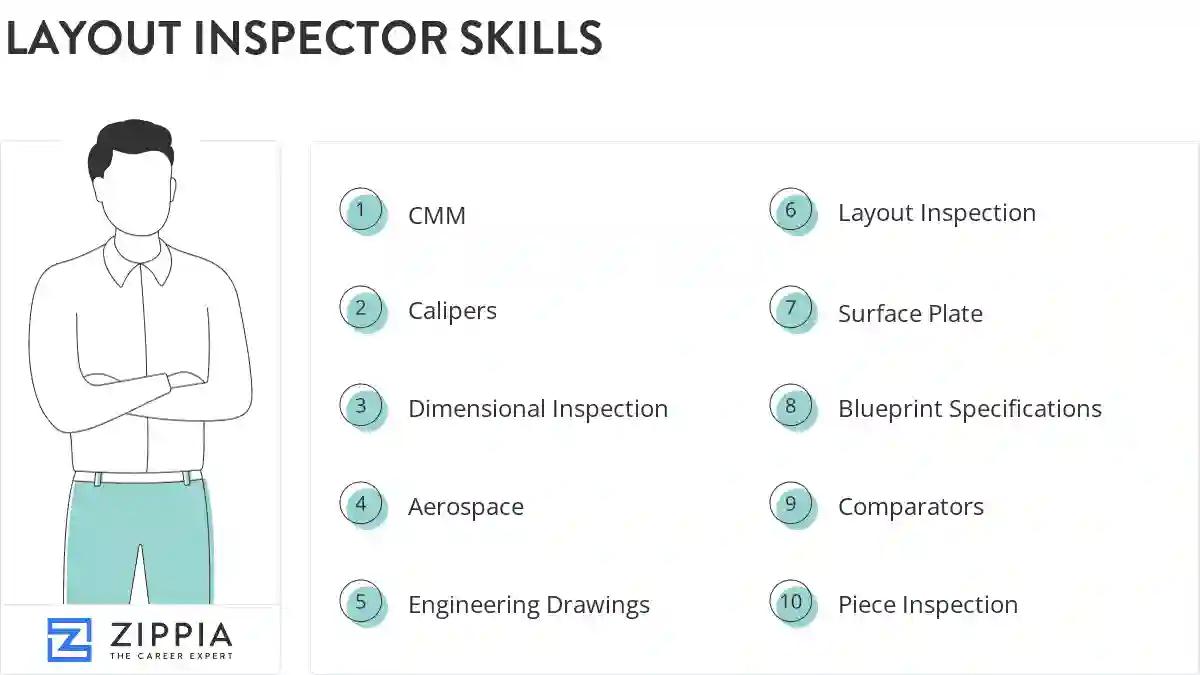
The most important skills for a layout inspector resume and required skills for a layout inspector to have include:
- CMM
- Calipers
- Dimensional Inspection
- Aerospace
- Engineering Drawings
- Layout Inspection
- Surface Plate
- Blueprint Specifications
- Comparators
- Piece Inspection
- Customer Specifications
- GD
- ISO
- Article Inspection
- Destructive Testing
- Inspection Tools
- Jigs
- Romer
- Inspection Programs
- PPAP
- Capability Studies
- Inspection Reports
- Coordinate Measuring Machine
- CAD
- In-Process Inspection
- MRB
- Pc-Dmis
- CNC
- Aluminum
- Quality Standards
- DEA
Updated January 8, 2025
