
Automatically apply for jobs with Zippia
Upload your resume to get started.
Lead analyst/developer skills for your resume and career
15 lead analyst/developer skills for your resume and career
1. Java
Java is a widely-known programming language that was invented in 1995 and is owned by Oracle. It is a server-side language that was created to let app developers "write once, run anywhere". It is easy and simple to learn and use and is powerful, fast, and secure. This object-oriented programming language lets the code be reused that automatically lowers the development cost. Java is specially used for android apps, web and application servers, games, database connections, etc. This programming language is closely related to C++ making it easier for the users to switch between the two.
- Developed WMB flow using java compute node (JCN) to transform message from one format to the other.
- Created a brand new Price Change application based upon the Java Server Faces framework.
2. SQL Server
- Served as the Microsoft SQL Server database administrator performing tasks related to maintenance and security access.
- Designed, developed, deployed, and maintained a controllable-expense program using VB6 front end and SQL Server 2000 back end.
3. Data Warehouse
Data warehouse, often abbreviated as either DW or DWH is a system used in computing for data analysis as well reporting. The DW is also considered to be an integral component of business intelligence as they also provide storage facilities for both real-time and historical data. ETL and ELT are the two driving forces behind a data warehouse system.
- Developed Views, Materialized views and designed custom data models for external reporting applications using Data warehouse related ETL tools.
- Designed and developed an enterprise data warehouse including ETL packages for international resort firm.
4. JavaScript
- Created a 3-tier client application using PHP, JavaScript, CSS and XML.
- Integrated JavaScript into the JSPs to produce dynamic menus.
5. SDLC
- Led the development coordinating the entire SDLC, creating and tracking the plans using MS Project and managing team activities.
- Developed standard documents for GHP and proposed standard process flows for SDLC of all EDW projects.
6. Extraction
- Validated tests to include new antibiotic testing requiring new extraction techniques.
- Trained clients on various Financial Reporting (TSER) applications as well as Data Extraction and Validation.
Choose from 10+ customizable lead analyst/developer resume templates
Build a professional lead analyst/developer resume in minutes. Our AI resume writing assistant will guide you through every step of the process, and you can choose from 10+ resume templates to create your lead analyst/developer resume.7. BI
- Developed and maintained effective BI data repositories including data marts and universes.
- Involved in capturing requirements for Reports which are to be generated using Oracle BI publisher.
8. Architecture
- Gathered requirements, documented and delivered functional specification documents and assisted in architecture analysis and design.
- Authored project, application, database, and system architecture documentation.
9. Web Services
A web service is software that is available on the internet and uses a specific messaging system. A web service is a kind of service that is not bound to any specific programming language or operating system. Web services help every device to communicate over the world wide web.
- Designed and developed several Workday web enabled custom reports and used them as web services for developing integration.
- Maintained WebSphere/Java web services for credit application processing.
10. PL/SQL
- Design and develop PL/SQL queries in Oracle SQL Developer to export them to lava storm 5.1.
- Re-coded malfunctioning procedures, functions, and PL/SQL packages that provided inaccurate results to users.
11. ETL
- Developed ETL data mapping/validation, and complex transformation logic.
- Worked with Business Analysts to prepare ETL Mapping Documents, source to target mappings from different sources and build Test cases.
12. Business Process
A business process is a group of tasks that are performed by people working in a business to attain a worthy product and to present it to their customers. A business process can also be defined as performing several steps to achieve a certain goal set by a company. Business processes need to set purposeful goals and the outcome of that goal should be clear.
- Documented and gained signoff for business process changes to ensure performance and productivity improvements.
- Consolidated business requirements, developed business process flows, fit/gap analysis, functional specifications, configuration, planned & executed testing.
13. XML
XML is a medium for storing and transporting data that is independent of software and hardware. XML stands for eXtensible Markup Language. XML, like HTML, is a markup language that was created to store and transport data. It was created with the intention of being self-descriptive. There are no predefined tags in the XML language. Another feature is that XML is extensible.
- Imported XML Metadata from the XML files and read the data from XML input.
- Designed and coded business logic and database layers in C#, XML.
14. Windows
Windows is a chain of operating systems that controls a computer and is developed by Microsoft. Every version of Windows consists of GUI (graphical user interface), with a desktop that allows the user to open their files.
- Coded an application menu interface system displaying cascaded windows of applications available for selection by the user.
- Managed several projects related to Y2K initiatives, converting mainframe to Windows based application
15. Apis
- Designed and developed Rates Gateway Server in C++/Reuters API to receive market quotes.
- Created new Standard Managers, Service APIs, Validations and Service Listeners using SessionBeans and EntityBeans.
5 Lead Analyst/Developer resume examples
Build a professional lead analyst/developer resume in minutes. Browse through our resume examples to identify the best way to word your resume. Then choose from 5+ resume templates to create your lead analyst/developer resume.

What skills help Lead Analyst/Developers find jobs?
Tell us what job you are looking for, we’ll show you what skills employers want.
What lead analyst/developer skills would you recommend for someone trying to advance their career?
Travis Grosser Ph.D.
Associate Professor of Management (@ UConn School of Business), University of Connecticut
1. Innovative and Critical Thinking: The ability to think creatively and critically to solve complex problems will be highly valued, especially in a rapidly changing business landscape.
2. Emotional Intelligence: The ability to understand and manage one's own emotions, as well as empathize with others, will be crucial for successfully navigating a workplace where change, diversity, and collaboration will continue to increase.
3. Leadership and Change Management: Skills in leading teams, managing change, and inspiring innovation will be essential as businesses navigate through transitions and transformations.
4. Digital Literacy and Technological Proficiency: As technology continues to evolve rapidly, proficiency in digital tools and platforms will be crucial. Understanding emerging technologies like artificial intelligence, blockchain/Web3, and data analytics will be increasingly valuable.
What type of skills will young lead analyst/developers need?
Brian Birgen Ph.D.
Professor of Mathematics, Wartburg College
What hard/technical skills are most important for lead analyst/developers?
Jason Caudill Ph.D.
Professor of Business, King University
List of lead analyst/developer skills to add to your resume
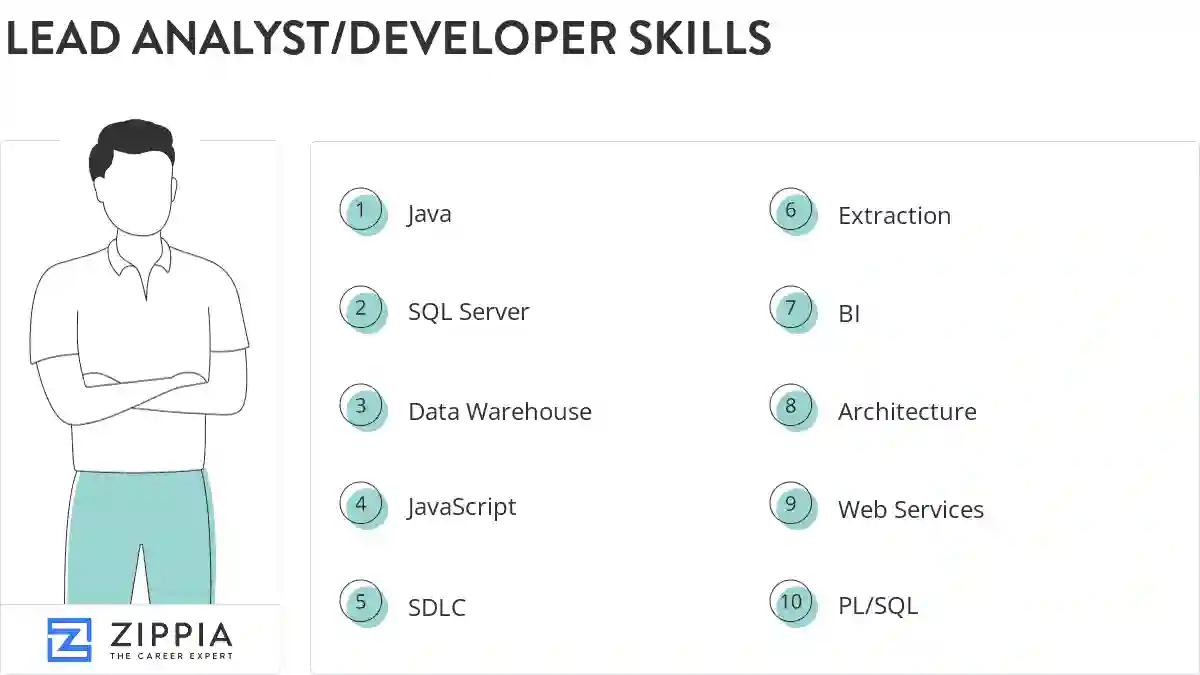
The most important skills for a lead analyst/developer resume and required skills for a lead analyst/developer to have include:
- Java
- SQL Server
- Data Warehouse
- JavaScript
- SDLC
- Extraction
- BI
- Architecture
- Web Services
- PL/SQL
- ETL
- Business Process
- XML
- Windows
- Apis
- C Net
- User Interface
- CSS
- Triggers
- MVC
- Visio
- Debugging
- Unix
- HTML
- Test Cases
- SAS
- DB2
- Ssis
- Business Analysis
- COBOL
- TFS
- SSRS
- Management System
- JQuery
- Linux
- Technical Specifications
- EDI
- User Acceptance
- Ajax
- Data Analysis
- Mainframe
- Business Logic
- ASP
- QA
- Oracle Sql
- Payroll
- SharePoint
- Toad
Updated January 8, 2025
