
Automatically apply for jobs with Zippia
Upload your resume to get started.
Lecturer/instructor skills for your resume and career
15 lecturer/instructor skills for your resume and career
1. Semester
A semester is a calendar that divides an academic year into sections of fifteen to eighteen weeks. The time system adopted by schools and countries differ. While the half system divides the academic year into two sessions, the quarter system divides the academic year into four sessions.
- Managed Minority Introduction To Engineering involving 25 students from different states during the Summer Semester, 2004.
- Instructed a Business Law class of twenty-nine students for three days per week for the Summer Semester.
3. Graduate Courses
- Conceptualized undergraduate courses in a wide range of mathematical subjects to cultivate students' mathematical skills and theoretical knowledge.
- Conducted and Evaluated Microbiology Practical Examinations for Post Graduate Courses of Microbiology and Bio Technology.
4. Mathematics
- Course instructor for Mathematics and Business Administration departments, primarily teaching Probability and Statistics, but also Corporate Finance courses as needed
- Collaborate with the Director of Mathematics & Technical Communication and other instructors to develop rubrics and set evaluation standards.
5. Syllabus
- Developed syllabus and overall course structure, including lab experiments, and administered grades
- Worked closely with department principal to outline student learning, designed syllabus, teaching methods, and student learning assessment.
6. Classroom Curriculum
- Created and implemented classroom curriculum for both Law and Speech and Debate classes.
Choose from 10+ customizable lecturer/instructor resume templates
Build a professional lecturer/instructor resume in minutes. Our AI resume writing assistant will guide you through every step of the process, and you can choose from 10+ resume templates to create your lecturer/instructor resume.7. Literature
- Facilitated instruction for developing the thesis topic statement, qualitative and quantitative research design, and conducting a review of literature.
- Consulted with the Humanities Faculty in Music Education and lectured on musical style and literature from all major Western historical periods
8. Course Curriculum
- Designed course curriculum, gave lectures, prepared handouts, instructed lab sessions, held review sessions and office hours.
- Integrated practical experiences/knowledge, applied research, and course curriculum for the development of new fitness trainers
9. Chemistry
Chemistry is the branch of science that tells us about the composition, properties, and structure of elements and compounds. The processes these elements undergo and how they undergo change all come under the branch of chemistry.
- Course included introduction to Chemistry, Organic and Biochemistry.
- Lectured discussions in General Chemistry/Organic Chemistry
10. Student Learning
- Conduct undergraduate lectures to facilitate student learning, challenge students, encourage participation and attendance, and communicate ideas effectively.
- Introduced and incorporated existing and emerging technologies into the curriculum and classroom environment to actively promote and advance student learning.
11. Economics
- Trained debaters in comprehensive research skills for materials in economics, philosophy, property and politics.
- Power stations plant Electrical circuit Practice of engineering profession Engineering economics Thermodynamic
12. Undergraduate Courses
Undergraduate courses usually refer to the first studies undertaken at university.
- Teach Microcomputer Application and Business/Management undergraduate courses
- Facilitated graduate and undergraduate courses in classroom management, assessment and evaluation and critical thinking with Common Core Standards
13. Course Materials
- Prepared course materials such as syllabi, assignments, handouts and graded examinations.
- Acted as critical reader for course materials for Marketing Research 5.
14. Fine Arts
- Accepted additional scheduling for the College of Theology and the College of Fine Arts Production.
- Worked as the drawing specialist in a collaboratively taught Fine Arts Core program.
15. Physiology
Physiology is a branch of biology focused on studying living things, other parts, and the functions of these parts. It studies the functions of living things, especially the human body, and the effects of different processes and actions on the well-being of the body.
- Worked as a part time lecturer in the subject of General Anatomy and Physiology.
- Job roles: * Medical physiology and anatomy lecturer.
5 Lecturer/Instructor resume examples
Build a professional lecturer/instructor resume in minutes. Browse through our resume examples to identify the best way to word your resume. Then choose from 5+ resume templates to create your lecturer/instructor resume.

What skills help Lecturer/Instructors find jobs?
Tell us what job you are looking for, we’ll show you what skills employers want.
What skills stand out on lecturer/instructor resumes?
Dr. Jason Pierce
Professor, Department Chair, Angelo State University
What hard/technical skills are most important for lecturer/instructors?
Gary Joiner Ph.D.
Professor and Chair, Mary Anne and Leonard Selber Professor of History, Director, Red River Regional Studies, Director, Strategy Alternatives Consortium, Louisiana State University at Shreveport
What soft skills should all lecturer/instructors possess?
Jia Yu Ph.D.
Associate Professor of Economics, Southern Connecticut State University
Public speaking skills: Teaching is the most essential work for an economics instructor. So, public speaking skills are very important.
Leadership: The instructor is the person leading students to knowledge and their future. An instructor needs to be a good leader to guide students for their future careers or even future life.
What lecturer/instructor skills would you recommend for someone trying to advance their career?
Helen Callus
Professor of Viola, Northwestern University
What type of skills will young lecturer/instructors need?
Dr. Lori Gray
Associate Professor: Director of Music Education, Boise State University
I would add that graduates need a strong work ethic, an understanding of professionalism and respect in the workplace, and self-awareness and an understanding of personal needs and limitations both at work and in their personal lives. In these current living conditions during a global pandemic (COVID-19), graduates also need resilience, perseverance, adaptability, and flexibility. These are all skills I would want for our Music Education majors to cultivate, as the climate in K-12 Education is ever-changing. However, I believe these are all skills that would be useful in any new career path.
List of lecturer/instructor skills to add to your resume
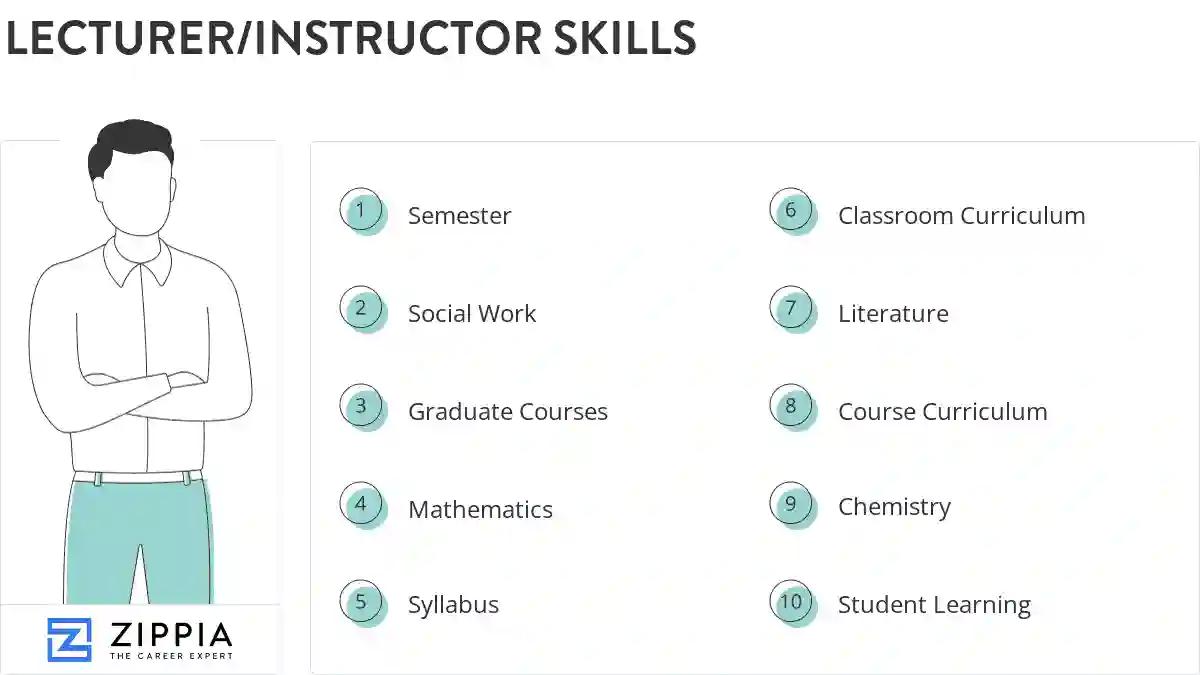
The most important skills for a lecturer/instructor resume and required skills for a lecturer/instructor to have include:
- Semester
- Social Work
- Graduate Courses
- Mathematics
- Syllabus
- Classroom Curriculum
- Literature
- Course Curriculum
- Chemistry
- Student Learning
- Economics
- Undergraduate Courses
- Course Materials
- Fine Arts
- Physiology
- Sociology
- Course Content
- Public Speaking
- Data Collection
- Seminar
- PowerPoint
- Student Performance
- Courses Taught
- Architecture
- ESL
- Photoshop
- Ethics
- C++
- Pharmacology
- UK
- Blackboard
- Poetry
- Community Health
- Autocad
- Instructional Materials
- Business Administration
- Business Management
Updated January 8, 2025

2. Social Work