
Automatically apply for jobs with Zippia
Upload your resume to get started.
Level vial inspector skills for your resume and career
15 level vial inspector skills for your resume and career
1. Calipers
- Performed measurements using OD, ID calipers, Tape measure and scale.
- Measured dimensions of products to verify conformance to specifications, using measuring instruments including rulers, calipers, gauges and micrometers.
2. Micrometers
A micrometer is a measuring instrument used in various laboratories to measure even the tiniest components in-depth with great precision and accuracy and to make precise linear measurements of dimensions such as diameters, thicknesses, and lengths of solid bodies. They are essential measuring instruments used by mechanical engineers, machinists, and workers in other technical professions. They allow workers to take extremely precise measurements, which can be viewed either in imperial or metric format. Most micrometers are designed to measure within one-thousandth of an inch! It's a snug fit. Accurate measurements like this are needed when even the smallest distance between objects can cause problems or difficulties.
- Utilize calipers, micrometers and other technical measuring devices to determine product conformance to specifications and end product requirements.
- Inspected casing pipe using gauges and micrometers to ensure tolerance levels were within customer and/or blueprint specifications.
3. GD
GD refers to Grade Delay and is often mentioned on report cards or academic records when the instructor of a particular subject decides to hold the grade of a student. This is usually done if the instructor wants the student to improve their grade by retaking the exam or doing something for extra credit that will ultimately enhance their overall grade. Eventually, when the grade is assigned, the GD is then replaced with the original grade.
- Performed activities related to Composite inspection, autoclave cure, trim evaluation Geometrical Data & Tolerance (GD & T).
- Weld qualification analysis GD & T per ASME Y14.5M Calibration.
4. Aerospace
Aerospace refers to the physical science focusing on designing and developing, testing, and producing systems that aid in navigation to space or traverse through the earth's atmospheric zone.
- Utilized diagrams and data to inspect aerospace components for structural integrity and weld conformity
- Review all aerospace parts against print and manufacturing process requirements.
5. Safety Procedures
Safety procedures are a set of standardized procedures, that ensures minimal to no risk to people, resources, and the work environment. A company follows the step-by-step safety procedures as it they not only keep the customers and the employees safe, but also help in avoiding legal claims.
- Ensured technicians used proper maintenance techniques, followed safety procedures, practiced supply discipline, and complied with security procedures.
- Contacted and scheduled site visits evaluating and if necessary correcting safety procedures to assure safe working conditions for life and property.
6. Particle Inspection
- Perform Non Destructive Testing, Magnetic particle inspection on a variety of down hole drilling tools and equipment.
7. PT
PT which stands for Prothrombin Time is a test to evaluate the body's ability to properly form blood clots using one's blood sample. PT results are used to calculate the International Normalized Ratio (INR) which detects the effectiveness of blood-thinning medications like Warfarin taken by patients that have blood-clotting disorders.
- perform MT, PT testing on equipment.
- Level II UT Level II RT Level II MT Level II PT Level II VT Performed Weld-Quality RT and film interpretation.
8. Magnetic Particle
Magnetic Particle testing, also known as Magnetic Particle Inspection, is a method or examination used to determine the flaws of the surface and subsurface materials like nickel, iron, cobalt, and alloy.
- Inspect new manufactured flight control components for various military and commercial aircraft, using magnetic particle and liquid penetrate testing.
- Perform repetitive types of magnetic particle or fluorescent penetrant non-destructive tests of raw material and finished products.
9. Radiographic Procedures
- Establish radiation areas for radiographic operations and compute and monitor personal.
10. NDT
Non-Destructive Testing, NDT, is a combination of different test techniques used individually or collectively to evaluate the integrity and properties of a material, component, system, or structure without permanently altering it. NDT is important for safe operation, as well as for quality control and lifetime evaluation of the system. It is used in industries such as aerospace, oil, and gas, nuclear, power generation, medical, rail, general manufacturing, etc.
- Administered training Of new NDT inspectors.
- Performed visual external corrosion and internal erosion inspection utilizing NDT techniques on process piping and equipment during refinery turnarounds.
11. CMM
CMM stands for "capability maturity model." This refers to the refinement of a company's processes, most commonly regarding software development. This methodology is achieved through five levels. Each of these levels attempts to refine the development process until the software is efficiently created, organized, and maintained. This may include security procedures for software or productivity among team members.
- Conducted dimensional and visual inspections procedures on CMM machines to ensure geometrical characteristics of the product are in specification.
- Developed part measurement programs and operator work instructions for CMM applications.
12. RT
- Conduct RT and PT on fuel pipelines
- Enlarge the team numbers and develop all work instructions, development, training and all safety pertaining to RT.
13. API
- Performed Routine and Batch Environmental Monitoring for sterile fill finish manufacturing processes and bulk API manufacture.
- Monitor fabrication activities to ensure adherence to company specification and API standards.
14. Destructive Testing
- Performed nondestructive testing on various types of drilling and production specialty tools.
- Perform Non destructive testing on drilling tools and equipment.
15. FDA
The Food and Drug Administration (FDA) is a division of the US Department of Health and Human Services that regulates the production and sale of food, pharmaceutical products, medical equipment, and other consumer goods, as well as veterinary medicine. The FDA is now in charge of overseeing the manufacture of products like vaccines, allergy treatments, and beauty products.
- Inspected and tested Pharmaceutical drugs in accordance with FDA regulated guidelines for accuracy, control date and operation
- Experienced using various instruments to perform inspections of product in accordance to standard operating procedures and FDA requirements.

What skills help Level Vial Inspectors find jobs?
Tell us what job you are looking for, we’ll show you what skills employers want.
List of level vial inspector skills to add to your resume
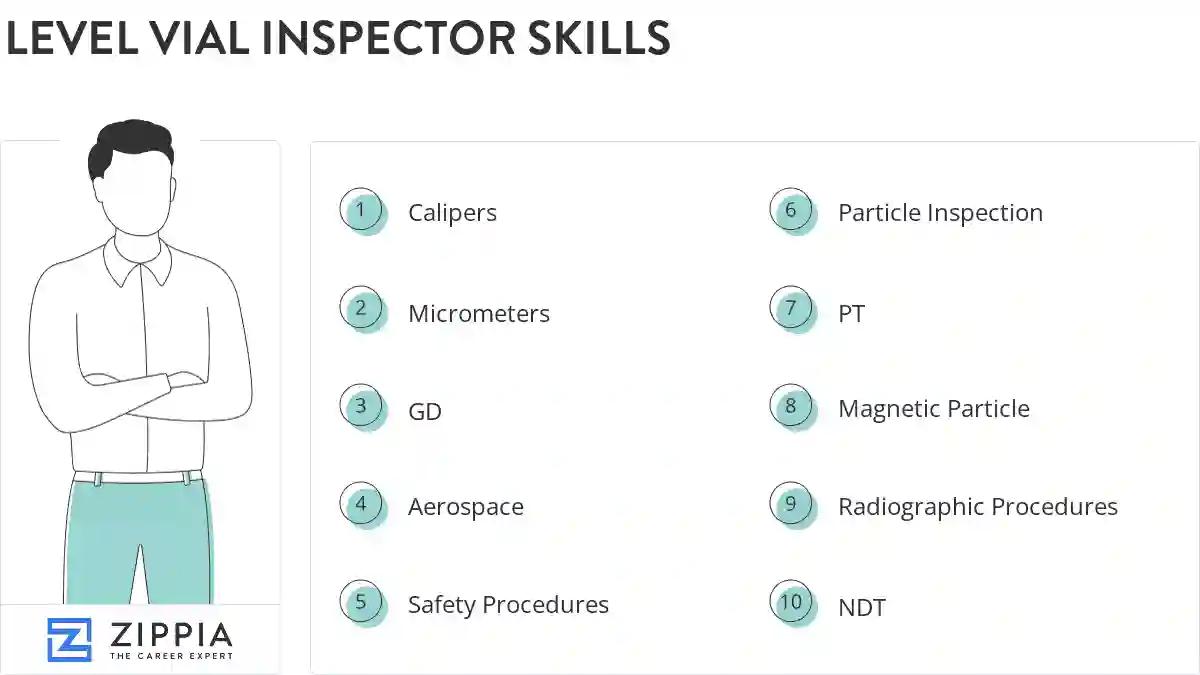
The most important skills for a level vial inspector resume and required skills for a level vial inspector to have include:
- Calipers
- Micrometers
- GD
- Aerospace
- Safety Procedures
- Particle Inspection
- PT
- Magnetic Particle
- Radiographic Procedures
- NDT
- CMM
- RT
- API
- Destructive Testing
- FDA
- Dimensional Inspection
Updated January 8, 2025
