Explore jobs
Find specific jobs
Explore careers
Explore professions
Best companies
Explore companies
Job outlook for licensed sales agents in the United States
Licensed sales agent job growth summary. After extensive research, interviews, and analysis, Zippia's data science team found that:
The projected licensed sales agent job growth rate is 10% from 2018-2028.
About 47,700 new jobs for licensed sales agents are projected over the next decade.
Licensed sales agent salaries have increased -4% for licensed sales agents in the last 5 years.
There are over 116,204 licensed sales agents currently employed in the United States.
There are 63,324 active licensed sales agent job openings in the US.
The average licensed sales agent salary is $36,453.
Are licensed sales agent jobs in demand?
Licensed sales agent job and salary trends over time
Licensed sales agent jobs over time
Licensed sales agent job growth rate over time
| Year | # of jobs | % of population |
|---|---|---|
| 2021 | 116,204 | 0.03% |
| 2020 | 117,248 | 0.03% |
| 2019 | 116,841 | 0.03% |
| 2018 | 111,413 | 0.03% |
| 2017 | 106,122 | 0.03% |
Average licensed sales agent salary over time
Licensed sales agent salary by year
| Year | Avg. salary | Hourly rate | % Change |
|---|---|---|---|
| 2026 | $36,453 | $17.53 | +4.0% |
| 2025 | $35,046 | $16.85 | --2.9% |
| 2024 | $36,087 | $17.35 | +0.5% |
| 2023 | $35,896 | $17.26 | --5.2% |
| 2022 | $37,882 | $18.21 | --5.9% |
Licensed sales agent jobs by state
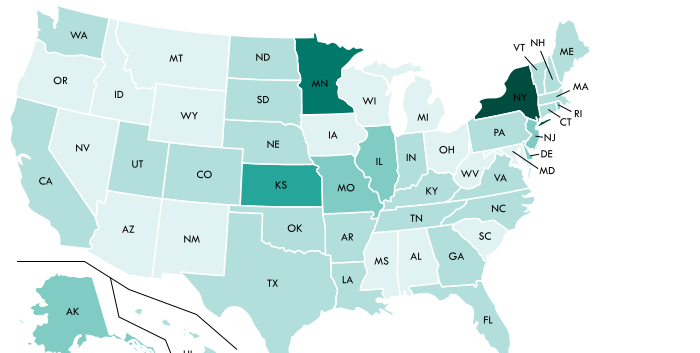
Most common states for licensed sales agents
| Rank | State | Population | # of jobs | Employment/ 1000ppl |
|---|---|---|---|---|
| 1 | Delaware | 961,939 | 326 | 34% |
| 2 | Nebraska | 1,920,076 | 521 | 27% |
| 3 | North Dakota | 755,393 | 170 | 23% |
| 4 | Missouri | 6,113,532 | 1,319 | 22% |
| 5 | Iowa | 3,145,711 | 705 | 22% |
| 6 | Rhode Island | 1,059,639 | 237 | 22% |
| 7 | Montana | 1,050,493 | 223 | 21% |
| 8 | Colorado | 5,607,154 | 1,138 | 20% |
| 9 | Minnesota | 5,576,606 | 1,095 | 20% |
| 10 | Wyoming | 579,315 | 113 | 20% |
| 11 | Arizona | 7,016,270 | 1,366 | 19% |
| 12 | Oregon | 4,142,776 | 780 | 19% |
| 13 | Kansas | 2,913,123 | 548 | 19% |
| 14 | Vermont | 623,657 | 121 | 19% |
| 15 | Washington | 7,405,743 | 1,337 | 18% |
| 16 | South Carolina | 5,024,369 | 860 | 17% |
| 17 | Utah | 3,101,833 | 540 | 17% |
| 18 | Michigan | 9,962,311 | 1,552 | 16% |
| 19 | New Jersey | 9,005,644 | 1,401 | 16% |
| 20 | Wisconsin | 5,795,483 | 952 | 16% |
Most common cities for licensed sales agents
| Rank | City | # of jobs | Employment/ 1000ppl | Avg. salary |
|---|---|---|---|---|
| 1 | Delray Beach | 2 | 3% | $33,784 |
| 2 | Clovis | 1 | 3% | $30,249 |
| 3 | Dover | 1 | 3% | $37,227 |
| 4 | Grants Pass | 1 | 3% | $32,096 |
| 5 | Bedford | 1 | 2% | $34,490 |
| 6 | Fairfield | 1 | 2% | $34,789 |
| 7 | Eugene | 1 | 1% | $31,816 |
| 8 | Fort Lauderdale | 1 | 1% | $33,857 |
| 9 | Portland | 2 | 0% | $31,660 |
| 10 | Baltimore | 1 | 0% | $31,467 |
| 11 | Baton Rouge | 1 | 0% | $33,508 |
| 12 | Boston | 1 | 0% | $35,449 |
| 13 | Cincinnati | 1 | 0% | $31,771 |
| 14 | Cleveland | 1 | 0% | $32,323 |
| 15 | Columbus | 1 | 0% | $31,983 |
| 16 | Denver | 1 | 0% | $33,955 |
| 17 | Detroit | 1 | 0% | $30,155 |
Licensed Sales Agent job outlook: Expert opinions
Our panel of licensed sales agent experts
University of Maryland - College Park
Butler University

Denison University

Brigham Young University-Idaho
Aurora University

Thomas More University

University of Central Missouri
What Licensed Sales Agent skills would you recommend for someone trying to advance their career?
Hank Boyd: With the looming prospects of AI, soft skills will reign supreme in sales. While at
first blush it might seem counterintuitive in that product knowledge used to be cardinal
skill, today's salesforce relies heavily on networking. Numerous academic papers lend
credence to this idea. Great people skills often trump wonkish knowledge about the
product line.
As we wade further into the 21st Century, environmental scanning (or better yet
the innate ability to read prospects) will remain pivotal. Exceptional salespeople
instinctively scan a prospective client's office noticing all the trappings. They are trying to find something they can comment upon, by doing so they can establish common
ground. Once a connection is forged, salespeople move out of the box of being pesky
interlopers into becoming valued associates.
Lastly, if you decide to embark on a career in sales never forget the tried-and-
true axiom of ABC - always be closing. This phrase means having the gumption to ask
for the business. While sales recruits might have congenial and bubbly personalities, if
they cannot look the prospect in the eye and ask for the business, they ought to find
another profession.
Tom Faulconer JD, CPCU, CLU, ChFC, CASL,CFP(r)
Clinical ProfessorButler University
Insurance
What will help Licensed Sales Agents increase their earning potential?
Tom Faulconer JD, CPCU, CLU, ChFC, CASL,CFP(r): Being an agent provides freedom. Most agents set their own hours meaning there is time for family and other activities. Of course, since it is a commission-based position, the harder you work, the more you make! Plus, property and casualty agents (home, auto and commercial lines) can build up their client list to the point where they make a very good living just off renewal commissions. At that point, an agent can truly work whenever they want and still get paid. (That takes a few years to get to, though.) As to dislikes, being a commissioned salesperson is difficult for some people. And the freedom that comes with being an agent is a double-edged sword. If someone takes advantage and doesn't work very hard, they won't last very long! And, depending on the company, etc., paperwork can be pretty extensive!
What will help Licensed Sales Agents increase their earning potential?
Ashley Strausser: Graduates need to do their research, know their worth and negotiate their job offer. It amazes me how many students accept the salary offered to them without considering negotiation. Graduates should do their due diligence using sites such as Glassdoor and Salary.com to compare their salary offer to similar roles in the same region. If you are going to negotiate, you must be able to make a strong case as to why you are deserving of more money. This cannot be based on what you feel you deserve, but rather the skills you possess, relevant experiences you've had and the tangible results you've achieved that will enable you to be successful in the role. Evaluate the job description to determine if you possess some, or perhaps many, of the desired qualifications beyond the minimum qualifications listed. If so, use those as part of your negotiation. If not, consider how you might be able to develop those desired qualifications to make you a stronger candidate.
Competitive candidates should have a strong, well-rounded skill set. Being able to articulate your skills and experiences (academic, co-curricular, internships, research, study abroad, etc.) both on your resume and in an interview is critical. Know the skills necessary to be effective in the roles you seek. If you are lacking skills essential to your desired roles or industries, consider completing online courses or certifications through LinkedIn Learning or Coursera. Take advantage of skill-building resources and programs available through your university. Finally, research and prepare well for your interviews. This includes conducting mock interviews with staff in your career center to practice and gain valuable feedback on ways to improve your interviewing skills.
Chad Newswander Ph.D.
Professor of Political ScienceBrigham Young University-Idaho
Department of Political Science
What technical skills for a Licensed Sales Agent stand out to employers?
Chad Newswander Ph.D.: It is a combination of soft and hard skills. Young professionals need to be reliable, conscientious, hardworking, and be able to work well with others. They also need to show early signs of leadership, allowing them to grow within the organization. Above all, they need to be trusted to get the work done and be likeable. They also need to have a concrete skillset that allows them to contribute. Each young professional needs to think how they can add value to their organization (not just what the organization will do for them). Those skills can range from data/statistical analysis, writing, speaking, research, etc. In order to show that they have these skills, students should do multiple internships while in school from credible organizations.
Jacqueline Babb
Assistant Professor of Digital Marketing, Director of Graduate StudiesAurora University
Marketing Department
What technical skills for a Licensed Sales Agent stand out to employers?
Jacqueline Babb: Technical skills paired with strong communication, flexibility in thought, diversity, and creative problem solving are a winning combination for job candidates. Candidates with a strong acumen in data analysis and storytelling are marketable right now.
Dr. John D. (Jack) Rudnick
ProfessorThomas More University
Department of Business Administration and Accountancy
How have salaries changed over time for Licensed Sales Agents?
Dr. John D. (Jack) Rudnick: The consolidation of health systems into larger entities throughout the continuum and the infusion of private equity into healthcare have prompted meteoric rises in base salaries and bonuses for many executives. Reimbursement specialists and strategy consultants have also benefited from salary increases over the past 40 years. Salaries have shifted to more of an incentive-based model with a foundational base salary aligned with bonuses linked to pre-established metrics aimed at revenue-growth and expense reduction to optimize a health organization's return-on-investment (ROI).
Stephen (Tyler) Hirlinger
Assistant Professor of MarketingUniversity of Central Missouri
Division of Business Strategy, Marketing Program
Will there be an enduring impact of the coronavirus pandemic on Licensed Sales Agents?
Stephen (Tyler) Hirlinger: The pandemic will certainly have a lasting impact on graduates, both positively and negatively. To start with the positives, I think the transition to online learning the past two semesters has forced students to gain many valuable skills that will be necessary for success in the post-pandemic work environment. The work dynamic in many industries may remain radically different for the foreseeable future and I think graduates will be more resourceful, organized, more productive in remote settings, and work better in groups due to the recent circumstances. I also think students will learn to be more entrepreneurial and improve their ability to "sell themselves" due to fewer career opportunities and higher competition in the workforce. Time will tell, but I think the lack of job availability may stunt the career growth for many recent graduates, while those that learn to grow when faced with adversity will thrive.