Explore jobs
Find specific jobs
Explore careers
Explore professions
Best companies
Explore companies
What is a life skills trainer and how to become one

Think about all the skills people need in order to survive in the modern world. We need to be able to find and maintain a job, budget, have the emotional intelligence to manage personal relationships, and more. For various reasons, these skills don't come naturally to everyone. Life skills trainers step in to help people learn those skills and thrive.
A life skills trainer could work with individual clients or groups and prepare them with the skills necessary for independent living. This can be as basic as teaching a client how to maintain personal hygiene or helping someone develop complex budgeting skills in order to manage their money. A life skills trainer can work with people of all ages, from children to adults, and all abilities.
A life skills trainer is very different from a social media self-help guru. Their work is often crucial in preparing clients for living alone. Over half of the life skills trainers hold bachelor's or master's degrees, but practical experience in the skills that they teach is important. Above all, compassion is often more important than a diploma.
What general advice would you give to a life skills trainer?
Matthew Sabin PhD, LAT, ATC, SMTC, CIDN
AT Program Director | Professor, Eastern Kentucky University
I think it is also fair to acknowledge that if you plan to pursue an industry that requires you to build a client base, thinking you will graduate and "maximize" your salary may be a misnomer. The goal will be to continue to develop those skills ("hard" and "soft") to maximize your earning overtime. Clients/patients want someone working with them who knows their field and is effective. Employers see that over time or word of mouth and marketing spread the news. That is what leads to your value increasing.
Avg. Salary $30,822
Avg. Salary $59,228
Growth rate 19%
Growth rate 0.3%
American Indian and Alaska Native 0.49%
Asian 5.11%
Black or African American 7.05%
Hispanic or Latino 10.64%
Unknown 5.40%
White 71.31%
Genderfemale 66.05%
male 33.95%
Age - 36American Indian and Alaska Native 3.00%
Asian 7.00%
Black or African American 14.00%
Hispanic or Latino 19.00%
White 57.00%
Genderfemale 47.00%
male 53.00%
Age - 36Stress level is moderate
7.1 - high
Complexity level is intermediate
7 - challenging
Work life balance is excellent
6.4 - fair
Life skills trainer career paths
Key steps to become a life skills trainer
Explore life skills trainer education requirements
Start to develop specific life skills trainer skills
Skills Percentages Medication Administration 16.65% Therapeutic Recreation 15.84% Medical Appointments 8.72% Direct Support 8.47% Rehabilitation 6.16% Complete relevant life skills trainer training and internships
Accountants spend an average of Less than 1 month on post-employment, on-the-job training. New life skills trainers learn the skills and techniques required for their job and employer during this time. The chart below shows how long it takes to gain competency as a life skills trainer based on U.S. Bureau of Labor Statistics data and data from real life skills trainer resumes.Gain additional life skills trainer certifications
More About CertificationsLife skills trainer certifications can show employers you have a baseline of knowledge expected for the position. Certifications can also make you a more competitive candidate. Even if employers don't require a specific life skills trainer certification, having one may help you stand out relative to other applicants.
The most common certifications for life skills trainers include Medical Assistant and First Aid, CPR and AED Instructor.
Research life skills trainer duties and responsibilities
- Train and experience at managing challenging classroom situations using CPI methods and positive behavior reinforcement practices.
- Deliver individual counseling and perform crisis intervention duties including reporting suicidal patients.
- Cultivate a culture of community by providing community integration at a residential rehabilitation facility for persons with severe brain injuries.
- Acquire CPR and life skills certifications.
Prepare your life skills trainer resume
When your background is strong enough, you can start writing your life skills trainer resume.
You can use Zippia's AI resume builder to make the resume writing process easier while also making sure that you include key information that hiring managers expect to see on a life skills trainer resume. You'll find resume tips and examples of skills, responsibilities, and summaries, all provided by Zippi, your career sidekick.
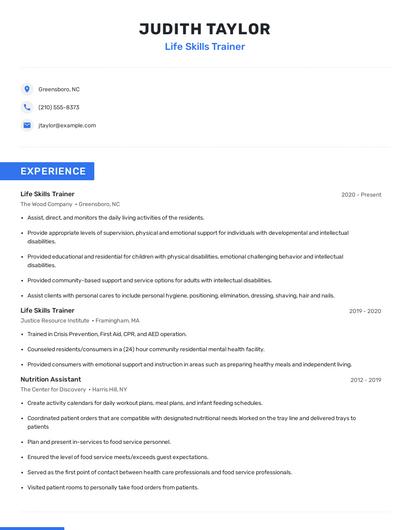
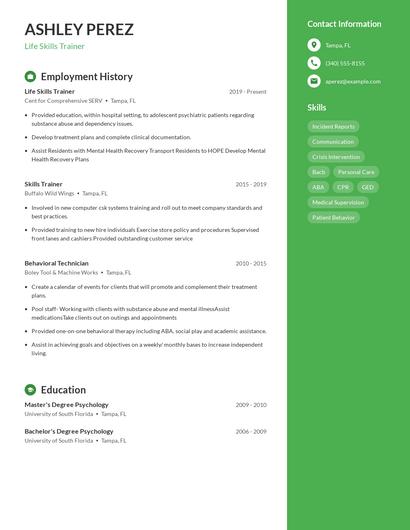
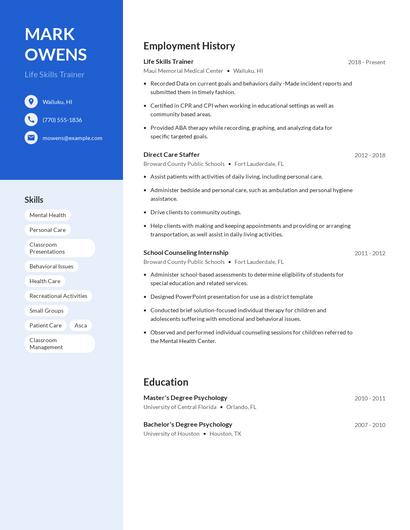
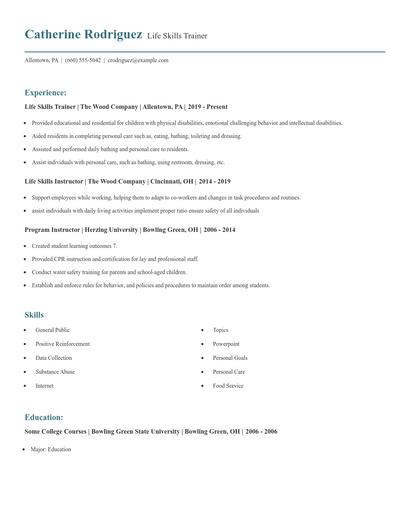
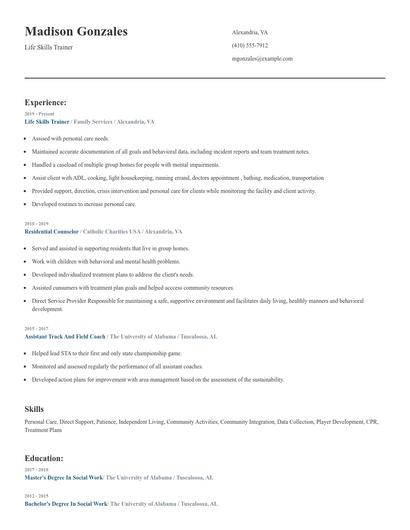
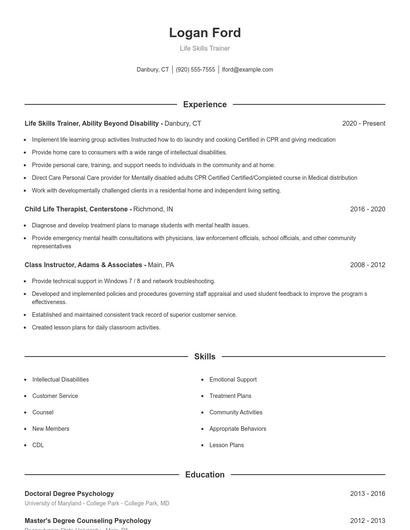
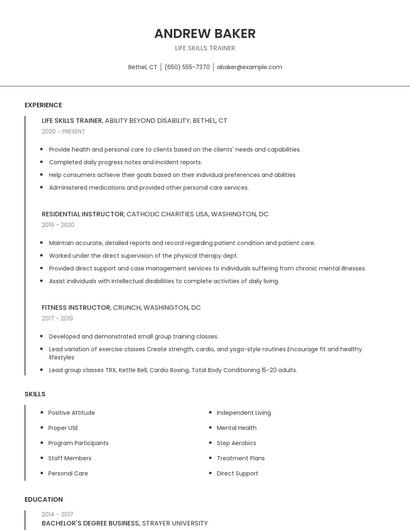
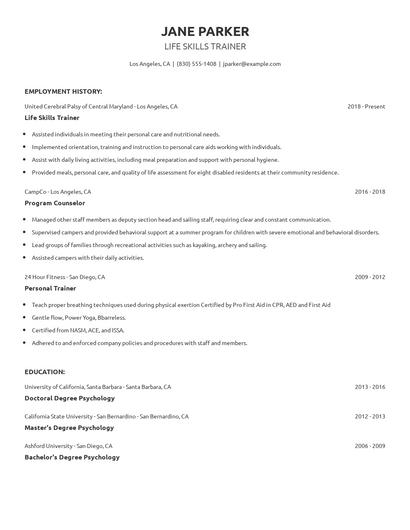
Choose from 10+ customizable life skills trainer resume templates
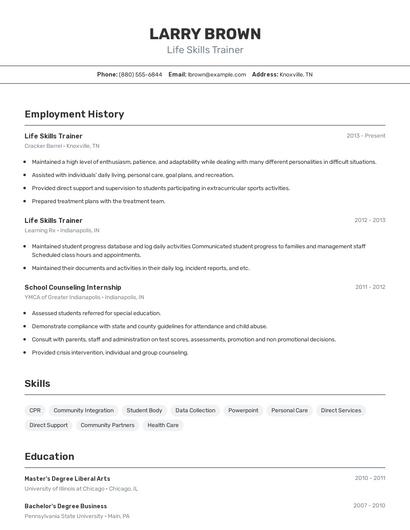
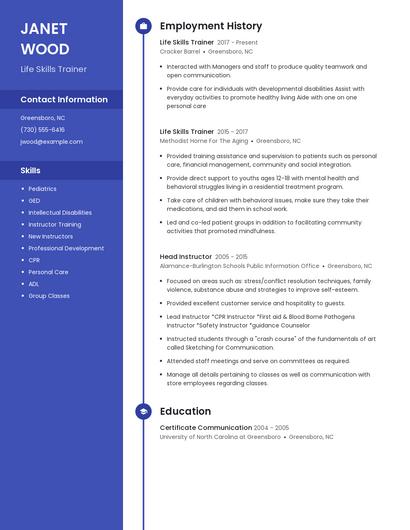
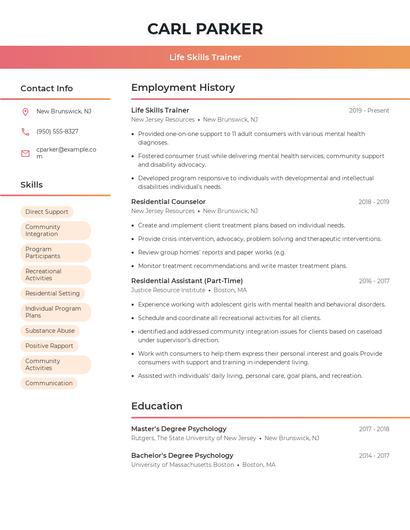
Build a professional life skills trainer resume in minutes. Browse through our resume examples to identify the best way to word your resume. Then choose from 10+ resume templates to create your life skills trainer resume.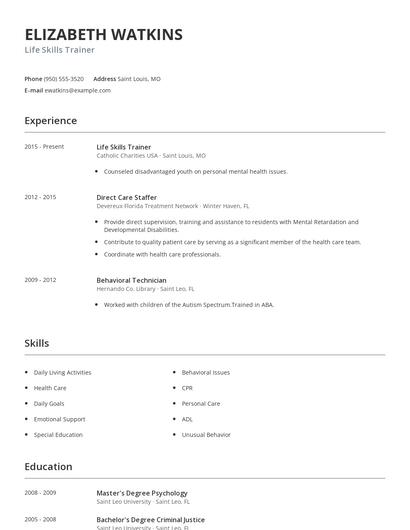
Apply for life skills trainer jobs
Now it's time to start searching for a life skills trainer job. Consider the tips below for a successful job search:
- Browse job boards for relevant postings
- Consult your professional network
- Reach out to companies you're interested in working for directly
- Watch out for job scams
How did you land your first life skills trainer job

Are you a life skills trainer?
Share your story for a free salary report.
Average life skills trainer salary
The average life skills trainer salary in the United States is $30,822 per year or $15 per hour. Life skills trainer salaries range between $22,000 and $41,000 per year.
What am I worth?

How do life skills trainers rate their job?
Life skills trainer reviews

Being able to help each client to become as independent as possible
I do not like the schedule .
The scheduling can change at anytime. There are always shortage of workers to cover shifts especially overnight shifts. You can get stuck on a shift any given day. The people you work with has more issues than the people you are hired for to take care of. They can be lazy!!!
The individual's are entertaining and loving. They do have their moments like any other person but when the individuals are having a good day it shows. They always look for validation from the staff when they are doing a good job. There is always something different to expect everyday. You really have to love what you do because it can be stressful but also rewarding.
The staffing is the least of my favorite. The staff can be lazy and do not can not accept change
Updated January 8, 2025
