
Automatically apply for jobs with Zippia
Upload your resume to get started.
Line pilot skills for your resume and career
14 line pilot skills for your resume and career
1. EMS
Emergency Medical Services, also known as EMS, is an emergency medical response system that provides stabilization and urgent preclinical and on-site treatment for serious illness and injury, as well as the transportation of patients who are unable to transport themselves to a definite health care center. The main objective of EMS is to provide emergency medical treatment to those who need urgent medical attention and to properly treat the patient's condition and transport them to a suitable health center or medical facility.
- Line Pilot, ENG, EMS, Aerial Photo Bell 206BIII, Bell 206LIII
- Manage the day-to-day operations of an EMS Base by maintaining company records, publications, training manuals and operation manuals.
2. Helicopter
A helicopter is a rotorcraft type of aircraft with one or more horizontally rotating motorized propellers or rotors that allow it to take off and land vertically, move in any direction, or remain stationary in the air. They are used to transport personnel and light cargo to and from offshore platforms and for the emergency evacuation of the wounded.
- Reacted with expedited mission management and delegated to the aircrews for efficient no-notice helicopter launches.
- Coordinated emergency refueling of helicopter leaking fuel after evacuating embassy personnel during Liberian Civil War.
3. Federal Aviation
Federal Aviation is the largest modern transportation agency and a governmental body of a nation with powers to regulate all aspects of civil aviation in that nation and over its surrounding international waters. Its powers include the construction and operation of airports, air traffic management, the certification of personnel and aircraft, and the protection of national assets during the launch or reentry of commercial space vehicles.
- Assisted captain in operating transport category aircraft Embraer-190, efficiently and within compliance of all company procedures and Federal Aviation Regulations.
- Maintain knowledge of applicable Federal Aviation Administration regulations as pilot in accordance with Federal Aviation Administration rules and regulations.
4. NVG
- Supported Op Enduring Freedom in security, reconnaissance and attack roles in high-threat environment under day, night & NVG conditions
- Earned flight lead duties for countless interstate VFR cross-country and tactical flights during day, night and NVG conditions.
5. PIC
A PIC, also known as a Programmable Intelligent Computer and Programmable Interface Controller, is a type of microcontroller component that is used in the development of electronics, computers, robotics, and the likes. It works as a standard microcontroller with small processors, memory, registers, and storage. Typically, a PIC enhances the I/O operations of a device by separating I/O-based data and programs from the core central processing unit (CPU).
- Line Pilot, AS350-B2 PIC flying tours of the Grand Canyon and the Las Vegas Strip.
- Fly simulator as SIC to customer PIC guiding customer through normal taxi, takeoff, cruise, approach and landing operations.
6. FAA
FAA (Federal Aviation Administration) is an aviation regulatory body in the USA.
- Operated Short SD3-60 and SD3-30 aircraft, configured for freight under FAA regulation Part 135.
- Ensured compliance with FAA regulations and safe operation of AS350 aircraft.
Choose from 10+ customizable line pilot resume templates
Build a professional line pilot resume in minutes. Our AI resume writing assistant will guide you through every step of the process, and you can choose from 10+ resume templates to create your line pilot resume.7. Flight Planning
- Flight planning and dissemination of weather systems.
- Job functions included flight planning, aircraft preparation, attending passengers and other copilot duties
8. IFR
IFR or Instrument Flight Rules refers to the rules and regulations regarding the flight of non-military civil aircraft. Just like there are traffic laws on cars and motorbikes, aircraft flights have their laws. The IFR guide works alongside the Visual Flight Rules or VFR to govern how aircraft should fly.
- Conduct aircraft operations in multiple modes of flight: Day/ Night VFR, NVG and simulated IFR Conditions.
- Single pilot IFR operations flying time critical chemotherapy supplies and interest bearing Federal Reserve notes.
9. Charter Operations
- Assisted with the evaluation of new pilots in charter operations.
- Lead project to relocate jet aircraft base from BUU to PWK Member of team certifying charter operations in turbojet aircraft.
10. Aerial Photography
- Provide tours, aerial photography, agricultural and commercial pilot services for a vast array of clients and customers.
- Conducted scenic tour, aerial photography, video, skydiving, and survey flights.
11. ATP
ATP stands for "available to promise." This phrase is often used in inventory management to determine the quantity of a product available for purchase and the approximate date the product can be delivered by. Using this thought process, a company can keep stock of an item low, freeing up space in warehouses for additional merchandise.
- Assisted with the administration of the unit aircrew training program (ATP).
- Reported data for military target acquisitions Automated Test Procedures (ATP).
12. GPS
GPS stands from Global Positioning System. It is a navigation system comprising of satellites that helps in determining the location, velocity, and synchronize time data for different modes of travel like air, sea, or land.
- Hired to pilot UAV aircraft for students to complete their PHD thesis on a variety of disciplines that incorporated GPS technologies.
- Flight duties included GPS and or VOR navigation, radio operations, and using effective crew resource management in IFR operations.
13. LiDAR
- Line Pilot, Lidar, Powerline Survey MD500E, Bell 206LIII
14. Routine Maintenance
- Ensured all routine maintenance was properly documented and updated.

What skills help Line Pilots find jobs?
Tell us what job you are looking for, we’ll show you what skills employers want.
List of line pilot skills to add to your resume
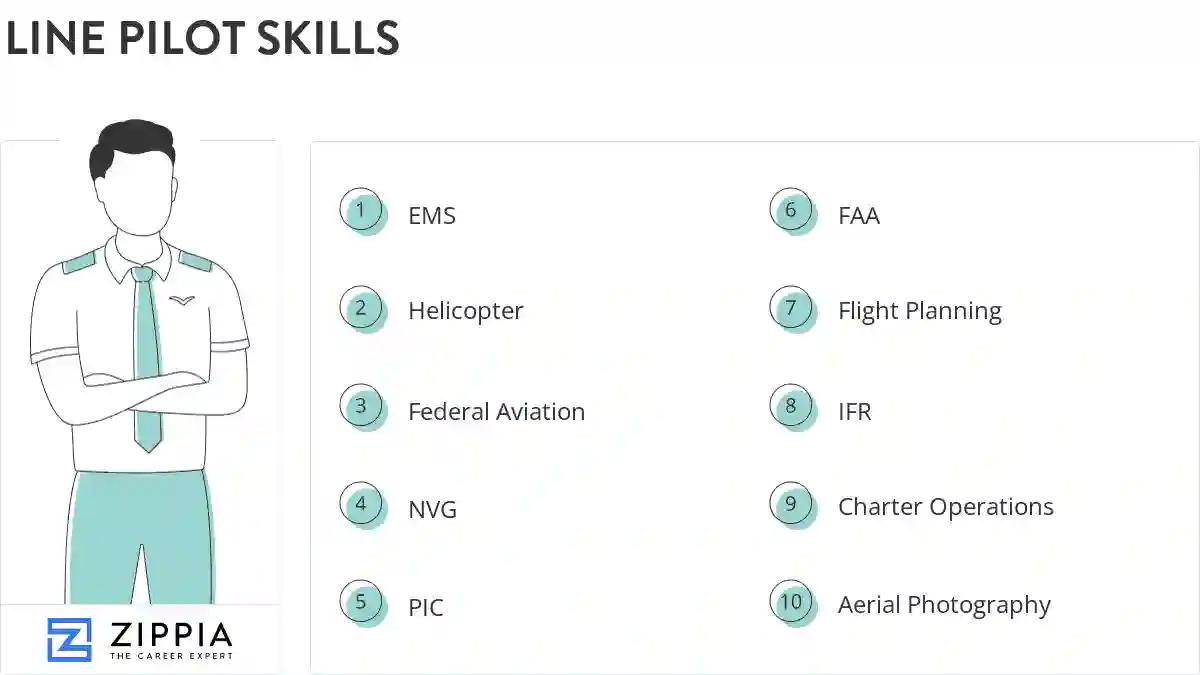
The most important skills for a line pilot resume and required skills for a line pilot to have include:
- EMS
- Helicopter
- Federal Aviation
- NVG
- PIC
- FAA
- Flight Planning
- IFR
- Charter Operations
- Aerial Photography
- ATP
- GPS
- LiDAR
- Routine Maintenance
Updated January 8, 2025
