
Automatically apply for jobs with Zippia
Upload your resume to get started.
Linux administrator skills for your resume and career

15 linux administrator skills for your resume and career
1. Python
Python is a widely-known programming language. It is an object-oriented and all-purpose, coding language that can be used for software development as well as web development.
- Developed python scripts to automate routine database maintenance and account provisioning tasks.
- Tested and implemented applications built using python.
2. Windows
Windows is a chain of operating systems that controls a computer and is developed by Microsoft. Every version of Windows consists of GUI (graphical user interface), with a desktop that allows the user to open their files.
- Managed prominent level web applications and worked with windows and Linux based administrations in physical/virtual environments.
- Deploy Windows 2003 Server for remote Terminal services administration to support on-call remote support administrators.
3. Linux Servers
- Monitored everyday systems and evaluated availability of all server resources and performed all activities for Linux servers.
- Mentored other systems administrators in engineering, installation, configuration, testing and administration of Linux servers.
4. Bash
The Bourne- Again Shell, or simply BASH, is commonly known as a default command interpreter of Linux and GNU systems.
- Developed bash scripts to automate system/build processing.
- Created users, manage user permissions, maintain User & File System quota on RHEL Bash shell-scripts to automate routine activities.
5. Red Hat
Red Hat is a USA software company that provides open sources software products to enterprises.
- Suds administration and Red Hat Linux package administration.
- Modernized security policy for Red Hat servers
6. OS
In technical terms, OS stands for "Operating System". It is a software that is used to run programs on the computer. An operating system acts as a link between the user and the hardware components. Windows, macOS, iOS, Linux are examples of an operating system.
- Performed OS Installation/configuration/Upgrades/Patches and migrations.
- Provide support to Application development/support teams integrating applications into Linux OS platform.
Choose from 10+ customizable linux administrator resume templates
Build a professional linux administrator resume in minutes. Our AI resume writing assistant will guide you through every step of the process, and you can choose from 10+ resume templates to create your linux administrator resume.7. Centos
CentOs which is an acronym for Community Enterprise Linux Operating system is a Linux distribution. It provides a computing platform that is built to be very safe and stable.
- Expanded functionality and updated existing VOIP Linux (RHEL, Debian, SUSE, Ubuntu, CentOS) systems.
- Use of Logical Volume Manager (LVM), creating Volume Groups, Logical volumes in RHEL and CentOS.
8. DNS
Domain Name Systems, or DNS for short, is the internet's system for converting readable language, i.e., google.com, to machine language, i.e, 192.168. For a simple analogy, some call it the phonebook of the internet. Any website has its own IP address, for example, 192.168.160. Understandably this is hard to remember. So what a DNS does is link the domain name, google.com, with its IP address, 192.168.160.
- Installed/Configured/Maintained/Administrated the network servers DNS, NFS and application servers Apache and Samba server.
- Controlled, maintained and supervised DNS server located hosting facility.
9. RHEL
- Automated processes and installed custom build and application specific RHEL operating systems.
- Modified/Migrated/Supported GIC adapters/routers which run in RHEL 5.11 environment.
10. Troubleshoot
Troubleshooting is the process of analyzing and fixing any kind of problem in a system or a machine. Troubleshooting is the detailed yet quick search in the system for the main source of an issue and solving it.
- Coordinated with application team in installation, configuration and troubleshoot issues with Tomcat server.
- Provided assistance and documentation which allowed the 24/7 operations department to troubleshoot and correct problems without needing to page other employees.
11. Database
A database is a collection of data and information which makes it easy to view, access, and manage. Databases save a lot of time and can store huge amounts of data. Databases make sorting data easier and stores it in certain fields which narrows the searching criteria. A database usually contains tables, graphs, and columns to display data.
- Coordinate build schedules between development teams, Database Administrators and Network Operations while developing and improving build communication channels.
- Administer database security including adding/removing users, auditing, and troubleshooting security related issues, provide internal management services.
12. Unix
UNIX is a computer operating system that was first created in the 1960s and has been constantly updated since then. The operating system refers to the set of programs that enable a machine to function. It is a multi-user, multi-tasking device that works on computers, laptops, and servers. UNIX systems also have a graphical user interface (GUI), similar to Microsoft Windows, that makes it simple to use.
- Performed systems administrator role in configuring, troubleshooting and maintaining Linux and Unix infrastructure for a mid-sized services company.
- Provided ongoing management, performance-tuning and Tier 3 support for approximately 50 Linux and Unix systems-users.
13. SAN
SAN abbreviation for storage area network is a computer network that provides storage access.
- Performed day-to-day operational support of the SAN environment.
- Involved in decommission of the servers which reached end of life and performed SAN migrations using LVM and EMC tools.
14. NFS
- Configure and maintain NFS Servers for both media and data sharing between servers and resolved any shared server issues.
- Analyzed network traffic using network protocols TCP/IP, UDP, ARP/RARP, DHCP and NFS using open source software.
15. AWS
- Configured and maintained automated environment using Chef Recipes and cookbooks to manage system configuration with in AWS environment.
- Migrated the On-premise WebLogic applications to AWS WebLogic applications by writing the required Chef-artifacts.
5 Linux Administrator resume examples
Build a professional linux administrator resume in minutes. Browse through our resume examples to identify the best way to word your resume. Then choose from 5+ resume templates to create your linux administrator resume.

What skills help Linux Administrators find jobs?
Tell us what job you are looking for, we’ll show you what skills employers want.
What skills stand out on linux administrator resumes?
Greg Kessler Ph.D.
Professor, Ohio University
List of linux administrator skills to add to your resume
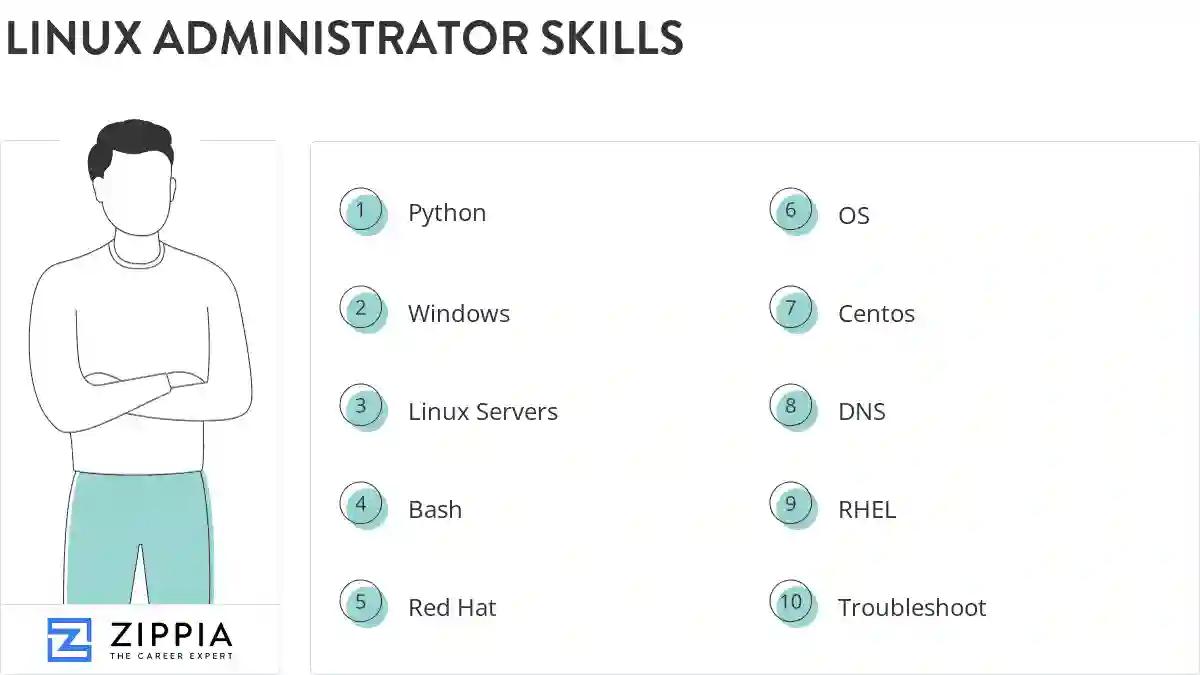
The most important skills for a linux administrator resume and required skills for a linux administrator to have include:
- Python
- Windows
- Linux Servers
- Bash
- Red Hat
- OS
- Centos
- DNS
- RHEL
- Troubleshoot
- Database
- Unix
- SAN
- NFS
- AWS
- Web Servers
- Perl
- LDAP
- Tomcat
- Nagios
- Configuration Management
- Java
- Http
- GIT
- Ubuntu
- DHCP
- Redhat Linux
- LVM
- Tcp Ip
- Solaris
- Virtual Machines
- Virtualization
- Apache Tomcat
- TCP/IP
- FTP
- RPM
- Vmware ESX
- Disk Space
- System Security
- Jenkins
- Kernel
- YUM
- Technical Support
- Application Server
- JBoss
- Jira
- Veritas Netbackup
- Production Environment
- Kickstart
- AIX
Updated January 8, 2025
