
Automatically apply for jobs with Zippia
Upload your resume to get started.
Load tester skills for your resume and career
15 load tester skills for your resume and career
1. Web Application
- Validated test case scenarios by utilizing the web application to ensure the balances/positions; money/activities and security activities were posted correctly.
- Project description-Web application for managing student and employee registration, exam management, assignments, interactions etc.
2. Windows
Windows is a chain of operating systems that controls a computer and is developed by Microsoft. Every version of Windows consists of GUI (graphical user interface), with a desktop that allows the user to open their files.
- Performed monitoring the Unix and Windows server statistics during the performance test.
3. Test Cases
- Analyzed system requirements specifications, developed executed detailed test plans test cases, security and usability of application information.
- Worked with Business analysts to understand Business/System requirements in order to transform business requirements into functional test cases.
4. Test Scenarios
- Conducted different load tests on different environments to find the performance of different applications using different test scenarios using LoadRunner Controller.
- Work on data preparation for different test scenarios including negative testing to provide accurate delivery of overall functionality of the product.
5. Mainframe
A mainframe is a high-performance digital computer used by large organizations for mission-critical applications, high transaction volumes, and reliable performance, designed for intensive high-speed computing for large-scale computing purposes that require greater availability and security which a smaller machine cannot offer.
- Extract data from Mainframe data sets to compare against Target Values.
6. Java
Java is a widely-known programming language that was invented in 1995 and is owned by Oracle. It is a server-side language that was created to let app developers "write once, run anywhere". It is easy and simple to learn and use and is powerful, fast, and secure. This object-oriented programming language lets the code be reused that automatically lowers the development cost. Java is specially used for android apps, web and application servers, games, database connections, etc. This programming language is closely related to C++ making it easier for the users to switch between the two.
- Developed and altered existing Java code based upon Business Analysts designs, and collaboration with Senior Technical Architects.
- Developed automated regression scripts using Selenium utilizing Java code scripting for both positive and negative boundary conditions.
Choose from 10+ customizable load tester resume templates
Build a professional load tester resume in minutes. Our AI resume writing assistant will guide you through every step of the process, and you can choose from 10+ resume templates to create your load tester resume.7. PL/SQL
- Executed and validate stored procedure functions developed using PL/SQL.
- Validated PL/SQL stored Procedures used for customers placing regular orders.
8. Unix
UNIX is a computer operating system that was first created in the 1960s and has been constantly updated since then. The operating system refers to the set of programs that enable a machine to function. It is a multi-user, multi-tasking device that works on computers, laptops, and servers. UNIX systems also have a graphical user interface (GUI), similar to Microsoft Windows, that makes it simple to use.
- Monitored UNIX logs for different types of exceptions during Load test manually and also using Failbox tool.
- Developed UNIX Shell scripts to automate repetitive database processes * Performed application setup in test environment and enhancing the documentation.
9. SQL Server
- Monitor Application server (Web logic) and Data base server (SQL Server 2005).
- Configured HP-QC environment- SQL Server repository, security/access guidelines and setup for HP-QC reporting, functional/regression testing and user access.
10. Test Results
- Marked items for acceptance or rejection, recorded test results and inspections.
- Analyzed system/error logs and output/input files to verify test results and resolve discrepancies in Linux operating system.
11. JMeter
- Analyzed the results using Online Monitors and Graphs to identify bottle necks in the server resources using Load Runner and JMeter.
- Performed Load and Performance Testing by monitoring the throughput and response time of the application using JMeter.
12. Test Data
- Defined and conditioned test data for positive and negative test cases as per system specifications and business requirements.
- Prepared Test Data for positive and negative Test Scenarios as per application specifications and application requirements and wrote Test Plans.
13. Jenkins
Jenkins is an open source automation server that is free to use. It aids continuous deployment and execution by automating the aspects of product creation related to building, analyzing, and deploying. It is a system based on the server that runs in servlet containers like Apache Tomcat. Jenkins is a Java-based fully accessible automation platform with plugins designed for Continuous Integration.
- Worked on distributed test automation execution on different environment as part of Continuous Integration Process using Selenium Grid and Jenkins.
- Worked on distributed test automation execution on different environment as part of Continuous Integration Process using Selenium Grid and Jenkins.
14. Regression
- Executed integration system and regression testing scripts.
- Created the Automated test scripts using WinRunner tool for regression and system thread testing.
15. Data Integrity
Data integrity denotes the consistency or accuracy validation of data in the whole lifecycle of data. It ensures the security of traceability and search-ability of all data in a person's device to the source.
- Implemented various integrity constraints for data integrity such as referential integrity using primary key and foreign keys relationships.
- Ensured data integrity and verified all data modifications and calculations during database migration using ETL tools.
5 Load Tester resume examples
Build a professional load tester resume in minutes. Browse through our resume examples to identify the best way to word your resume. Then choose from 5+ resume templates to create your load tester resume.

What skills help Load Testers find jobs?
Tell us what job you are looking for, we’ll show you what skills employers want.
List of load tester skills to add to your resume
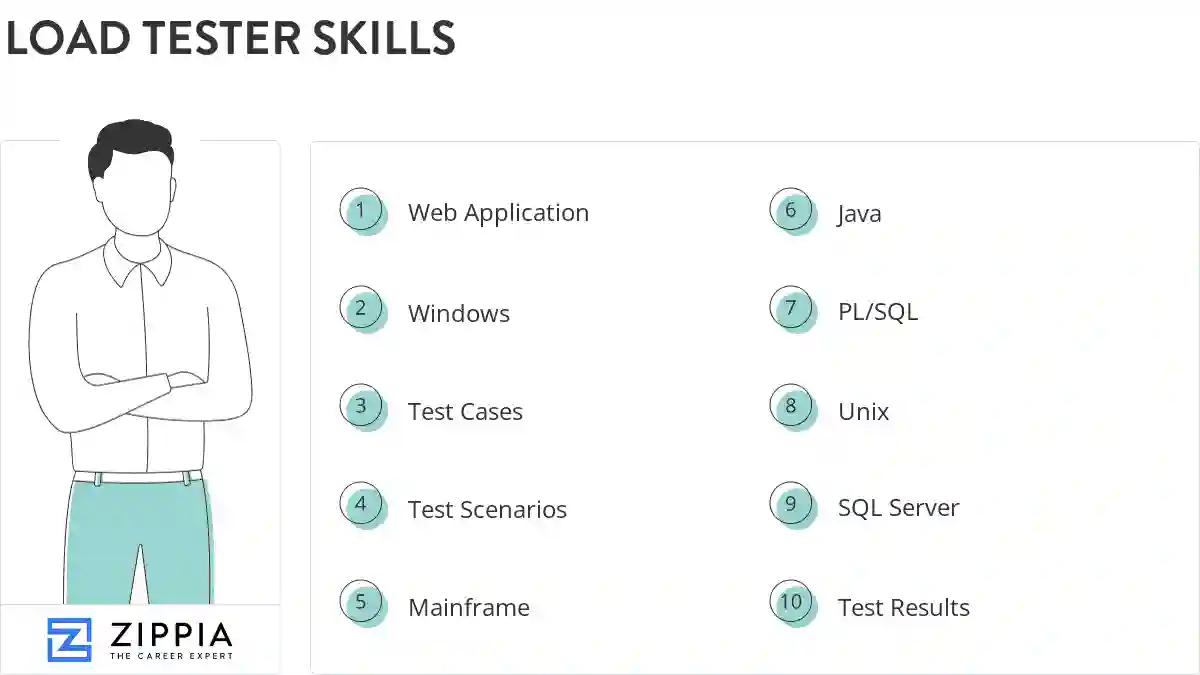
The most important skills for a load tester resume and required skills for a load tester to have include:
- Web Application
- Windows
- Test Cases
- Test Scenarios
- Mainframe
- Java
- PL/SQL
- Unix
- SQL Server
- Test Results
- JMeter
- Test Data
- Jenkins
- Regression
- Data Integrity
- ETL
- Vugen
- CPU
- DB2
- End Testing
- QA
- Functionality
- XML
- Test Documentation
- Toad
- Performance Improvement
- System Performance
- Oracle Sql
- LoadRunner
- UAT
- Critical Issues
- Performance Test Suites
Updated January 8, 2025
