
Automatically apply for jobs with Zippi
Upload your resume to get started.
Loading supervisor skills for your resume and career
15 loading supervisor skills for your resume and career
1. Safety Procedures
Safety procedures are a set of standardized procedures, that ensures minimal to no risk to people, resources, and the work environment. A company follows the step-by-step safety procedures as it they not only keep the customers and the employees safe, but also help in avoiding legal claims.
- Developed supply procedures and trained employees on daily operations, safety procedures, and company policies.
- Implemented loading and safety procedures for drivers.
2. Delivery Truck
- Trained new hires, audited employees on safe work methods, loaded and unloaded delivery trucks.
- Train and evaluate employees in the area on loading UPS delivery trucks
3. Load Trucks
- Supervised 5 employees to load and unload trucks with inventory from warehouse
- Load Trucks and weighed them In and Out.
4. Safety Policies
Safety policies are the rules and codes of conduct developed by an organization to ensure workplace safety.
- Supervised employees, making sure that safety policies and sanitation guidelines were adhered to.
- Adhere stringently to safety policies to ensure safe environment.
5. Pre-Load
- Received promotion to Pre-Load Supervisor after 30-day probation period.
- Performed Pre-load Supervisor and responsibilities including providing training personnel in package loading and hazardous material handling safety.
6. Rail Cars
Rail Cars, also called railroad cars, are large containers set on a railway and pulled by a locomotive. Rail cars are frequently used for shipping large quantities of product or material, such as metal, chemicals, or livestock; however, a rail car may also transport people such as a subway system. A locomotive often pulls numerous cars that attach to each other, which then form a train.
- Supervised 12 loading employees and 10 subcontractors loading 100+ trucks and 3 rail cars per day.
- Oversee company and contract employees loading rail cars and barges.
7. Production Schedules
The project plan of a film or a documentary that highlights how a production budget will be spent over a given period until its completion is called a production schedule. The scheduling process starts with writing and analyzing the script, which is then broken down to determine and allocate the budget for each scene. The production schedule also includes several elements of the film including; cast actors, special effects, wardrobe, special equipment, stunts, extras, silent bits, production equipment, and many others.
- Studied production schedules and estimated worker-hour requirements for completed job assignments.
- Adjusted work procedures to meet production schedules using knowledge of capacities of machines and equipment.
8. Hazardous Materials
Any substance or good that is harmful to human health as well as the environment are called hazardous materials. Such materials must be handled carefully to avoid any mishaps. Harmful gases. chemicals, strong medicines or drugs, radioactive elements required for radiation purposes, a human blood sample that carries germs, all of these are considered hazardous materials.
- Audit hazardous materials packages for compliance with internal and external regulations, maintain files for regulatory purposes.
- Follow all procedures and inform my immediate supervisor of any unsafe work environments or hazardous materials.
9. Safety Standards
- Worked closely with other department supervisors to improve productivity while upholding safety standards.
- Train new employees on safety standards and job methods.
10. Safety Regulations
- Conducted quality control inspections on trucks to maintain compliance with organizational safety regulations.
- Verify all operators are instructed on Sony warehouse safety regulations and are issued and wearing all the required personal protective equipment.
11. Safety Training
The guidance and skills taught to workers and employees of a company to carry out their duties safely and efficiently are referred to as safety training. The purpose of safety training is to inform workers about the potential and risks associated with this kind of work and to teach them ways to avoid such risks.
- Promoted safety training and techniques to maximize employee proficiency and availability.
- Conduct risk management and safety compliance audits, maintain employee safety training certifications, and determine training needs.
12. Disciplinary Actions
Disciplinary actions refer to a corrective measure taken against an employee for unsatisfactory behavior. Many work environments have a tiered system for disciplinary action, where the first warning is verbal and the second is written. Disciplinary action may be given after a weak performance review, a violation of company rules and policies, or a poor customer review.
- Resolve employee problems and concerns along with issuing disciplinary actions and recording proper documentation of employees when necessary.
- Completed all disciplinary actions including write ups and suspensions.
13. RAN
RAN stands for "revenue anticipation note," which refers to a practice where an organization (often the government) borrows money to support a specific project. When these funds are then repaid, the money given to the lenders comes from the profits generated by the business originally funded.
- Ensured load process and driver dispatch ran smoothly; helped any loaders who were especially heavy get caught up.
- Shrimp & Crabber Fueled and cleaned boats and traps Did inventory & bought supplies Navigate boat Ran the Dock
14. Safety Committee
A safety committee is in charge of promoting a safety culture in an organization, primarily by implementing various safety policies and regulations. They may arrange meetings and seminars, address issues and concerns, and conduct regular inspections to ensure different departments comply with the safety standards and regulations.
- Assisted as a safety committee member and made sure everyone was following proper safety protocols.
- Head of Safety Committee, conduct meetings and inspections.
15. Inventory Control
- Prepared monthly status reports on movement of materials and maintain inventory control logs.
- Trained in all warehouse duties including, shipping/receiving and inventory control/reconciliation.

What skills help Loading Supervisors find jobs?
Tell us what job you are looking for, we’ll show you what skills employers want.
List of loading supervisor skills to add to your resume

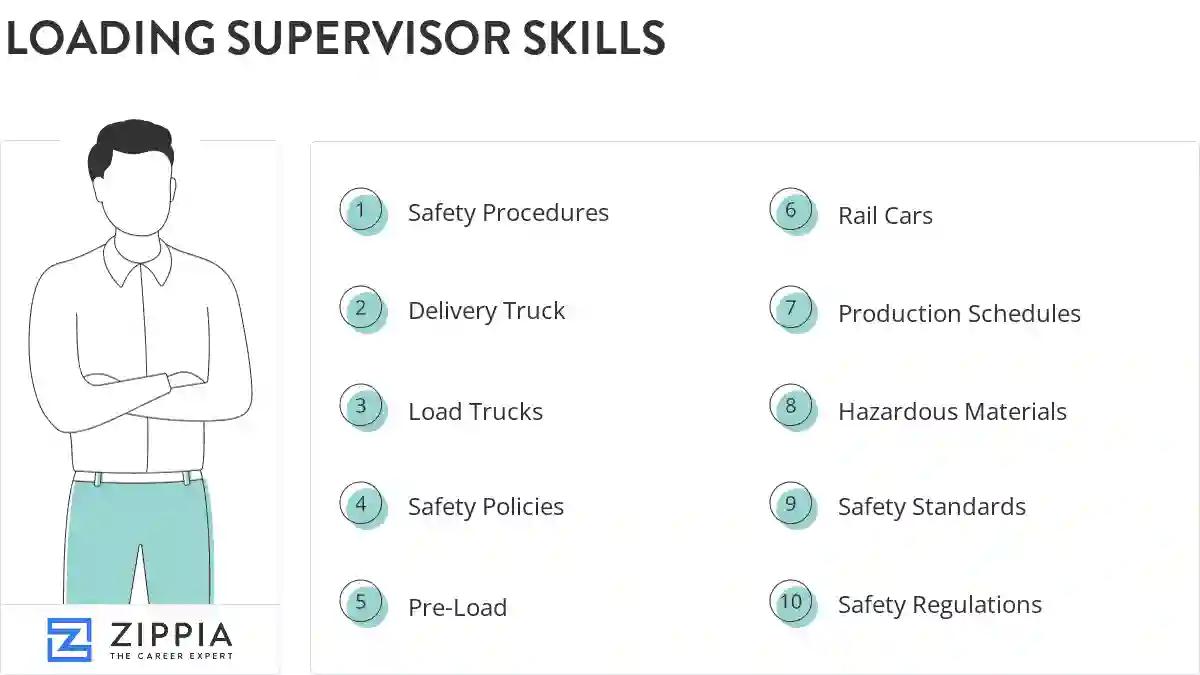
The most important skills for a loading supervisor resume and required skills for a loading supervisor to have include:
- Safety Procedures
- Delivery Truck
- Load Trucks
- Safety Policies
- Pre-Load
- Rail Cars
- Production Schedules
- Hazardous Materials
- Safety Standards
- Safety Regulations
- Safety Training
- Disciplinary Actions
- RAN
- Safety Committee
- Inventory Control
- Quality Standards
- Safety Guidelines
- Pro-Active Communication
- Warehouse Operations
- Hand Trucks
- Cost Management
- Safety Rules
- Delivery Vehicle
- Customer Expectations
- Safety Methods
- Customer Orders
- Regular Evaluations
- Legal Regulations
- Direct Reports
- Routine Pre
Updated January 8, 2025
