
Automatically apply for jobs with Zippia
Upload your resume to get started.
Machine shop inspector skills for your resume and career
15 machine shop inspector skills for your resume and career
1. Calipers
- Utilized standard measuring equipment including digital calipers, dial drop indicators, digital scales and related devices to verify product quality.
- Used calipers to measure thickness of boards and measured components purchased from outside vendors to ensure manufacturing accuracy.
2. Magnetic Particle
Magnetic Particle testing, also known as Magnetic Particle Inspection, is a method or examination used to determine the flaws of the surface and subsurface materials like nickel, iron, cobalt, and alloy.
- Contributed expertise in the utilization of magnetic particle inspection and dielectric test inspection techniques for telephone bucket trucks.
- Maintained and calibrated magnetic particle and florescent inspection equipment.
3. Machine Shop
- Started in a sandblasting position and over time trained and moved into the machine shop.
- Performed first article, in process and final inspections throughout CNC machine shop.
4. NDT
Non-Destructive Testing, NDT, is a combination of different test techniques used individually or collectively to evaluate the integrity and properties of a material, component, system, or structure without permanently altering it. NDT is important for safe operation, as well as for quality control and lifetime evaluation of the system. It is used in industries such as aerospace, oil, and gas, nuclear, power generation, medical, rail, general manufacturing, etc.
- Organize all NDT operations to satisfy customer contracts Reason for leaving: Higher pay, better job.
- Position as third party NDT shop Inspector for San Francisco Transbay Transit Center Project.
5. Inspection Tools
- Inspected turbine components to very tight tolerances using inspection tools: Height Gages Surface Plates Surface Finish Gage.
- Performed visual & dimensional Inspections of all incoming materials including all RMA'S, using all inspection tools.
6. NDE
Nondestructive evaluation (NDE) is a term used in describing quantitative measurements and locating a defect. It helps identify material properties like formability and fracture toughness. Majority of people know the technology used in NDE from the medical industries such as x-ray and ultrasound.
- Developed and recommend NDE solutions for equipment examination.
- Walk down engineering drawings and locate CUI susceptible locations and coordinate with NDE crews to further inspections done to assess damage.
7. Grinders
- Inspect CNC mills, lathes and grinders from Taiwan before they are delivered to customers in America.
8. GD
GD refers to Grade Delay and is often mentioned on report cards or academic records when the instructor of a particular subject decides to hold the grade of a student. This is usually done if the instructor wants the student to improve their grade by retaking the exam or doing something for extra credit that will ultimately enhance their overall grade. Eventually, when the grade is assigned, the GD is then replaced with the original grade.
- Read and interpret drawing & specification requirements and working knowledge of GD & T
- Weld qualification analysis GD & T per ASME Y14.5M Calibration.
9. CNC
CNC stands for Computer Numerical Control. It is a subtractive manufacturing technique that usually uses computerized controls and machine tools to strip layers of material from a stock piece.
- Programmed CNC machines using CAM software to input G codes needed to produce parts and instruments.
- Operate and tended CNC robotic MIG welders, resistance and friction welders and hot/cold forming presses.
10. Procedure Specifications
- Reviewed all welding procedure specifications and verified it was in accordance to ASME code.
11. Mechanical Inspection
A mechanical inspection is the examination of mechanical machinery and equipment in order to guarantee that the machinery is free of any mechanical failure. Mechanical inspections can be done visually and also through advance mechanical testing apparatus.
- Performed mechanical inspection on received parts.
- Sound Deadening, Thermal Insulation, Piping / Wiring Inspections and Mechanical Inspections by means of Squawk reports.
12. Visual Inspections
Visual inspection is a method used to perform quality control checks on different objects and structures. It includes techniques like data acquisition and data analysis. Moreover, a visual technique is done through quality control instruments and also human senses.
- Performed visual Inspection on product finish per customer supplied visual aids and purchase order requirements.
- Performed Internal visual inspection on equipment or pressure vessel associated piping during plant-scheduled shutdown as needed.
13. FAI
- Create full, accurate FAI Reports to customer and in house blueprints.
- Go to Net-Inspect to perform FAI report when it's require
14. Quality Products
A quality product satisfies the client's intended need and matches the cost the consumer paid for it.
- Keep records of products inspected, repaired and or scrapped to maintain the highest quality products for sale.
- Team Leader:Oversaw daily instructions to ensure quality products produced.
15. ISO
- Maintained compliance in all aspects to ISO: 9000 quality standards through proficient use of M/Soft Word and Excel.
- Assigned responsibilities included ISO 9001-2000 management representative and lead internal auditor.

What skills help Machine Shop Inspectors find jobs?
Tell us what job you are looking for, we’ll show you what skills employers want.
List of machine shop inspector skills to add to your resume
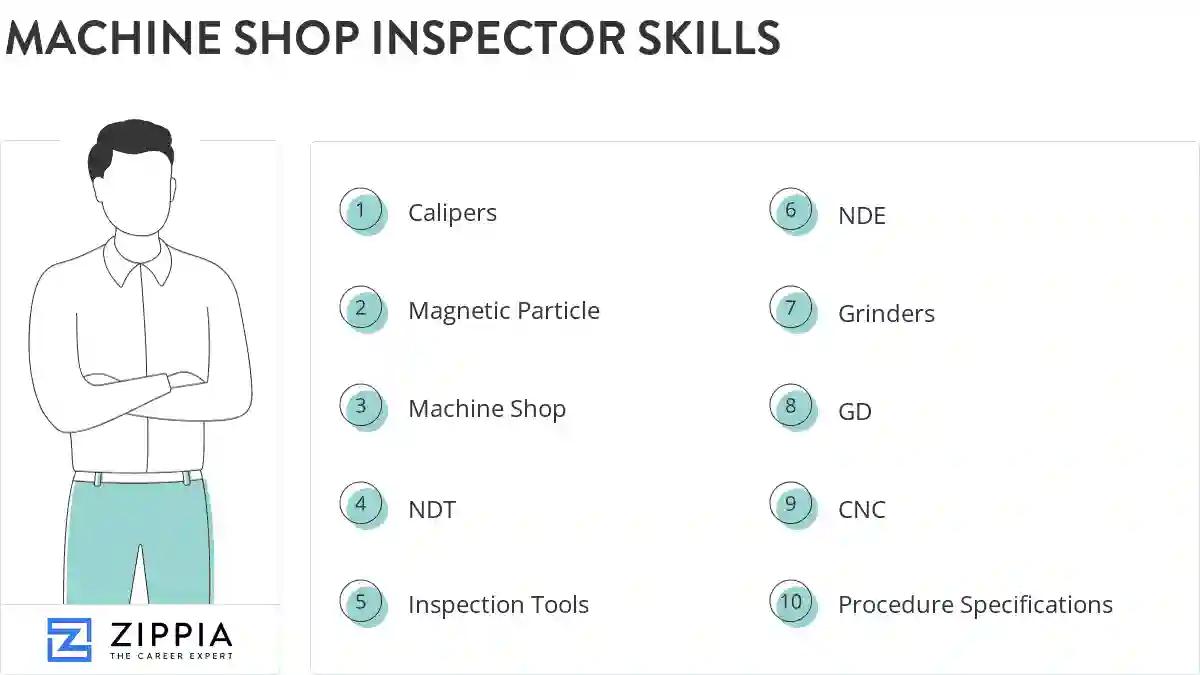
The most important skills for a machine shop inspector resume and required skills for a machine shop inspector to have include:
- Calipers
- Magnetic Particle
- Machine Shop
- NDT
- Inspection Tools
- NDE
- Grinders
- GD
- CNC
- Procedure Specifications
- Mechanical Inspection
- Visual Inspections
- FAI
- Quality Products
- ISO
- Preform
- Pressure Vessels
- QC
- Process Inspection
Updated January 8, 2025
