
Automatically apply for jobs with Zippia
Upload your resume to get started.
Mainframe systems programmer skills for your resume and career
15 mainframe systems programmer skills for your resume and career
1. Technical Support
Technical support or tech support are the services provided by any hardware or software company to users. They help in solving the technical difficulties the customers face with their products or services. Moreover, the tech support employees maintain, manage, and repair the IT faults. They are also responsible for resolving the network problems, installing and configuring hardware and software.
- Provided technical support and instruction to user community and application programming personnel on system and network related components
- Tied SNA network to IBM Technical Support through SNI Gateway (WAN) using the previously established network.
2. DB2
The DB2, known as the Relational Database Management System, is a type of procedure developed by IBM to run and operate software applications such as Windows, Unix, and the Linux System. This type of system is designed mainly for IBM but was innovated to run in various operating systems. The main feature of the DB2 is to handle and manage a big chunk of data while allowing the users to enter the database engine without any problem.
- Begin the Planning, and initial installation preparation of the TEST system/LPAR for the installation of DB2 V11.
- Provided DB2 DBA, and Systems Services, and z/OS Systems Programming Services.
3. Mainframe Systems
- Performed systems administration of mainframe systems.
- Subject Matter Expert / Team Leader/Mainframe Systems Programmer Provided Mainframe Expertise in support of both Hardware and Software Upgrades.
4. REXX
- Used PL/I, Rexx, and JCL to maintain and improve EDS software to enhance team productivity.
- Code programs needed for institutions applications using Assembler, COBOL, Easytreive and REXX.
5. RMF
RMF (the Risk Management Framework) refers to a set of criteria used by the federal government and its contractors to improve information security. To be proficient in RMF, in-depth technical experience with core technologies like Digital, Cloud, Data Protection, etc., along with knowledge of FISMA and FedRAMP regulatory compliance requirements.
- Installed AT-TLS and customized RMF and CMF Performance Tuned z/OS, JES2, and TSO.
- Work included using analysis tools OMEGAMON; RMF III EPILOG to identify and resolve performance related problems.
6. COBOL
- Developed and maintained the Systems Programmer's & System Operation's COBOL & C program utilities and maintenance library.
- Provide subsystem exit customizations, assembler and COBOL programming, CA-7 scheduling support, JCL setup and IBM Utilities execution.
Choose from 10+ customizable mainframe systems programmer resume templates
Build a professional mainframe systems programmer resume in minutes. Our AI resume writing assistant will guide you through every step of the process, and you can choose from 10+ resume templates to create your mainframe systems programmer resume.7. Disaster Recovery
The ability or procedure by which an organization regains its access and control over its IT framework after an unwanted disaster such as natural calamity or a cyberattack.
- Coordinated the implementation of an Internet email account for Disaster Recovery communications allowing continuous email capabilities should a disaster occur.
- Provided hands-on z/OS administration, performance management, hardware configuration and implementation and disaster recovery solutions for the company.
8. Problem Determination
- Performed problem determination and recovery activities on computing services that spanned multiple operating systems, mainframes and critical application systems.
- Perform problem determination to ascertain if problem is hardware or software related utilizing proper vendor support structures.
9. JCL
- Coded and tested using IBM Assembler, used IPCS, and also used JCL and TSO/ISPF under z/OS.
- Contracted to update JCL and document procedures for Sprint's class training regions.
10. TCP/IP
- Maintain TCP/IP Open System Adapter (OSA) definitions; verify and test OSA microcode upgrades.
- Updated TCP/IP to support the implementation of the Network F5 Load Balancer.
11. IMS
- Designed, created, tested, maintained specialized IMS engineering databases for the storage division s development lab.
- Performed root cause analysis on IMS and DB2 outages looking for resolution to prevent repeat occurrences.
12. FTP
- Involved in transmission of information (files) from mainframe Host to & from external systems using IBM FTP, TCP/IP.
- Assisted programming with daily FTP uploads and maintain procedures and manuals for changes and updates.
13. SAS
SAS stands for Statistical Analysis System which is a Statistical Software designed by SAS institute. This software enables users to perform advanced analytics and queries related to data analytics and predictive analysis. It can retrieve data from different sources and perform statistical analysis on it.
- Participated in IBM's SHARE national users' conferences and SAS Users Group International (SUGI) conferences.
- Created nightly reports using SAS, CLIST Macros as a Health Checker mechanism.
14. System Software
System software is the set of software that controls the management and internal functioning of a computer using the operating system, disk operating system, and file management utilities. The most crucial characteristics of system software include fast speed, closeness to the system, difficulty to design, difficulty to manipulate, and written in a low-level language.
- Implement projects to customize operating system software to support the customer environment.
- Implement, update and install system software and reduce risk systems downtime to provide continuous services to users worldwide.
15. SMP/E
- Reviewed, recoded, and reinstalled usermods using SMP/E.
- Acquired extensive experience installing and maintaining software utilizing SMP/E.
5 Mainframe Systems Programmer resume examples
Build a professional mainframe systems programmer resume in minutes. Browse through our resume examples to identify the best way to word your resume. Then choose from 5+ resume templates to create your mainframe systems programmer resume.

What skills help Mainframe Systems Programmers find jobs?
Tell us what job you are looking for, we’ll show you what skills employers want.
List of mainframe systems programmer skills to add to your resume
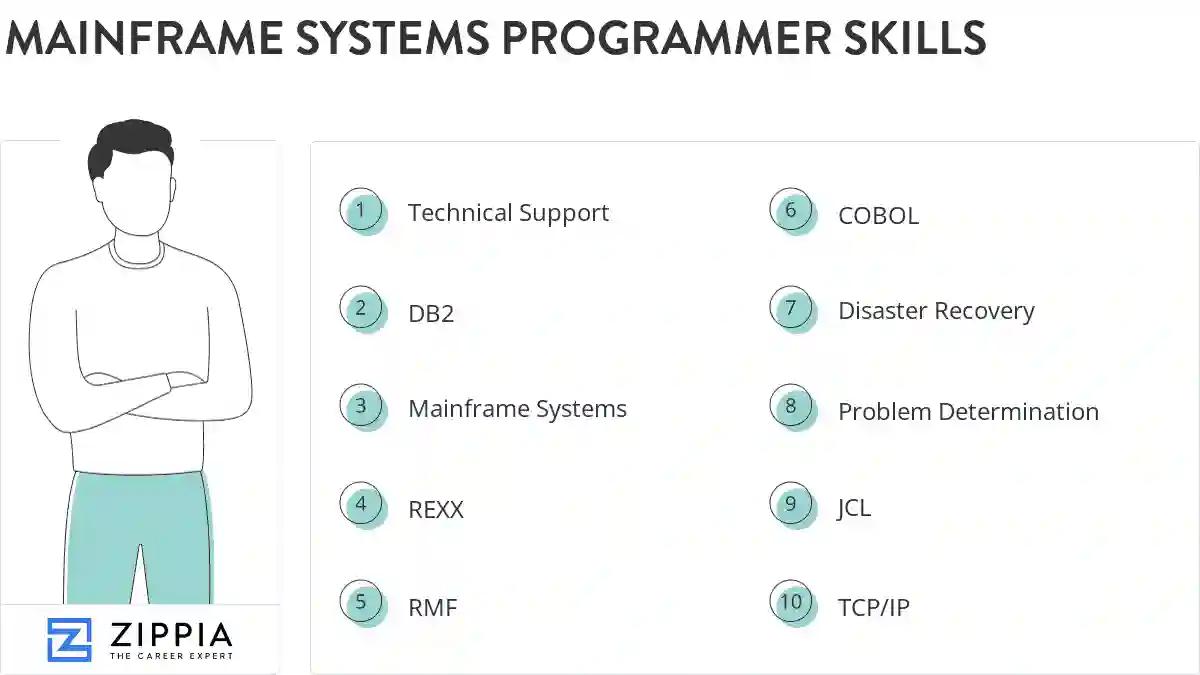
The most important skills for a mainframe systems programmer resume and required skills for a mainframe systems programmer to have include:
- Technical Support
- DB2
- Mainframe Systems
- REXX
- RMF
- COBOL
- Disaster Recovery
- Problem Determination
- JCL
- TCP/IP
- IMS
- FTP
- SAS
- System Software
- SMP/E
- BMC
- SQL
- RACF
- VM
- Unix
- JES2
- IBM Mainframe
- Problem Resolution
- Debugging
- Linux
- HCD
- Omegamon
- Capacity Planning
- Z/OS System
- ISV
- Mainframe Operating Systems
- CA-1
- Dasd
- TSO
- ISPF
- IPL
- OSA
- SMF
- Vendor Products
- MQ
- Software Upgrades
- Procs
- File-Aid
- Program Products
Updated January 8, 2025
