Explore jobs
Find specific jobs
Explore careers
Explore professions
Best companies
Explore companies
Job outlook for managers finance planning and analysis in the United States
Manager finance planning and analysis job growth summary. After extensive research, interviews, and analysis, Zippia's data science team found that:
The projected manager finance planning and analysis job growth rate is 17% from 2018-2028.
About 123,100 new jobs for managers finance planning and analysis are projected over the next decade.
Manager finance planning and analysis salaries have increased 10% for managers finance planning and analysis in the last 5 years.
There are over 152,144 managers finance planning and analysis currently employed in the United States.
There are 111,706 active manager finance planning and analysis job openings in the US.
The average manager finance planning and analysis salary is $106,888.
Are manager finance planning and analysis jobs in demand?
Manager finance planning and analysis job and salary trends over time
Manager finance planning and analysis jobs over time
Manager finance planning and analysis job growth rate over time
| Year | # of jobs | % of population |
|---|---|---|
| 2021 | 152,144 | 0.05% |
| 2020 | 134,362 | 0.04% |
| 2019 | 178,717 | 0.05% |
| 2018 | 143,937 | 0.04% |
| 2017 | 136,209 | 0.04% |
Average manager finance planning and analysis salary over time
Manager finance planning and analysis salary by year
| Year | Avg. salary | Hourly rate | % Change |
|---|---|---|---|
| 2026 | $106,888 | $51.39 | +3.3% |
| 2025 | $103,471 | $49.75 | +1.5% |
| 2024 | $101,957 | $49.02 | +2.3% |
| 2023 | $99,639 | $47.90 | +2.7% |
| 2022 | $96,987 | $46.63 | +3.2% |
Manager finance planning and analysis jobs by state
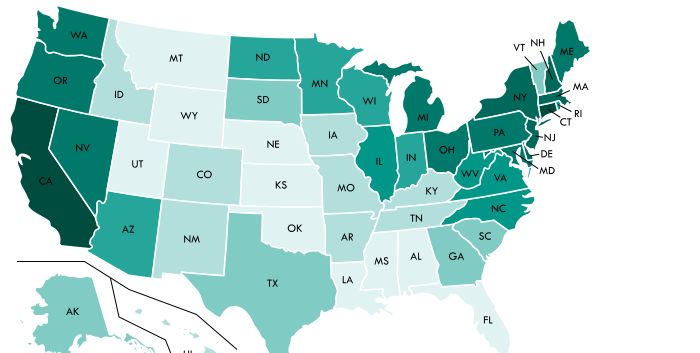
Most common states for managers finance planning and analysis
| Rank | State | Population | # of jobs | Employment/ 1000ppl |
|---|---|---|---|---|
| 1 | District of Columbia | 693,972 | 406 | 59% |
| 2 | Delaware | 961,939 | 245 | 25% |
| 3 | Massachusetts | 6,859,819 | 1,665 | 24% |
| 4 | Utah | 3,101,833 | 675 | 22% |
| 5 | Virginia | 8,470,020 | 1,737 | 21% |
| 6 | Washington | 7,405,743 | 1,484 | 20% |
| 7 | Minnesota | 5,576,606 | 1,109 | 20% |
| 8 | North Dakota | 755,393 | 149 | 20% |
| 9 | Wyoming | 579,315 | 113 | 20% |
| 10 | Colorado | 5,607,154 | 1,062 | 19% |
| 11 | Connecticut | 3,588,184 | 665 | 19% |
| 12 | Illinois | 12,802,023 | 2,308 | 18% |
| 13 | Maryland | 6,052,177 | 1,081 | 18% |
| 14 | Rhode Island | 1,059,639 | 195 | 18% |
| 15 | Vermont | 623,657 | 114 | 18% |
| 16 | New Hampshire | 1,342,795 | 224 | 17% |
| 17 | Wisconsin | 5,795,483 | 922 | 16% |
| 18 | Alaska | 739,795 | 118 | 16% |
| 19 | California | 39,536,653 | 5,934 | 15% |
| 20 | New York | 19,849,399 | 2,970 | 15% |
Most common cities for managers finance planning and analysis
| Rank | City | # of jobs | Employment/ 1000ppl | Avg. salary |
|---|---|---|---|---|
| 1 | Hartford | 5 | 4% | $122,150 |
| 2 | Cambridge | 4 | 4% | $113,387 |
| 3 | Little Rock | 5 | 3% | $88,148 |
| 4 | Atlanta | 9 | 2% | $90,371 |
| 5 | Des Moines | 4 | 2% | $85,183 |
| 6 | Boston | 7 | 1% | $113,434 |
| 7 | Denver | 7 | 1% | $85,570 |
| 8 | Indianapolis | 7 | 1% | $95,659 |
| 9 | Baltimore | 6 | 1% | $108,067 |
| 10 | Sacramento | 6 | 1% | $128,666 |
| 11 | Detroit | 5 | 1% | $106,007 |
| 12 | Jacksonville | 5 | 1% | $81,890 |
| 13 | San Francisco | 5 | 1% | $130,858 |
| 14 | Washington | 5 | 1% | $91,251 |
| 15 | New Orleans | 4 | 1% | $83,264 |
| 16 | Chicago | 8 | 0% | $102,112 |
| 17 | Los Angeles | 7 | 0% | $113,585 |
| 18 | Phoenix | 7 | 0% | $99,083 |
| 19 | San Diego | 6 | 0% | $109,195 |
Manager Finance Planning And Analysis job outlook: Expert opinions
Our panel of manager finance planning and analysis experts
Manhattan College
Fairfield University
Lynn University
University of Oregon
Stonehill College
King's College
American University
Cedar Falls
Southwestern College
Lawrence Technological University
Pacific Lutheran University
University of Nevada - Las Vegas

DePaul University
South College

Red Rocks Community College
Keith Kerr Prof.
What Manager Finance Planning And Analysis skills would you recommend for someone trying to advance their career?
Keith Kerr Prof.: There are two basic ways that most people in the US find financial success: Either find a job that pays a high salary, or find a career that you love, regardless of the salary, and make a habit of saving and investing part of your income each month starting with your first paycheck.
If you invest only $90 a month starting at 21 and ending at retirement, you would have a bit over 1 million dollars (assuming a 10% annual gain). Wait just 5 years and start doing this at 26 and your 5 years of time will have cost you $400,000 by retirement. This is the power of compounding. Start early and even with a lower salary, you still can find financial success while pursuing careers that are meaningful to you.
What general advice would you give to a Manager Finance Planning And Analysis?
Dr. Natalia Boliari PhD: First, learn everything about the company you just started working for - its historical path, management, the way it's dealt with crises, etc. Second, learn everything about the specific industry the company belongs to and see how the company has developed relative to the development of the industry domestically and internationally. Third, always be extremely alert to notice new opportunities and be prepared to take calculated risks. That is, actively look for opportunities to complete as many and diverse tasks as possible, and volunteer to complete any type of work regardless of whether it seems relevant to your assigned job or not. Opportunities to learn, grow, and improve and thus to maximize your income, will only come up if you are exposed to diverse situations.
What Manager Finance Planning And Analysis skills would you recommend for someone trying to advance their career?
Dr. Natalia Boliari PhD: Be open minded. Finance is the broad definition of an industry which provides opportunities for careers in financial consultancy, financial analysis, stock brokerage, foreign investment, modeling, exchange rate forecasts, and many more. While most of those careers are attributed to the banking industry, you can find those and others in other sectors of the economy, such as insurance, technology, health care/medical, government, and so on. So, be open and look beyond the banking sector, examine the current and predicted trends in the economy to hunt for exciting career options.
What general advice would you give to a Manager Finance Planning And Analysis?
John McDermott Ph.D.: To maximize your salary potential, keep learning, investing in your human capital, and expanding your capabilities. Learn as much as you can about your new position and industry, work with a variety of people at your firm, and seek opportunities outside your comfort zone. Your salary potential will increase as you are recognized as a capable and hard working colleague.
What will help Managers Finance Planning And Analysis increase their earning potential?
David Spohn DBA, MBA, MJUR, CWM®: Likes:
- Intellectual Stimulation: Many finance analysts enjoy the challenge of solving complex financial puzzles and deriving insights from data. The role often requires staying updated with the latest economic trends and financial theories, providing continuous learning opportunities.
- Impact on Decision-making: Analysts often take pride in the fact that their work directly influences strategic business decisions. This can be highly rewarding, especially when their recommendations lead to successful outcomes.
- Career Opportunities: The field offers numerous pathways for career advancement. Analysts can ascend to roles in senior management, specialize in particular sectors such as fintech or healthcare, or move into investment roles.
Dislikes:
- High Pressure: The role can be highly stressful, with tight deadlines and significant implications tied to their analyses and recommendations. Financial markets are dynamic, and the pressure to provide accurate, timely insights can be intense.
- Monotony in Initial Stages: New entrants might find the work initially repetitive as they learn the ropes of data collection and basic analysis techniques. The intellectual rewards and more engaging tasks often come with increased responsibility.
- Work-Life Balance: Depending on the employer and the state of the market, long hours can be common, especially during financial reporting periods or significant market changes, which can impact work-life balance.
What will help Managers Finance Planning And Analysis increase their earning potential?
Clemens Kownatzki PhD, MBA: As a beginner in any field, it pays to listen more than to talk. Be humble, pay attention, be nice to folks and probably most helpful is having a mentor who can guide you along and show you some best practices for navigating your career. You should take advantage of your education, not just to show a piece of paper that says you graduated but think of every single project, essay or paper that you write as part of a portfolio that demonstrates your skill sets. Especially in finance where we can sometimes be enamored with the beauty of a mathematical model, think about how any model should be applied in the real world. In some cases that might mean that you have to “get your hands on the wheel and learn how to drive.” I am not suggesting that you should put all your savings at risk and buy the next iteration of the latest cryptocurrency, but If you’re interested in a career in investing, put a small amount of money at risk and trade a stock, or if you must trade a few dollars’ worth of Bitcoin or Ether – as much as you would risk for a movie ticket seems reasonable. There are lots of virtual trading apps where you can trade with paper money, but there’s nothing like understanding risk when your own dollars are at stake, even if it’s just a few dollars. You should also absorb all the workshops, seminars and resources available out there. Follow Prof. Aswath Damodaran who has a YouTube Channel and hundreds of spreadsheets with financial models, all for free! Also follow some good content providers on various channels to get additional insights – in the field of finance, you need to be up-to-date on all events because those influence markets and the economy. Be ready to continue learning and update your skills and understanding while you’re working. Education doesn’t end after you finish your degree. All successful people are life-long learners.
Z. Jay Wang
Department Head, Associate Professor of FinanceUniversity of Oregon
Finance And Financial Management Services
What will help Managers Finance Planning And Analysis increase their earning potential?
Z. Jay Wang: Students who have a history of doing work in the field outside the classroom either through internships, industry projects, or school-sponsored clubs managing financial decisions are better poised to maximize starting salary potential. Starting early to secure internships with top companies will also position students well for higher earning potential. Most top banks and firms will post internships from April/May to August, and close by the end of September for the following summer. They are also rolling, so may fill the roles by as early as June of the sophomore year for the following summer after junior year. Finally, networking with industry and alumni professionals in the companies, firms, banks prior to applying for an internship or full-time position will have an impact. The candidate will learn more about the opportunity and company culture for their resume and potential interview, and most top companies in finance will have a referral program. If the candidate impresses the internal connection with excellent questions and strategic answers, they may get a referral that moves them up in the stacks of applicants.
What general advice would you give to a Manager Finance Planning And Analysis?
Dr. Wayne Durr: Maximizing your salary potential starts with understanding your value. What skills and
capabilities can you articulate to a prospective employer? The ability to articulate these skills
and what you bring to that company can be challenging. Think of your resume like an artist
thinks of their portfolio. What projects or analysis have you worked on? You cannot articulate
the value you will bring to that prospective company without the ability to articulate your skills
and capabilities. Do your research to determine what other employers pay people with the
same abilities. Ask employers what the salary range is and use that as your baseline. As you
get close to graduating, your classmates talk about the job offers they receive and most likely
share the salaries they are being offered. Listen and use this as a baseline. All this gives you
an idea of your value. Your first job isn't always the place where you'll be able to maximize your
earning potential. Think of your first job as where you will get the work experience to maximize
your future earning potential. Look at this as the place where you will sharpen your skills and
develop new ones. This first job will be where you fill out your resume and either have an
opportunity to maximize your earning potential there or elsewhere in the future.
Additionally, think about passive income and the "side gig". If you don't feel like you're
maximizing your earning potential at that first job, think about how you can make money on the
side. I believe we now live in a society where truly maximizing your earning potential comes
from more than your current employer. The ability to earn money from a side gig is more
prevalent than ever before. I think every student should take an entrepreneur class. Think
about your skills, which one could make you some side money. Don't dismiss jobs you did
growing up, like delivery service, landscaping, etc. There are so many apps and websites that
people and companies are looking for anything from an hour to a couple of days worth of work.
Take that first six months on the job to get settled in, and then start thinking about that side gig.
What Manager Finance Planning And Analysis skills would you recommend for someone trying to advance their career?
Dr. Wayne Durr: My advice to a graduate beginning their career in Finance is don't stop learning. You've spent
the last four plus years grinding through the required academics to graduate, but how much did
you learn? Most students spend most of their time "memorizing" the content necessary to pass
their exams, but memorizing isn't learning. Employers aren't as patient as in years past and
want new graduates to jump in and be productive. Employers aren't spending money and
resources on long training periods for new graduates. This doesn't mean you must return to
college or spend money on additional courses. Once you've landed that job that begins your
career in the world of Finance, find ways to increase your knowledge of the tasks assigned to
you by that employer-great sites like Coursera, Udemy, etc. Find current books related to the
topic, use audiobooks, ebooks, podcasts, etc. These can all be ways to update your learning in
a simple and shorter time frame. You might find listening to an audible book or podcast more
enjoyable without memorizing the content to pass an exam. Even contact a former professor for
recommendations. Many of your former professors do the same thing to stay current in their
field.
Peter Ibbott
Associate Professor of EconomicsKing's College
Economics
What general advice would you give to a Manager Finance Planning And Analysis?
Peter Ibbott: Advanced methods in Econometrics and Data Analytics are particularly valuable. In particular, experience with R, SQL, Python, Excel, and STATA are currently in great demand. There is growing evidence that a deep familiarity with AI tools (like ChatGPT) is increasingly important - particularly around using effective prompts to increase research productivity.
Octavian Ionici PhD
Sr. Lecturer in FinanceAmerican University
Finance And Financial Management Services
What Manager Finance Planning And Analysis skills would you recommend for someone trying to advance their career?
Octavian Ionici PhD: The finance profession is lucrative, rewarding and very competitive. Graduates should do their research about the organization they are interviewing with and be able to discuss how their skills can contribute to the business. They should also know if they would rather interact with people and clients or if they are drawn to intellectual pursuits such as analysis. Do they value power, prestige status, risk, or something else? Ultimately our core values, personal goals, interests, aptitudes, and personality will shape our career paths.
Being able to articulate what sparked their interest in the financial field and why they are interested in a chosen role will be an advantage during the hiring process. While still in college, students should join a professional association like the Financial Management Association to give them more access to that broad network, as well as access to career development resources that can set them apart from the crowd.
It's also critical to get an internship (paid or unpaid) in order to show some real-life experience. They can do this while they are still in college, during the summers, or even afterwards, to get a foot in the door.
Reading the WSJ and FT daily, and listening to Bloomberg, or other financial programs as a regular practice will help them to have fluency in the language of our profession. Because the finance sector is heavily regulated and changes occur due to changing economic and political conditions, they will need to stay updated with those changes. Financial media sources will help bring them that context to stay up to date on all of these moving parts.
What will help Managers Finance Planning And Analysis increase their earning potential?
Octavian Ionici PhD: Try to understand what your boss or your company needs, then see if you can fill that gap with your skill set and work ethic. Finance constantly evolves. A career with lifelong learning will help keep you employable. Investing in continuous learning and skill development can increase your income potential down the road.
Plus, don't underestimate the power of a positive attitude and strong work ethic. You may not be an expert at the beginning, but you can take on every challenge given to you, work hard and try to turn it into a success for your organization. Each win will build your reputation and your portfolio of skills which you will then bring with you to your next job. As you do this, you will inevitably acquire specialized skills.
What Manager Finance Planning And Analysis skills would you recommend for someone trying to advance their career?
Noah Alatza: Prior to graduation, gain as much relevant experience as possible through internships. Having multiple internships where you've proven yourself to be successful and hardworking is essential to getting the best offers for full-time roles. In the early years of your career, take note of the qualifications of your next promotion and proactively take steps to ensure that you achieve those qualifications. Finally, make sure to do your research on salary levels for similar positions and don't be afraid to ask for an increase when your work performance and data support that request.
What will help Managers Finance Planning And Analysis increase their earning potential?
Noah Alatza: Effective communication skills and the ability to quickly adjust to changing conditions will become even more important in the next few years. Technology is changing rapidly and financial professionals can enhance their success by learning to utilize those new tools to their advantage.
What general advice would you give to a Manager Finance Planning And Analysis?
Dr. Kimberly Gaither: Finance majors will also be valued for their analytical skills, but more and more soft skills will be valued into the future. Communicating your analysis in a manner consistent with your audience will make you a valued person in the field. Students who were forced to navigate learning along through COVID will need to be able to re-engage in person-to-person professional relationships, even when those meetings are remote. Clear writing is essential today and may not have been stressed in your curriculum. There are many opportunities to continuously upskill, take advantage of those courses.
What will help Managers Finance Planning And Analysis increase their earning potential?
Dr. Kimberly Gaither: Maximize your salary potential by asking questions and learning as quickly as possible. Be a good communicator with those above and below you as well as your peers. Be dependable. Persons who show up early and work hard will be valued and rewarded.
Brett Olsen
Department Head and Professor of FinanceCedar Falls
Finance And Financial Management Services
What general advice would you give to a Manager Finance Planning And Analysis?
Brett Olsen: This question is not as simple as it appears. Companies across different industries have job titles labeled "Finance Analyst," yet the job duties can differ. In other words, this is a very company-specific position. If we take a step back and examine this position from a broader perspective, we could describe the Finance Analyst as one who identifies a problem related to financial cash flows, obtains the data and information to assess the problem, performs quantitative and qualitative analysis, develops a proposed solution to the problem, and communicates the proposed solution to the concerned party. "Financial Cash Flows" could describe internal funds for projects, compensation packages, customer investment funds, taxpayer dollars, etc., that may be historical, current, or future (potential) in nature.
Kevin Alston MBA
Doctoral Candidate DBASouthwestern College
Finance And Financial Management Services
What general advice would you give to a Manager Finance Planning And Analysis?
Kevin Alston MBA: Ensure that you are marketable and are considered a commodity. What that means is the firm that you are interested in joining should consider your skills and knowledge an invaluable commodity. One who stands head and shoulders above the competition.
What Manager Finance Planning And Analysis skills would you recommend for someone trying to advance their career?
Kevin Alston MBA: Crypto Currency and AI. These two are the most impactful variables associated with the Financial Industry.
Matthew Cole Ph.D.
Interim Dean, College of Business and Information TechnologyLawrence Technological University
Architecture And Related Services
What Manager Finance Planning And Analysis skills would you recommend for someone trying to advance their career?
Matthew Cole Ph.D.: Maximizing Salary Potential: Specializing in high-demand areas like tax or forensic accounting, demonstrating strong technology skills, negotiating based on industry salary standards, and pursuing professional development and additional credentials will maximize salary potential.
What general advice would you give to a Manager Finance Planning And Analysis?
Matthew Cole Ph.D.: Important Skills for the Next 3-5 Years: Digital fluency in accounting software and data analytics, strategic financial planning capabilities, in-depth knowledge of regulatory and compliance issues, and expertise in sustainability accounting will become increasingly important.
What will help Managers Finance Planning And Analysis increase their earning potential?
Matthew Cole Ph.D.: Specializing in high-demand areas like tax or forensic accounting, demonstrating strong technology skills, negotiating based on industry salary standards, and pursuing professional development and additional credentials will maximize salary potential.
Fang Lin
Assistant Professor of FinancePacific Lutheran University
Finance And Financial Management Services
What Manager Finance Planning And Analysis skills would you recommend for someone trying to advance their career?
Fang Lin: Don't be afraid to negotiate your starting salary. Young journalists have a lot to offer newsrooms through social media skills and a willingness to adapt to new technologies such as artificial intelligence. Technology skills have value and should not be undersold. Also, young journalism students should not discount the value of their student media and internship experiences. Young journalists must use everything on their resumes to show how they bring value to their position and ask to be compensated fairly for the work they will contribute to the newsroom's success.
Dhruba Banjade
Assistant Professor in Finance & Department Chair of Business AnalysisWhat general advice would you give to a Manager Finance Planning And Analysis?
Dhruba Banjade: i. The industry technology is changing fast. Specific skills will be more critical in the finance field in the next 3-5 years. Some of these are:
ii. Data analysis/ data mining skills. Knowledge of Excel, R, Python, data visualization, Tableau, RapidMiner, machine learning, and financial modeling skills are essential in finance and business.
iii. Skills and knowledge of artificial intelligence and machine learning will give more opportunities and help career development.
iv. Network security and cybersecurity are essential to protect financial transactions and digital data.
v. Knowledge of financial regulations and risk management will be in high demand in the next 3-5 years.
vi. Soft skills such as politeness, ability to work in a diverse group, good communication, learning attitude, etc, are also necessary.
vii. Many industry and business companies today focus on sustainable development and environmental, social, and governance activities. Knowledge of sustainability and ESG measures is also helpful.
viii. Broad knowledge of global financial markets, international finance, global economy, etc., will be valuable in the next 3-5 years.
What Manager Finance Planning And Analysis skills would you recommend for someone trying to advance their career?
Dhruba Banjade: Everyone's career journey is unique and different. As a finance professor, I suggest a few things to graduates beginning their careers.
i. Learning is a continuous process and essential. Even after graduation, learn and enhance new skills. The person must be familiar with the latest industry trends.
ii. Building a good network helps with career development. I suggest attending industry events and connecting with many friends and colleagues on social networks such as LinkedIn.
iii. I further suggest to improve verbal and written communication. It helps in career development.
iv. Understanding basic financial principles is essential. For example, the person must be familiar with economic and income statement analyses, budgeting, profit/loss, and savings.
John Clark Ph.D., CFA, CFP
Chair, Dept. of FinanceUniversity of Nevada - Las Vegas
Geological And Earth Sciences/Geosciences
What general advice would you give to a Manager Finance Planning And Analysis?
John Clark Ph.D., CFA, CFP: Show you have experience. Doing an internship is a great way to increase your starting salary. I always advocate for doing applied research, this is research that you can show has implications for society - science for the sake of science is not good science! Obtaining an MS degree is also a good way to increase your salary, especially if your MS degree is relevant to your future job.
Will there be an enduring impact of the coronavirus pandemic on Managers Finance Planning And Analysis?
Delvin Grant: Yes. I strongly believe coronavirus will have a lasting impact on new graduates. A increasing paradigm shift is taking place as we speak, as some IT-related jobs can be done remotely. I expect the shift to continue until a steady state condition is achieved, when companies feel they have the right mix of remote and face-to-face employment. Some companies may resist the trend, valuing face-to-face over remote working. Face-to-face satisfies a human need to socialize and, in some cultures, much business is done by face-to-face. There is evidence of a paradigm shift as many IT employees work remotely, due to the pandemic. Some companies have realized the shift is here to stay and others take a wait and see attitude. It is hard not to recognize the shift as there are cost saving from office rent, office space, heating, cooling, computing cost, travel costs, etc. The impact will vary by profession. IT and other professions are a natural fit for remote working while others are not. For example, a chemist working in a lab environment cannot work from home as his lab is the only place to mix and experiment with chemicals and chemistry.
What are the biggest trends we'll see in the Manager Finance Planning And Analysis job market given the pandemic?
D. Pace Porter: I believe the need for accounting and financial expertise will even be greater as a result of the pandemic. First, the increased technical accounting and reporting requirements related to risks disclosures, impairment analysis and so forth, and the tax and compliance requirements as a result of the various Coronavirus relief and stimulus legislation, will prompt an increase in demand whether through in-house personnel or through CPA firms. Trends toward more technologically advanced graduates began before the pandemic but will accelerate as a result of it. More importantly, however, is the need for improving economic and operational efficiencies, and therefore cash flow, for businesses to continue as a going concern throughout this pandemic and position themselves for growth once things return to some sort of normal. Accounting and financial expertise has an increasingly important role to play here.
Janet Tarase
Lead Accounting Faculty / Accounting Department ChairRed Rocks Community College
Accounting Department
What are the biggest trends we'll see in the Manager Finance Planning And Analysis job market given the pandemic?
Janet Tarase: Even though over 7 million people are currently unemployed, employers still need individuals to maintain their operations. Human Resource departments are recruiting individuals through social media platforms. My daughter works in HR recruiting and they only use LinkedIn. Companies are using video or phone interviews to select candidates. Which means that potential candidates have to communicate effectively and make a good first impression quickly.
Employers will be looking for individuals that have proven communication, organizational and time management skills that are able to work independently since telecommuting will be continuing in the future. Applicants will also need to have technological and critical thinking skills to manage the challenges presented while working from home. Because of the pandemic and so many of us having to work from home, companies may broaden their recruiting geography to find the best candidates out of state or in different time zones. Finally, employees need to be flexible and resilient - you never know what the next job requirement will demand.