Explore jobs
Find specific jobs
Explore careers
Explore professions
Best companies
Explore companies
Job outlook for managers of clinical services in the United States
Manager of clinical services job growth summary. After extensive research, interviews, and analysis, Zippia's data science team found that:
The projected manager of clinical services job growth rate is 28% from 2018-2028.
About 136,200 new jobs for managers of clinical services are projected over the next decade.
Manager of clinical services salaries have increased 8% for managers of clinical services in the last 5 years.
There are over 47,876 managers of clinical services currently employed in the United States.
There are 155,742 active manager of clinical services job openings in the US.
The average manager of clinical services salary is $74,232.
Are manager of clinical services jobs in demand?
Manager of clinical services job and salary trends over time
Manager of clinical services jobs over time
Manager of clinical services job growth rate over time
| Year | # of jobs | % of population |
|---|---|---|
| 2021 | 47,876 | 0.01% |
| 2020 | 44,124 | 0.01% |
| 2019 | 43,288 | 0.01% |
| 2018 | 40,850 | 0.01% |
| 2017 | 38,034 | 0.01% |
Average manager of clinical services salary over time
Manager of clinical services salary by year
| Year | Avg. salary | Hourly rate | % Change |
|---|---|---|---|
| 2025 | $74,232 | $35.69 | +3.3% |
| 2024 | $71,882 | $34.56 | +1.3% |
| 2023 | $70,993 | $34.13 | +1.4% |
| 2022 | $70,010 | $33.66 | +1.9% |
| 2021 | $68,722 | $33.04 | +2.2% |
Manager of clinical services jobs by state
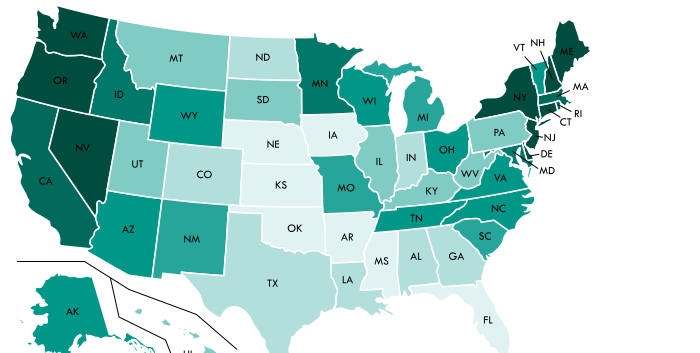
Most common states for managers of clinical services
| Rank | State | Population | # of jobs | Employment/ 1000ppl |
|---|---|---|---|---|
| 1 | District of Columbia | 693,972 | 668 | 96% |
| 2 | Massachusetts | 6,859,819 | 2,530 | 37% |
| 3 | Rhode Island | 1,059,639 | 370 | 35% |
| 4 | Connecticut | 3,588,184 | 1,142 | 32% |
| 5 | Washington | 7,405,743 | 2,331 | 31% |
| 6 | Iowa | 3,145,711 | 984 | 31% |
| 7 | Delaware | 961,939 | 284 | 30% |
| 8 | Minnesota | 5,576,606 | 1,602 | 29% |
| 9 | Oregon | 4,142,776 | 1,182 | 29% |
| 10 | Maine | 1,335,907 | 385 | 29% |
| 11 | Illinois | 12,802,023 | 3,461 | 27% |
| 12 | Utah | 3,101,833 | 823 | 27% |
| 13 | New Hampshire | 1,342,795 | 358 | 27% |
| 14 | Montana | 1,050,493 | 285 | 27% |
| 15 | Alaska | 739,795 | 203 | 27% |
| 16 | Virginia | 8,470,020 | 2,194 | 26% |
| 17 | Colorado | 5,607,154 | 1,468 | 26% |
| 18 | New Jersey | 9,005,644 | 2,248 | 25% |
| 19 | Maryland | 6,052,177 | 1,511 | 25% |
| 20 | Kansas | 2,913,123 | 736 | 25% |
Most common cities for managers of clinical services
| Rank | City | # of jobs | Employment/ 1000ppl | Avg. salary |
|---|---|---|---|---|
| 1 | Atascocita | 2 | 3% | $60,576 |
| 2 | Evansville | 2 | 2% | $55,290 |
| 3 | Sugar Land | 2 | 2% | $60,704 |
| 4 | Denver | 5 | 1% | $61,963 |
| 5 | Pasadena | 2 | 1% | $60,536 |
| 6 | Antioch | 1 | 1% | $91,523 |
| 7 | Atlanta | 2 | 0% | $61,407 |
| 8 | Houston | 2 | 0% | $60,621 |
| 9 | Indianapolis | 2 | 0% | $58,035 |
| 10 | Los Angeles | 2 | 0% | $82,450 |
| 11 | Washington | 2 | 0% | $79,446 |
Manager Of Clinical Services job outlook: Expert opinions
Our panel of manager of clinical services experts
Molloy College
The University of Alabama

Weber State University
Saginaw Valley State University
Idaho State University
Cedar Crest College
The University of Texas at Austin

University of Minnesota

Illinois Wesleyan University
Missouri Baptist University

Eastern Michigan University
Rose Schecter PhD, RN
Associate Dean: Undergraduate Nursing & Nursing Administrative AffairsMolloy College
Registered Nursing, Nursing Administration, Nursing Research And Clinical Nursing
What general advice would you give to a Manager Of Clinical Services?
Rose Schecter PhD, RN: New graduates should be open to the opportunities that present that are sought after AND those that just present themselves. Graduates should welcome offers of interviews in areas of nursing that perhaps were not first choices. New graduates should take part in continuing education courses if available to increase their skill set even before starting their first professional job. For example EKG testing and phlebotomy are skills one can learn prior to first positions. They will enhance the new graduate's resume.
What will help Managers Of Clinical Services increase their earning potential?
Rose Schecter PhD, RN: Salaries for new graduates is fairly consistent across health care systems in a geographic region. Being willing to travel may result in a salary differential as will as working off shift. Increasing salary potential will most likely be a result of further education. Seeking a master's or DNP degree is likely the most important way to maximize salary potential.
Pawn Johnson-Hunter MS, RN, AGPCNP-BC, GERO- BC, CM/DN
Nurse Educator, Nclex Mentor/CoachWhat general advice would you give to a Manager Of Clinical Services?
Pawn Johnson-Hunter MS, RN, AGPCNP-BC, GERO- BC, CM/DN: A few ways to maximize earning potential as a new graduate nurse is through skillful negotiations and previous experience in healthcare, such as degree level, nurse externships, phlebotomy skills, or certifications. Many, if not all, employers appreciate that new graduates are equipped with clinical skills that are strongly recommended for the practice area. While many nurse certifications require experience, some are for entry-level, such as advanced life support (ACLS and PALS) and IV insertion. There are also some specialty practice certifications that new grads can obtain without years of experience; although they may recommend the experience at times, this is optional. All of this demonstrates the applicant's commitment to the profession and interest. Other ways are to work overtime hours, learn about clinical career ladders, or continue formal education.
Dr. Michelle Cheshire
Associate Dean Undergraduate ProgramsThe University of Alabama
Registered Nursing, Nursing Administration, Nursing Research And Clinical Nursing
What will help Managers Of Clinical Services increase their earning potential?
Dr. Michelle Cheshire: As nursing education transitions to competency based education I believe that students will graduate from programs more "practice ready". I believe that in the next 3-5 years having strong leadership and delegation skills will be critical for nurses to optimize patient care outcomes. The healthcare team is interdisciplinary so delegation and leadership for fellow nurses is not the only skill you will need. You will need to be able to lead a healthcare team with members from other disciplines within the healthcare arena.
Dr. Sally Cantwell Ph.D.
Professor and Chair of Annie Taylor Dee School of NursingWeber State University
Annie Taylor Dee School of Nursing
What skills stand out on Manager Of Clinical Services resumes?
Dr. Sally Cantwell Ph.D.: Honestly, a list of task-based skills and experience is always important (including certifications, IV skills, a degree from an accredited institution, etc.), but what stands out are leadership experiences, participation in volunteer work, experience showing strong communication skills, and the ability to work in difficult circumstances and with sometimes challenging individuals. Resilience and active coping skills are a real thing!
Are there any particularly good places in the United States for Managers Of Clinical Services to find work opportunities?
Dr. Sally Cantwell Ph.D.: The workforce is wide open for registered nurse jobs. The nursing profession needs compassionate, educated individuals who have a strong work ethic and the ability to critically think and clinically reason. Flexibility is a must. Take the time to research the nursing program you want to attend to evaluate the quality of your potential alma mater. You will be able to find a job anywhere in the United States if you graduate from a quality nursing program and have the qualities listed above.
What are the biggest trends we'll see in the Manager Of Clinical Services job market given the pandemic?
Dr. Karen Brown-Fackler: Nurses are in even greater demand than they were before. Job security, pay, and variety of positions have never been better.
What skills stand out on Manager Of Clinical Services resumes?
Dr. Karen Brown-Fackler: Skills are not important on resumes for nurse graduates, other than being good employees with outstanding attendance. If they graduated from an accredited nursing program, the program (associate's degree or bachelor's degree) defines their skills. Employers don't have time for reading long resumes. I was a director of nursing for fifteen years at a large hospital. I hate getting long resumes. Stick to the facts. I like to see they have been employed previously and for how long in each position.
What are the biggest trends we'll see in the Manager Of Clinical Services job market given the pandemic?
Susan Belliston Ph.D.: It is my experience that during times of economic instability, jobs that require a foundational education, either a college degree or specialty certification, are more stable. I expect this trend to continue through the pandemic. The majority of jobs in health care require additional education. This fact, combined with the high demand for health care related to the pandemic, should result in a favorable job market for graduating health care providers. Other essential services, such as law enforcement, public safety, energy, water safety, and food production, will continue to be in demand.
Wendy Robb Ph.D.
Dean & Professor, School of Nursing, Hazel and Walter May Nursing Endowed Chair for Excellence in NursingCedar Crest College
School of Nursing
What experience really stands out on Manager Of Clinical Services resumes?
Wendy Robb Ph.D.: The quality that I would be looking for on a resume is balance. Nurses need to protect themselves and their long-term mental health. This happens through self-care. Investment in self is one way to demonstrate self-care. Whether this is through hobbies, extra-curricular interests, volunteering and service, activities outside of nursing are an important indicator of self-care.
What skills stand out on Manager Of Clinical Services resumes?
Dr. Cara Young Ph.D.: More than skills, it is what school/program the student is graduating from and the types of clinical experiences they have had while in school, and the number of hours spent in those clinical settings.
Are there any particularly good places in the United States for Managers Of Clinical Services to find work opportunities?
Dr. Cara Young Ph.D.: Family nurse practitioners are highly qualified primary care providers. States where NPs have full practice authority afford much more opportunities than states (such as Texas) where NP practice is restricted. The WHO designated 2020 as 'the International Year of the Nurse," and they have recently announced extending this into 2021. The WHO Director-General stated, "Nurses and midwives are the backbones of every health system: in 2020, we're calling on all counties to invest in nurses and midwives ". Nurses can always find a job; I think the major issue impacting the public's access to quality primary health care services is the unhelpful NP practice restrictions in many states across the nation.
What experience really stands out on Manager Of Clinical Services resumes?
Karen Monsen Ph.D. RN, FAMIA, FNAP, FAAN: Hands-on experience means more than training, even though the training is essential. Volunteer to create, from the ground up, something that is innovative or practical. Participate in teams that develop or enhance a tech solution. Provide links to your successful projects. Show that you can do what you're trained to do.
Will there be an enduring impact of the coronavirus pandemic on Managers Of Clinical Services?
Karen Monsen Ph.D. RN, FAMIA, FNAP, FAAN: The pandemic has launched all of society into a virtual world, where everyone must rely on information systems in new and important ways. This has already caused exponential growth in information systems and other tech innovations and applications in new fields, especially healthcare, education, and social spaces. These innovations have gone beyond proof-of-concept and have broken old patterns and conceptions of reality. They will endure and will provide a platform for further innovations in the future.
What type of skills will young Managers Of Clinical Services need?
Karen Monsen Ph.D. RN, FAMIA, FNAP, FAAN: The future of information systems will expand into self-learning systems through automated data analytics or artificial intelligence. To get there, we will need young graduates who can program, manage, and analyze data to produce meaningful output for decision-makers. These are different skill sets that rely on having some content expertise -- an awareness of healthcare terminologies and clinical contexts. Teamwork skills are essential because of these diverse perspectives required to create a true data-driven project; success depends on interprofessional collaboration - great listening - willingness to learn and adapt to meet the needs arising in an evolving world.
Will there be an enduring impact of the coronavirus pandemic on Managers Of Clinical Services?
Dr. Brenda S. Lessen Knoll PhD, RN: Yes, of course. However, the enduring impact falls in both the positive and negative categories. The negative impact will certainly be a risk for disillusionment in entering the workforce under these crisis conditions that include understaffing, high patient loads, mandatory overtime, etc. New graduates who may have had their clinical experiences cut short in Spring when COVID first ramped up feel a lack of confidence in their hands-on skills, despite still receiving all the theory and virtual training possible. Agencies hiring the nation's "COVID grads" will need to plan more orientation and skills evaluations when onboarding. And that takes more time, so right now, we are caught in a catch 22 with needing more nurses immediately, yet getting more nurses who may not feel prepared to jump in that fast to this environment.
New grads may be asked to shift to ICU training faster than they planned as well. And the experienced ICU Nurses who will be training them are already pushed to their limits. The challenges are endless. However, on the positive side, this PandemicPandemic is providing a historic opportunity to teach pandemic science, epidemiology, and how to follow constantly evolving data in the science of a novel disease. Nursing Schools use the actual data as clinical case studies and developing learning modules on the impact of coronavirus-19 on each field of study; obstetrics, intensive care, neurology, pediatrics, etc. It has provided us with the best "real world" learning while preparing them to launch their careers in the middle of it. One new graduate shared with me that the newer nurses may have an advantage over the more seasoned staff because new grads entering the field during COVID have never known different. I found this very interesting as we watch old and new nurses showing signs of PTSD, not unlike soldiers in a war who watch those responsible for dying alone in their arms.
What experience really stands out on Manager Of Clinical Services resumes?
Dr. Brenda S. Lessen Knoll PhD, RN:
Our newer graduates already in the workforce who now have direct COVID experience are including that on their resumes. COVID and PandemicPandemic may very well be keywords that recruiters are looking for to inform employers on not only skills with direct patient care experience with COVID pathologies and PPE, but for experience in screening and policy development. These skills represent epidemiological and public health arenas, where nurses are key players.
For new graduates who have not yet entered the workforce, an internship or additional clinical time spent in a critical care setting would be a valuable addition to anyone's toolkit. Experiences that showcase professional agility will also be important, as nurses are now being required to transition to other units to meet the demands of the increased census and care for patients that may fall outside their established expertise.
Ashley Bell MSN, RN, OCN, CNE
Assistant ProfessorMissouri Baptist University
School of Nursing
What type of skills will young Managers Of Clinical Services need?
Ashley Bell MSN, RN, OCN, CNE: In addition to critical thinking and clinical judgment skills, students should have skills sets in resiliency and emotional intelligence.
Will there be an enduring impact of the coronavirus pandemic on Managers Of Clinical Services?
Frank Schaller DNP, APRN, FNP-C: As we recognize the Year of the Nurse, we not only celebrate the nurses on the front line of this crisis but the nursing students who were determined to find ways to continue their education and persevere during the COVID-19 pandemic. Nursing graduates will be more resilient and noble than ever.
What experience really stands out on Manager Of Clinical Services resumes?
Frank Schaller DNP, APRN, FNP-C: A resume should include unique experiences and other leadership/professional development items in order to stand out. It is key to include items that all of the other applicants might not have, such as internships, externships, healthcare-related experience outside of clinical rotations, and membership to and participation in organizations.