Explore jobs
Find specific jobs
Explore careers
Explore professions
Best companies
Explore companies
Job outlook for marketing and research associates in the United States
Are marketing and research associate jobs in demand?
Marketing and research associate job and salary trends over time
Marketing and research associate jobs over time
Marketing and research associate job growth rate over time
| Year | # of jobs | % of population |
|---|---|---|
| 2021 | 2,360 | 0.00% |
| 2020 | 2,239 | 0.00% |
| 2019 | 2,201 | 0.00% |
| 2018 | 2,070 | 0.00% |
| 2017 | 1,935 | 0.00% |
Average marketing and research associate salary over time
Marketing and research associate salary by year
| Year | Avg. salary | Hourly rate | % Change |
|---|---|---|---|
| 2025 | $56,357 | $27.09 | +3.2% |
| 2024 | $54,627 | $26.26 | +1.1% |
| 2023 | $54,054 | $25.99 | --0.2% |
| 2022 | $54,148 | $26.03 | +1.1% |
| 2021 | $53,574 | $25.76 | +0.7% |
Marketing and research associate jobs by state
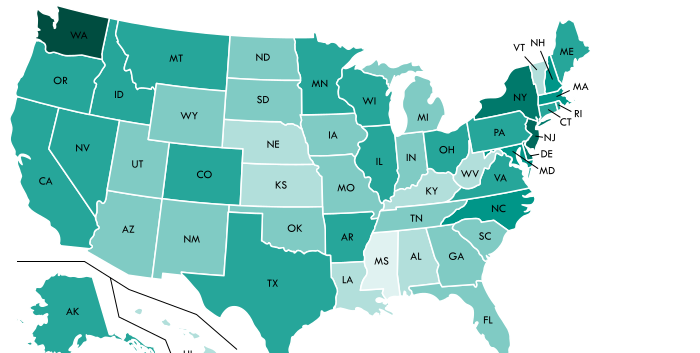
Most common states for marketing and research associates
| Rank | State | Population | # of jobs | Employment/ 1000ppl |
|---|---|---|---|---|
| 1 | District of Columbia | 693,972 | 211 | 30% |
| 2 | New Hampshire | 1,342,795 | 395 | 29% |
| 3 | Vermont | 623,657 | 173 | 28% |
| 4 | Minnesota | 5,576,606 | 1,397 | 25% |
| 5 | Rhode Island | 1,059,639 | 256 | 24% |
| 6 | Delaware | 961,939 | 235 | 24% |
| 7 | South Dakota | 869,666 | 207 | 24% |
| 8 | Wyoming | 579,315 | 141 | 24% |
| 9 | Colorado | 5,607,154 | 1,225 | 22% |
| 10 | Nebraska | 1,920,076 | 430 | 22% |
| 11 | Virginia | 8,470,020 | 1,748 | 21% |
| 12 | North Dakota | 755,393 | 162 | 21% |
| 13 | Oregon | 4,142,776 | 844 | 20% |
| 14 | Maine | 1,335,907 | 272 | 20% |
| 15 | Pennsylvania | 12,805,537 | 2,469 | 19% |
| 16 | Connecticut | 3,588,184 | 697 | 19% |
| 17 | North Carolina | 10,273,419 | 1,790 | 17% |
| 18 | Utah | 3,101,833 | 516 | 17% |
| 19 | Montana | 1,050,493 | 174 | 17% |
| 20 | Georgia | 10,429,379 | 1,705 | 16% |
Marketing And Research Associate job outlook: Expert opinions
Our panel of marketing and research associate experts
Siena College
University of North Georgia

University of Scranton
University of Central Oklahoma

Southern Connecticut State University

University of Hawaii-West Oahu

Georgia College

The University of Texas at Austin
Temple University

Nichols College
Hiniker
Allison Lauenstein
Teaching Instructor of MarketingSiena College
Marketing Department
What skills will help Marketing And Research Associates earn the most?
Allison Lauenstein: Leadership and collaboration will go a long way. The best ideas can come from anywhere, and it's not always about who has the best idea but who can execute the idea the best. Good marketers must understand that if you cannot successfully execute or effectively communicate a great idea, it may not be so great.
What hard/technical skills are most important for Marketing And Research Associates?
Mary Norman: -Project management skills
-Knowledge of key marketing tools and analytics:
-Social media tools like Hootsuite, Google analytics, etc.
-Design tools like Canva, Photoshop, Illustrator
-Email and Survey tools like Mailchimp and Survey Monkey
-SEO Tools like Google Ads
-Digital/Social Media Marketing Skills in the following areas:
-Email marketing
-Search Engine Marketing and Search Engine Optimization (SEM/SEO)
-Email marketing
-Content marketing - ability to create content for social media and additional formats like blogs, etc.
-Social Media marketing through top platforms: i.e., Facebook, Twitter, Instagram, TikTok, LinkedIn, etc.
-Data Analysis - mining insights into customer behavior based on website and social media analytics
-Trendwatching / Consumer insights
Abhijit Roy
Professor of MarketingUniversity of Scranton
School of Management
What soft skills should all Marketing And Research Associates possess?
Abhijit Roy: These are very important, yet harder to quantify skills, not only for marketing professionals but for business graduates in general. They include the ability to make sound decisions under pressure, having a high emotional intelligence quotient (EQ) as embodied by having empathy towards coworkers and subordinates, delegating appropriately, mentoring, communicating, time management, maintaining positivity despite setbacks and adapting to unforeseen challenges, being flexible, being persuasive and assertive at appropriate moments, yet being collaborative, seeking feedback, and the ability to negotiate and resolve conflicts when needed, amongst others.
Soft skills are typically more instrumental in enabling candidates to fit into an organization's culture and be strong candidates for promotion. Most marketing jobs involve candidates representing their brand initiatives and building strong client relationships, so interpersonal, and other soft skills are often valued more than hard skills. The strongest case for having excellent soft skills is that they are more easily transferable across various jobs and industries.
Stacia Wert-Gray Ph.D.
Professor of Marketing, ChairpersonUniversity of Central Oklahoma
Department of Marketing
What soft skills should all Marketing And Research Associates possess?
Stacia Wert-Gray Ph.D.: Communication is important in any job but especially in marketing. These professionals must be able to communicate with customers/clients about product/service benefits and must be able to listen and represent the needs of customers/clients to their own company.
Charles Gamble
Adjunct ProfessorSouthern Connecticut State University
Marketing Department
What skills will help Marketing And Research Associates earn the most?
Charles Gamble: -Lead Generation - Customers are the lifeblood of the business. Having the ability to generate leads will make you a valuable team member.
-Writing - Positioning, value proposition, messaging, and effective written communication are foundational to promoting or selling a product or service
-Data Analysis - Almost everything in marketing can be measured now. Data analytics can help to measure, improve and report on the performance of all marketing activities.
-Scalability - Always look to make a greater impact and operate on a larger scale.
-Leadership - As a marketer, you have the opportunity to work with almost every department in the business. Look how you can empower your team, as well as other departments, to be successful.
What type of skills will young Marketing And Research Associates need?
Reed Young Ph.D.: Graduates need writing, analytical, technological, along with research methods and critical thinking skills. These are basic skills required to be competitive in the workforce. To be able to identify an opportunity with a technology solution is important in any managerial situation in today's workforce. Graduates need to be thinking how can we make this better in the future while applying the theory of constant impovement or CI is essential for success. Researching what others have found and apply those solutions is important.
What skills stand out on Marketing And Research Associate resumes?
Lauren Easom M.Ed, GCDF: Two skills that employers are always looking for on a resume is an individual's ability to problem solve and work well in a team.
What general advice would you give to a Marketing And Research Associate?
Andrew Gershoff Ph.D.: First, graduates may find that they need to do more leg work to find jobs in this environment. Schools with career services often have long-term relationships with the same businesses, who tend to hire multiple students in any given year. If one sector falls apart, there may be fewer jobs available at the career center. But students should take advantage of any services that help them understand the jobs in the marketplace, develop their resumes, and practice interviewing.
Second, students should try to think more broadly about following their interests and still finding employment. So taking some time to learn about career paths that they hadn't considered is worth doing. Many jobs rely on similar skills and may offer similar fulfillment and happiness.
Third, students should be ready to explore possibilities at companies they may not have heard of. Now, is an excellent time to look at companies that may only have a few jobs to offer, but may be doing some of the most exciting things a student can be part of. Finding a good fit is essential to happiness in a career, which may not be at a "name brand" firm.
Finally, students should keep in mind that their journey is their own. It is easy to discourage if you are having a difficult time, and your peers find success. But it can be freeing to focus on developing new knowledge and skills that interest you. Your success will come, and it doesn't have to be defined by someone else.
What type of skills will young Marketing And Research Associates need?
Sheri Lambert: Marketers and businesses need to keep their finger on the pulse of what their customers are looking for. Market research and customer insights are a critical way to help with that. To ensure that students have the skills they need to thrive in an environment that updates faster than a Twitter feed, new market hires need to provide the insights and stories behind the data with a curriculum that combines marketing management, research, and strategy with data business analytics.
Graduates coming out of higher-ed institutions need to display that they have been exposed to peer-to-peer learning through case studies, class activities, and real-world problems through experiential learning. In today's fast-paced, agile world of marketing, science and technology are the names of the game. Therefore, graduates must have a strong knowledge base at the intersection of science, and art and data, and creativity. Companies want new hires that are looking at marketing through a scientific lens. Companies are looking for candidates that can handle the job market's unique responsibilities and display agile leadership qualities.
Jean Beaupré
Associate Professor of Communication and Marketing, Communication B.A. Program ChairNichols College
Department of Communication
What type of skills will young Marketing And Research Associates need?
Jean Beaupré: If the events of 2020 have taught us anything, it is the importance of resilience and flexibility. New graduates will need to remain alert, curious, and ready for inevitable change. Communication skills like active listening, teamwork, and writing will never go out of style and are consistently valued by organizations of all sizes and industries. In light of increasing globalization and emphasis on gender and racial diversity, successful professionals will have high cultural intelligence (CQ), contributing to strong negotiation and interpersonal skills.
Business communication graduates will need to possess comfort with technology, including the ability to self-teach the new and proprietary applications they will indeed be expected to use. Finally, they should be prepared to support why communication initiatives are vital to business outcomes strategically. Effective communication practices have been connected to organizational innovation, efficiency, and profitability; communication professionals should have the capability to make that case using data and evidence.
What general advice would you give to a Marketing And Research Associate?
Ella Andreasen: Marketing is a dream job for me, and I'm thrilled with my decision. I recommend tailoring your classes to what you view you may need, not just taking standard, required courses. For example, I was not required to take Graphic Design, but I thought it would help me be more well-rounded, and it has helped me quite a bit. I'd also recommend trying out different internships, with companies of various sizes, to gauge if you enjoy being a big part of a little company or a small part of a big company.