
Automatically apply for jobs with Zippia
Upload your resume to get started.
Material logistics specialist skills for your resume and career
15 material logistics specialist skills for your resume and career
1. Purchase Orders
- Scheduled and released work orders into the shop along with creating Purchase Orders and prioritized by critical date.
- Issued and managed purchase orders; tracking delivery to schedule, expediting, resolving issues, i.e.
2. Inventory Control
- Managed production inventories utilizing inventory control measures to enhance record accuracy and determine root cause of discrepancies for continual improvement program.
- Analyzed inventory data to generate accurate work orders for parts and produced inventory control reports.
3. Material Logistics
- Managed flow of parts through Machine and Fabrication shops by communicating with other Material Logistics Agents and elevating priorities as needed.
4. MRP
MRP is an abbreviation of Material Requirements Planning and refers to the control system which is implemented in the planning and management of the activities related to manufacturing. Through MRP, manufacturers can easily schedule the production and it can also be used for inventory. MRP systems are mostly software-based but the process can also be carried out manually.
- Determined parts MRP, developed min/max model and set proper inventory levels for each item based on A-B-C valuations.
- Maintain Material Resource Plan (MRP) variations according to usage, production, part numbers and new/discontinued parts.
5. Expedite
- Monitored and communicated component shortages to expedite and secure supplier fulfillment of demand and update Operations on shortage status.
- Direct touch contact with vendors to ensure customer satisfaction and expedite repaired material being shipped when necessary.
6. Production Schedules
The project plan of a film or a documentary that highlights how a production budget will be spent over a given period until its completion is called a production schedule. The scheduling process starts with writing and analyzing the script, which is then broken down to determine and allocate the budget for each scene. The production schedule also includes several elements of the film including; cast actors, special effects, wardrobe, special equipment, stunts, extras, silent bits, production equipment, and many others.
- Participate in the planning and coordination of new product introductions; assess the impact and support changes to overall production schedules.
- Procured components for the manufacturing of body coils used for MRI scanning by interpretation of weekly and monthly production schedules.
Choose from 10+ customizable material logistics specialist resume templates
Build a professional material logistics specialist resume in minutes. Our AI resume writing assistant will guide you through every step of the process, and you can choose from 10+ resume templates to create your material logistics specialist resume.7. Part Numbers
Part Numbers are special sets and strings of numbers used to identify and label parts. There is no one specific kind or set of parts for which this is used and the term can be found in various industries and used for various parts. Most often, a part number is only used to refer to one part and product within one company or organization. Part numbers, also, tend to inadvertently describe the item's purposes and physical features, too, through an organized code of sorts.
- Fox receiving involved receiving product from outside sources verifying part numbers and transporting to specific warehouse locations.
- Verify internal part numbers match specifications on customer bill of materials.
8. Hazardous Materials
Any substance or good that is harmful to human health as well as the environment are called hazardous materials. Such materials must be handled carefully to avoid any mishaps. Harmful gases. chemicals, strong medicines or drugs, radioactive elements required for radiation purposes, a human blood sample that carries germs, all of these are considered hazardous materials.
- Responded to hazardous materials spills such as oil, corrosive and reactive liquids; implemented clean-up plan.
- Ship hazardous/non-hazardous materials domestically and internationally.
9. FAA
FAA (Federal Aviation Administration) is an aviation regulatory body in the USA.
- Ensured documentation complied with QAD and FAA policies and regulations; resolved discrepancies.
- Ensured operations were in compliance with FAA as well as military specifications and requirements.
10. Production Cycle
- Anticipated demand and production cycles to ensure maximum production and eliminate downtime.
- Guide the monitoring of very complex materials through the production cycle.
11. Chain Management
- Developed excel load plan for greater supply chain management.
- Supply Chain Management and analysis for 3,000 SKUs with a $12 Million annual spending budget Exceeded Financial Metrics.
12. Physical Inventory
Physical inventory is an inventory method in which store personnel manually count items in a company's inventory. This may involve counting, weighing, and other measurements of volumes and objects, as well as asking third parties to count inventory items entrusted to them. This is done to keep track of the inventory cost of items sold and purchased, damaged, expired, and/or stolen.
- Report and notify all vendors of quarterly physical inventory.
- Maintain and control physical inventory to ensure the correct amount of supplies are kept on hand for the aircraft.
13. Inventory Management
- Managed transfer projects, executing on purchasing and inventory management, sustaining supply chain.
- Organized stockroom for efficient kit pulling and inventory management.
14. Sigma
In Greek alphabets, sigma is the 18th letter that means "to sum up". In statistics, the lower case symbol of sigma is the unit of measurement for standard deviation which is used to assess the variability in a given set of data. While the upper case symbol is for summation notation means to add up all the given numbers in the data set.
- Utilize Honeywell Operating System (Six Sigma) tools to develop production management improvements to support customer satisfaction.
- Ensured accuracy of system data, investigated material issues, and resolved inventory disparities utilizing Six Sigma method.
15. HTS
- Analyze and perform US HTS classification , tenders documents to broker for customs clearance.
5 Material Logistics Specialist resume examples
Build a professional material logistics specialist resume in minutes. Browse through our resume examples to identify the best way to word your resume. Then choose from 5+ resume templates to create your material logistics specialist resume.

What skills help Material Logistics Specialists find jobs?
Tell us what job you are looking for, we’ll show you what skills employers want.
List of material logistics specialist skills to add to your resume
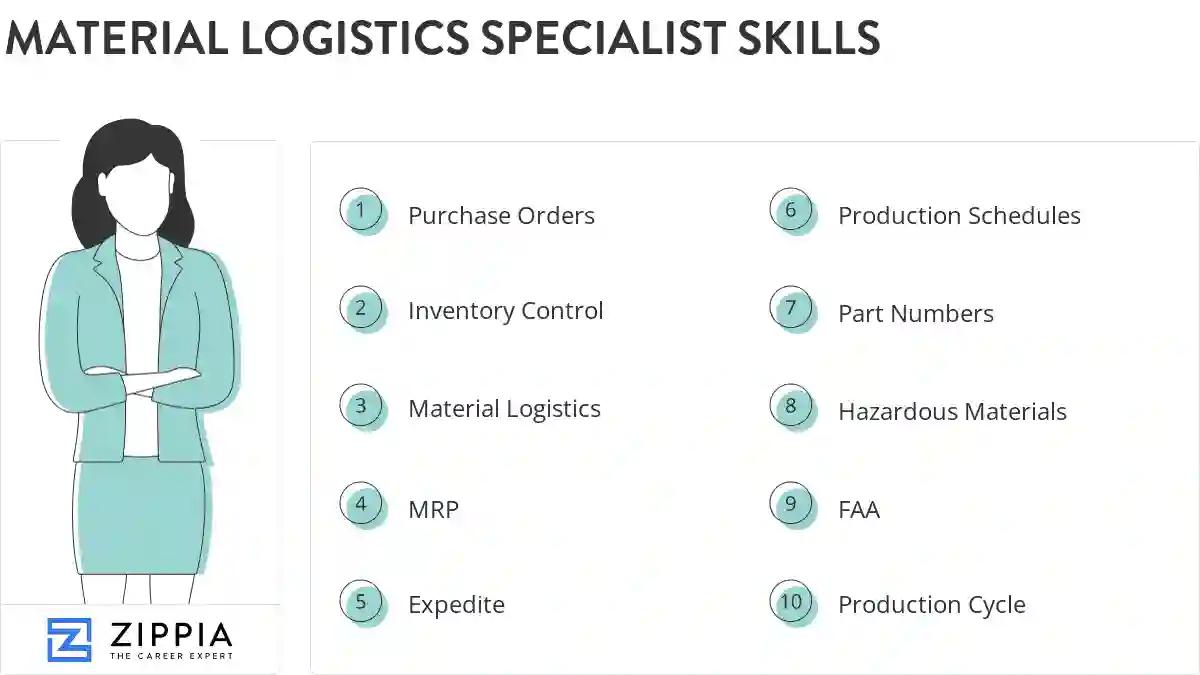
The most important skills for a material logistics specialist resume and required skills for a material logistics specialist to have include:
- Purchase Orders
- Inventory Control
- Material Logistics
- MRP
- Expedite
- Production Schedules
- Part Numbers
- Hazardous Materials
- FAA
- Production Cycle
- Chain Management
- Physical Inventory
- Inventory Management
- Sigma
- HTS
- Forwarders
- ERP
- Customer Demand
- Cycle Counts
- Materials Management
- External Suppliers
- Master Data
- Customer Orders
- On-Time Delivery
- Process Improvement
- Order Management
- Inventory Accuracy
- BOM
- Production Planning
- NPI
- Material Planning
- Production Orders
- Quality Issues
- WIP
- Material Flow
- Production Floor
- ISO
- Cost Savings
- Inventory Planning
- Master Production
- Delivery Reliability
- DOT
- RF
- KPI
- Inventory Audits
- Engineering Changes
- FDA
- RMA
- GMP
Updated January 8, 2025
