Explore jobs
Find specific jobs
Explore careers
Explore professions
Best companies
Explore companies
Job outlook for mathematics faculty members in the United States
Are mathematics faculty member jobs in demand?
Mathematics faculty member job and salary trends over time
Mathematics faculty member jobs over time
Mathematics faculty member job growth rate over time
| Year | # of jobs | % of population |
|---|---|---|
| 2021 | 752 | 0.00% |
| 2020 | 844 | 0.00% |
| 2019 | 871 | 0.00% |
| 2018 | 873 | 0.00% |
| 2017 | 867 | 0.00% |
Average mathematics faculty member salary over time
Mathematics faculty member salary by year
| Year | Avg. salary | Hourly rate | % Change |
|---|---|---|---|
| 2026 | $59,878 | $28.79 | --0.1% |
| 2025 | $59,911 | $28.80 | +0.6% |
| 2024 | $59,537 | $28.62 | +3.3% |
| 2023 | $57,650 | $27.72 | +2.0% |
| 2022 | $56,520 | $27.17 | +3.5% |
Mathematics faculty member jobs by state
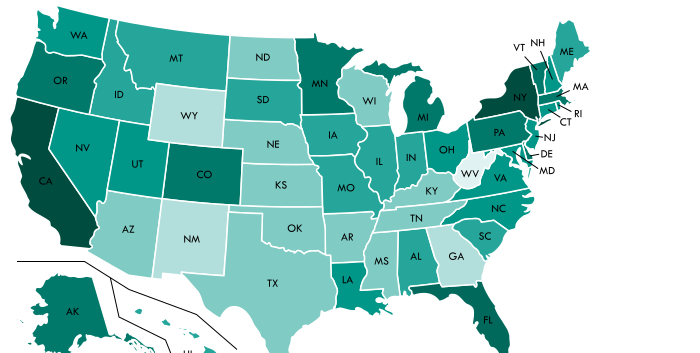
Most common states for mathematics faculty members
| Rank | State | Population | # of jobs | Employment/ 1000ppl |
|---|---|---|---|---|
| 1 | District of Columbia | 693,972 | 245 | 35% |
| 2 | Alaska | 739,795 | 165 | 22% |
| 3 | Oregon | 4,142,776 | 702 | 17% |
| 4 | Montana | 1,050,493 | 180 | 17% |
| 5 | Vermont | 623,657 | 100 | 16% |
| 6 | Delaware | 961,939 | 145 | 15% |
| 7 | New Hampshire | 1,342,795 | 187 | 14% |
| 8 | North Dakota | 755,393 | 104 | 14% |
| 9 | New York | 19,849,399 | 2,438 | 12% |
| 10 | Washington | 7,405,743 | 923 | 12% |
| 11 | Virginia | 8,470,020 | 833 | 10% |
| 12 | South Dakota | 869,666 | 87 | 10% |
| 13 | Colorado | 5,607,154 | 455 | 8% |
| 14 | Maine | 1,335,907 | 108 | 8% |
| 15 | Indiana | 6,666,818 | 450 | 7% |
| 16 | Iowa | 3,145,711 | 177 | 6% |
| 17 | New Jersey | 9,005,644 | 406 | 5% |
| 18 | Maryland | 6,052,177 | 315 | 5% |
| 19 | South Carolina | 5,024,369 | 259 | 5% |
| 20 | Hawaii | 1,427,538 | 71 | 5% |
Most common cities for mathematics faculty members
| Rank | City | # of jobs | Employment/ 1000ppl | Avg. salary |
|---|---|---|---|---|
| 1 | Washington | 5 | 1% | $69,120 |
| 2 | Amarillo | 1 | 1% | $53,120 |
| 3 | Concord | 1 | 1% | $61,529 |
Mathematics Faculty Member job outlook: Expert opinions
Our panel of mathematics faculty member experts
California State University - Fresno
Lehigh University
Wittenberg University

Slippery Rock University of Pennsylvania
Belmont University
Fairfield University

Brigham Young University - Hawaii
The University of West Florida
Worcester Polytechnic Institute
Aquinas College
Bluffton University

Southeast Missouri State University
California State University - Chico
California State University
Pacific Lutheran University
What general advice would you give to a Mathematics Faculty Member?
Mario Bencomo: Programming is vital in applied mathematics and should be incorporated into courses. Having teaching pedagogy in incorporating programming at varying levels for courses that can be traditionally taught without these skills will be extremely valuable to future mathematics departments.
What Mathematics Faculty Member skills would you recommend for someone trying to advance their career?
Mario Bencomo: Have as many relevant experiences towards tenure (relative to your university's/department's expectations). This includes: teaching and course development, grant writing, research publications, etc. You should be leveraging your graduate/post-doc experiences to give you these opportunities.
Dr. Floyd Beachum
Bennett Professor of Urban School LeadershipLehigh University
Educational Administration And Supervision
What Mathematics Faculty Member skills would you recommend for someone trying to advance their career?
Dr. Floyd Beachum: This advice would be for a recent graduate of a doctoral program who is interested in pursuing
a career as a faculty member at a college or university. Three quick pieces of advice I would give
include: get organized, get focused, and get moving. Get organized in terms of getting all of
their materials together as they embark upon a new position or as they look for a position. They
will need to have easy access to relevant documents, official paperwork, files, and/or work
products. Organization is the key to a better work flow. Get focused in terms of having the right
mindset to be successful as an academic. This requires that the person work diligently to
develop a research agenda in which they will have to publish articles, books, book chapters, and
present their research at academic conferences. Two major conferences in educational
leadership are the annual meeting of the University Council of Educational Administration
(UCEA) and the American Educational Research Association (AERA). Focus also includes
teaching various courses in educational leadership. It will take a considerable amount of time to
plan, read, coordinate, teach the course, and continuously learn while teaching. Focus also
means getting used to serving on various department, college, and/or university committees.
Service work helps evenly distribute work loads to help accomplish the goals of that college or
university. The last step, is get moving. This means that once the preliminary steps are taken,
then the person should be very purposeful as they go about doing all of the things mentioned
here. There is no time to waste because a person in the role of a new faculty member usually
has about three years before their first big review and six years before they must go up for
tenure and promotion. These decision points are high stakes because if they are productive,
then employment continues, if they are not productive, specific improvement advice can be
given and/or employment can be terminated.
What will help Mathematics Faculty Members increase their earning potential?
Dr. Floyd Beachum: In the next three years, professors of educational leadership should look to develop skills in the
areas of technology, problem-solving, and diversity awareness. Technology, including the
proliferation of artificial intelligence (AI) will surely transform the overall career landscape. In
educational leadership, faculty members should develop skillsets that will enhance their
understanding so that the technology can better support their teaching and research
endeavors. The skill of problem-solving is universal. For educational leadership professors, this
skill will better align them with the real-world issues that their students face. Being a better
problem-solver will also help build credibility with their students as well as practicing
administrators who sometimes call on professors for advice or consul. Diversity-awareness is an
important skill because the demographic landscape in the United States will become more
diverse. It is counter-productive to try and ignore, downplay, or refute this fact. School leaders
who recognize and prepare themselves to deal with diverse communities will be much better
off than those who choose not to engage.
Alyssa Hoofnagle Ph.D.
Assistant Professor of MathematicsWittenberg University
Mathematics Department
What skills stand out on Mathematics Faculty Member resumes?
Alyssa Hoofnagle Ph.D.: The skills we look for when reviewing math educator resumes involve both technical and non-technical abilities. The person should have enough technical experience so that s/he can explain mathematical concepts clearly to new learners. That means educators should understand all fields of undergraduate mathematics, including calculus, algebra, analysis, and even some statistics. Another aspect of mathematics is being able to clearly write mathematical proofs, so good technical writing skills are necessary too. Finally, from an educator's perspective, good oral communication skills and a focus on educating students with different learning needs are really important at a teaching-focused university like Wittenberg. Engaging with the students in the material has been shown to be the most effective method of teaching mathematics, so educators should be able to incorporate active learning techniques into their classrooms.
What soft skills should all Mathematics Faculty Members possess?
Alyssa Hoofnagle Ph.D.: Honestly, I think the soft skills necessary for a mathematics educator are similar to any quantitatively focused position. They include exceptional problem-solving and critical thinking skills, but also good written and oral communication skills, as well as the ability to work with others in order to convey conceptual and quantitative information effectively.
What hard/technical skills are most important for Mathematics Faculty Members?
Alyssa Hoofnagle Ph.D.: As I mentioned above, understanding the mathematical concepts and being able to solve technical problems using those concepts is important. However, our world is increasingly utilizing our technology to collect, store, and analyze data. So I believe all technical job applicants will benefit from having a background in statistical/data analysis as well as computer programming. We strongly encourage all of our majors to take as many statistics and computer science courses as they can in order to stay current in our ever-changing, technologically advanced environments.
What skills will help Mathematics Faculty Members earn the most?
Alyssa Hoofnagle Ph.D.: Careers in data science and computer science are in high demand right now due to many industries collecting and analyzing data in new ways, so I think the skills necessary to be successful in those careers will most likely lead to the highest earning potential. Again, technical skills involving mathematics, statistics, and computer programming are essential. However, these careers also involve working in both the technical arena as well as non-technical areas. So, applicants should be able to not only work on solving these technical problems but also be able to explain the process and results to those outside of their field. This means applicants need to develop and refine their communication skills so that they can share the necessary and relevant information with others.
Dr. Jana Asher
Assistant Professor, Director of Statistics EducationSlippery Rock University of Pennsylvania
Department of Mathematics and Statistics
What skills stand out on Mathematics Faculty Member resumes?
Dr. Jana Asher: We are responding first, assuming you mean non-tenure-track Mathematics Instructors, as this is the more common scenario.
Right now, because of the surge in distance education, skills with online teaching -- that is, being able to use an online course management system, being able to create and edit videos, and using zoom and other online conferencing platforms -- are the skills that stand out. Experience using one of the more common online course management systems like Desire2Learn, Blackboard, Canvas, or Moodle will stand out.
Skills in the particular subject matter being taught are also highly desired. While Mathematics Instructors will typically teach remedial and introductory level mathematics and/or statistics (through Calculus), the more upper-level mathematics that the applicant knows and can teach, the better.
Teaching mathematics in the 21st century requires fluency with software packages such as Matlab and Mathematica, so programming skills in these languages are highly desirable.
Finally, teaching skills -- as evidenced by experience or training in curriculum development, student assessment, pedagogy, and student advising -- helps make a candidate stand out.
One note: most Mathematics Instructor positions require a Master's degree, so a Ph.D. will stand out.
If the position is a tenure-track Mathematics Instructor, then all of those skills are still going to help the candidate stand out, but the candidate should also be working towards completing a Ph.D.
What soft skills should all Mathematics Faculty Members possess?
Dr. Jana Asher: Strong written and oral communication skills are essential in a mathematics department, whether at a community college or research university. Organizational and time management skills are also absolutely essential. A Mathematics Instructor can expect to teach 4-5 classes a semester. Keeping up with the demands of preparing lectures, maintaining the online course platform, meeting with students for office hours, and getting grading/feedback to students in a timely manner requires very good organization and time management.
Mathematics Instructors must also be able to adapt and be open to criticism. Most universities have students fill out course evaluations at the end of each semester; Mathematics Instructors need to be able to accept student criticism and use it to continuously improve their instruction.
What hard/technical skills are most important for Mathematics Faculty Members?
Dr. Jana Asher: First and foremost, problem-solving in a mathematics context! It is not enough for a Mathematics Instructor to know the basic material of the class; they must also be able to see new, novel problems and be able to solve them. When a Mathematics Instructor enjoys the problem-solving process and can communicate that enjoyment in the classroom, students also begin to enjoy problem-solving as well.
After that, skills with mathematical software packages and skills with online course management systems are most important.
What skills will help Mathematics Faculty Members earn the most?
Dr. Jana Asher: At public universities, Mathematics Instructors are paid on a set scale, so there aren't particular skills that will help you earn more money, just skills that make it more likely that you will get the job. Promotions are based on experience teaching.
If you are hired as a non-tenure-track mathematics instructor, try to teach as many new and different courses as possible as your progress in your career. Also, try to get involved in the life of the department. Volunteer to be on committees, work with students on research projects or advise a student club. The more you invest time and care into your work as a Mathematics Instructor, the more likely you will be hired back the next year and even encouraged to consider moving into a tenure-track position.
If you are hired as a tenure-track Mathematics Instructor, you will be expected to serve on committees, complete research and publish peer-reviewed papers, become involved in professional societies, and continue to improve and develop your teaching. Maintaining excellence in all these areas will allow you to obtain promotions in the minimum allowed time, which in turn means a higher salary.
Dr. Daniel Biles
Chair and ProfessorBelmont University
Mathematics and Computer Science Department
What skills stand out on Mathematics Faculty Member resumes?
Dr. Daniel Biles: We usually have four or five faculty members at a time at the position of Lecturer. These people teach four courses per semester and do not contribute university service or research, and are hired on a year-to-year basis. They are required to have a master's degree in mathematics or a closely related discipline. A Ph.D. is not a requirement and is not really considered an asset. We especially look for lecturers with teaching experience, preferably at the freshman level, which includes basic courses such as general education math courses, college algebra, precalculus, and statistics. We look for people who have been successful in their previous teaching experiences, as demonstrated by student evaluations and letters of recommendation, and in their interview, they should demonstrate an enthusiasm for teaching mathematics and strong skills in communication.
What soft skills should all Mathematics Faculty Members possess?
Dr. Daniel Biles: I believe there's a good possibility that the world will constantly change over the next few decades in ways that we cannot envision now. As a result, two very important soft skills are 1) adaptability and 2) learning new things independently. To strengthen the skill of adaptability, acquiring a broad background in math, computer science, data science, and statistics, and taking courses in science and business and even courses in the humanities would help. To build up the ability to learn new things independently, a person should read varied types of material, especially technical material and areas they are not familiar with. Other soft skills such as speaking, writing, and congeniality have always been important and will continue to be so.
What hard/technical skills are most important for Mathematics Faculty Members?
Dr. Daniel Biles: Generally, all future mathematics jobs will involve computers in some way. Having skills with current, heavily used software and programming languages, such as SPSS and Python, is big to land that first job. For the future, knowing anything and everything about computers should be helpful: programming, cybersecurity, software engineering, database management, numerical approximation, etc. Data is becoming increasingly important, so statistical, data science, and database skills will be helpful.
What skills will help Mathematics Faculty Members earn the most?
Dr. Daniel Biles: Two of the most lucrative mathematics-related positions are Data Scientist and Actuary. In this day and time, data is constantly being collected in pretty much every area of life. Data scientists skilled at processing and analyzing data are currently in high demand and are paid well. Some universities offer degrees in Data Science, but if one attends a university that does not have such a program, they can prepare for such a career by taking many mathematics, computer science, and statistics courses. Historically, actuaries are paid well, are in high demand, and have good job satisfaction. As more and more math/computer science-savvy graduates go into Data Science, it may be that actuarial students will be more in demand than ever. Again, some universities offer Actuarial Science degrees, but a student trained in mathematics (especially probability) and finance who knows some computer science and statistics should be of interest to companies hiring actuaries.
What are the biggest trends we'll see in the Mathematics Faculty Member job market given the pandemic?
Dr. Janet Struili: I am coming from a point of view that there is no one favorite profession for a math major--our graduates become teachers, data analysts, actuaries, but they also find jobs in various different fields: some of them go into health care as doctors or as physician assistants, some of them work in software companies or information technology. I see a trend on interest on data field--biostatistic and business analytics, but it is hard to know how will specifically develop for our majors.
I am sure that the jobs related to internet security will be a field in expansion, and companies will require more personal, but again it is hard to say whether this is will attract more math majors or majors from other stem disciplines.
What soft skills should all Mathematics Faculty Members possess?
Dr. Janet Struili: All graduates should be able to do team work, as problems are rarely tackled by a single person. Presentation skills are very important, and important is also the ability to communicate science to non-experts.
Will there be an enduring impact of the coronavirus pandemic on Mathematics Faculty Members?
Scott Hyde: No, there won't. Especially in the STEM fields. There will be a demand to learn how to create vaccines by kids inspired by the pandemic. Coding and remote work has increased. I see this as good for the graduates.
What's a day at work look like for a Mathematics Faculty Member?
Scott Hyde: The recent graduates are either attending graduate school or trying to find a job. I don't know of their struggles as of yet. All that we have had that have graduated have either found a job or are attending graduate school. There are some that have also decided to be a full-time caretaker to their children.
What will help Mathematics Faculty Members increase their earning potential?
Scott Hyde: I think coding will be helpful. Combining fields will yield more earning potential more than it has in the past. Statistics and computers together with artificial intelligence have created the field of data science lately.
Dr. Achraf Cohen
Assistant ProfessorThe University of West Florida
Department of Mathematics and Statistics
What are the biggest trends we'll see in the Mathematics Faculty Member job market given the pandemic?
Dr. Achraf Cohen: The changes that we all observed and lived during the pandemic time impacted everything, from individuals to businesses. The biggest trend in the job market, in my opinion, is going to be remote work. It seems like working from home/remotely does not negatively affect productivity after all. As consequence, many employers will possibly expect to hire remote workers in the future. This will result in a more competitive job market since everyone everywhere can apply and get hired, even outside the USA.
What certifications/licenses/courses can have the biggest impact for Mathematics Faculty Members?
Dr. Achraf Cohen: We live in an era of data and science. Candidates need to have the skills (e.g. certifications or courses) to manage, analyze, and visualize data. They also need to understand the science behind the data to discover new knowledge and drive businesses. Looking into the most in-demand jobs in the past few years, Statisticians and Data Scientists are among the best jobs in Business and STEM (science, technology, engineering, and mathematics) disciplines. Candidates should be armed with mathematical reasoning, computer tools, and communication skills.
What's a good job out of college for Mathematics Faculty Members?
Dr. Achraf Cohen: One of the best jobs in the U.S. out of college is being a www.zippia.com. One of the exciting aspects of being a statistician is that they get to practice science with data in a multidisciplinary environment, from deciding what data are needed to reporting results. As John Tukey said, "The best thing of being a statistician is that you get to play in everyone's backyard." That means statistics applies to many domains, like education, marketing, environment, health care, sport, and manufacturing. Thus, candidates will have a broad range of fields to choose from and make a career in it, still, the beauty is that they can also succeed in more than one field. Lastly, Statisticians are among the good-paying jobs out of college.
Will there be an enduring impact of the coronavirus pandemic on Mathematics Faculty Members?
Brigitte Servatius Ph.D.: The enduring impact on graduates (and in fact on all of us) is that they are forced to reflect what is essential for their education.
What type of skills will young Mathematics Faculty Members need?
Brigitte Servatius Ph.D.: Communication and problem solving are essential. The ability to listen, negotiate, plan, and predict. Communication and problem-solving skills of course require the meta-skill of knowledge.
What experience really stands out on Mathematics Faculty Member resumes?
Brigitte Servatius Ph.D.: What really stands out is the IQP and MQP experience. The quality of our projects was by no means compromised by the pandemic. The IQP prepares our students to meet the unexpected, the MQP is the synthesis of knowledge that enables problem solving even in the absence of expected tools.
What are the biggest trends we'll see in the Mathematics Faculty Member job market given the pandemic?
Michael McDaniel Ph.D.: "Given the pandemic" is quite funny. I don't think anybody is going to make any predictions as if there's no pandemic. I am going to write as if you mean, during the pandemic, before the vaccine gets worldwide distribution. So, for the next year or two, the college grads are going to face an employment situation where not many businesses will be hiring. Kids will have to take an entry-level job, lower than they might have hoped in 2019: shipping, any kind of food handling. Biotech will continue to beg for technicians.
If the vaccine does its job, some old poops should retire. That should help a bit.
What Mathematics Faculty Member skills would you recommend for someone trying to advance their career?
Michael McDaniel Ph.D.: I always regard a gap year as a complete and utter waste of time. You can find yourself and discover your inner strengths and resources by taking a job where you push yourself to be useful, make yourself indispensable. If you want to move to Spain and sleep all day, drink all night and discover, whoa, are you kidding me - are these people too? I won't stop you. But just when the vaccine does its thing, and the boomers finish retiring, lots of jobs are going to open up, and Mr. Gap Year has a year blank on the resume. Good luck with that.
I'm a boomer. I'd retire now if it hadn't been for 2008 and this past debacle. Now all us boomers have the following strategy: Do you KNOW you can make it on what you've saved and what you might get from Social Security (until 2034) and from investments? No? Then suck it up and work another year. I want to think we've postponed a demographic job-shift, which should still happen when us poor slobs can finally afford to retire.
What general advice would you give to a Mathematics Faculty Member?
Michael McDaniel Ph.D.: Hustle. It's too late to make up for the four years of small talk you have endured. Don't forget that many employers are not on their phones looking for people. Employers don't want to hire and fire. They want to know what they're getting through physical meetings. A Jimmy Johns delivery person should have an envelope with a resume and cover letter on it so when they do the drop at Switch, they can say, "Hey, I hustle. You hiring?"
Stephen Harnish Ph.D.
Professor and ChairBluffton University
Mathematical and Natural Sciences Department
What are the biggest trends we'll see in the Mathematics Faculty Member job market given the pandemic?
Stephen Harnish Ph.D.: I expect to see continued demand for mathematics teachers at all levels, and especially to replace some early retirements due to COVID-19. Here is one caveat. There seem to be temporary uncertainties of sustained enrollments at medium to large universities cutting back on in-person classes. With smaller class sizes, careful public health guidance, and planning of safe social activities, Bluffton has done reasonably well and has even seen increases in transfers since we successfully met face-to-face throughout the fall. The post-holiday spring before wide-spread vaccinations is yet to unfold on the pandemic front. This will impact state-mandated restrictions and will require each academic institution to discern their best response.
There should be continued demand for data analysts for industry, scientific research, insurance companies, and traditional actuarial work. Many of our graduates in such fields are enjoying more flexibility with virtual work from home, although we all know the down-side of less face-to-face interaction.
Finally, demand continues for computationally-trained mathematicians and scientists to assist HPC (high performance computing) use in the sciences, biotech, and pharma. The pandemic has evoked an "all hands on deck" response, including HPC for COVID-19 research and development of treatments and vaccines.
Will there be an increase or decrease in demand for Mathematics Faculty Members in the next 5 years?
Stephen Harnish Ph.D.: I expect steady demand for mathematics majors, and an increase when coupled with another field of study. For education, there should generally be increased hiring in STEM areas, especially due to COVID-19-induced retirements. I also expect increasing demand for STEM expertise to address the day-to-day needs of business and industry, as well as long-term challenges of sustainable agriculture and energy production. Climate change is forcing on us the urgent need to at least attempt to bring ecosystems towards restoration and communities towards greater resilience with mitigation capability and robust health care delivery. We also need to prepare for more frequent emergencies, whether pandemics or other kinds. Statistical and mathematical modeling skills will play important roles for research, development, and decision making for all of the above.
No matter whether the times are extraordinary or ordinary, a mathematics degree has always been valuable. For example, before coming to Bluffton, I taught at a Franciscan University near Philadelphia in the mid-'90s. During my first meetings with the VP of Academic Affairs, she shared a personal account shedding light on the practical importance of mathematics.
The academic dean introduced herself by saying: "I received a doctorate in psychology, but started with a BA in mathematics." She described applying to her graduate program while wondering if she'd be accepted without taking more psychology classes. When she finally received her letter of response, she anxiously opened it and read, "She's a math major. She can think. She's accepted." Of course, other fields can rightfully claim their own preparation for critical reasoning skills, and yes, time has passed since that conversation. But from my many years working with our mathematics students and graduates, I know her point remains true. The rigor, breadth of skills, and mental agility fostered through a degree in mathematics prepare students well. Augmented with another concentration or minor, they are well-served and in a good position to promote themselves with many different career options.
What technology do you think will become more important and prevalent for Mathematics Faculty Members in the next 3-5 years?
Stephen Harnish Ph.D.: Here are three categories.
Traditional and continuing to emerge: We will still use traditional technologies of hand-written problem-solving in mathematics instruction. But I expect the expanding use of CAS (computer algebra systems) to easily tackle more practical but messy problems to continue within academia. These CAS include Maple, Mathematica, MATLAB, SageMath, and WolframAlpha, among others.
Emerging: I also expect to see more ready access to data-intensive science and the wider recognition of e-science, which Tony Hey from Microsoft Research describes as a new fourth paradigm of science (after experimental, theoretical and computational--see the book of that title). The next 5 years should also move us closer to the predictions of the theoretical physicist and futurist Michio Kaku. He predicts that, like electricity, computing access and power will seem to be both everywhere and nowhere. Electric power is ubiquitous and taken for granted. The wiring in buildings is behind walls and almost invisible, while batteries have become smaller, more long-lasting, and portable. In a similar way, he predicts that through the use of the cloud, quantum computing, and miniaturized/flexible computer chips, our access to computing power will be everywhere, even as the mechanisms of computation are more hidden and appear nowhere. With cloud technologies, ubiquitous cell phones, and nearly exascale HPC computing, we already see hints of these predictions today. I'm eager to find out how well Kaku's projections hold up in the coming decade.
Data analysis and decision making from a liberal arts, values-based perspective; that is Analytics with a sense of responsibility for long-term implications:
We've just gone through another general election, and in the not-too-distant past, we recall controversies surrounding Cambridge Analytica's microtargeting of population groups though questionable methods of obtaining Facebook users' personal data and psychological profiles. We shouldn't teach data analytics unfettered from ethics and concern for unintended consequences. We come to expect business ethics courses. Let's also raise awareness among our 'front-line' technical data experts of the importance of ethics in analytics, data acquisition, and data science. Various groups are doing good work in this area. I'd simply like this to be more commonplace.
Joseph M. Snyder Ph.D.
Assistant Professor of HistorySoutheast Missouri State University
Department of History and Anthropology
What experience really stands out on Mathematics Faculty Member resumes?
Joseph M. Snyder Ph.D.: Students who study history develop the types of critical thinking, analytical, and written and oral communication skills, and are trained to synthesize multiple perspectives with often incomplete or inconsistent evidence and draw informed conclusions from it. Such skills are valued in dozens of professions, from public relations and marketing to financial analysis, political advising, teaching, journalism, and everything in between.
History students -- so, the first thing I like to explain to students is that the skills they are developing as history majors are transferrable across a wide spectrum of professions. Most students-and their parents-have a fairly narrow idea of the types of careers open to history majors. Part of my job is to help students understand that that isn't the case.
Before applying for a job, I always recommend students research their potential employer and then tailor their resume accordingly. For example, if a student is applying to be an entry-level marketing specialist, they should highlight the public-speaking and presentation skills they developed as part of their coursework. Upper-division history courses often require a large capstone project where students develop an argument which they must "sell" to an audience. They accomplish this by marshaling the evidence to convince their audience of their thesis. Arguably, this is the very essence of marketing.
On the other hand, a student who is considering applying to be a research specialist in a museum or library ought to emphasize archive-based research or relevant coursework. Many history programs have courses that touch on archival research; some even offer courses specifically in public history or museology. But lacking these, history coursework always involves students in research-intense projects that help them develop theories and arguments and then guide them through the processes of writing about the outcomes. Such coursework is the building blocks of the work of professional historians, of course, but it is no less important to a research specialist in a museum, a policy analyst in a lobbying firm, or a journalist.
I could go on, but in a nutshell, the research and problem-solving skills required of history majors, honed over years of coursework and practical experience, are always attractive to potential employers. Having worked for over a decade as a business executive in software development and telecommunications with a hand in hiring supervisory and managerial staff, I can attest that I always sought out history majors because I knew they brought these skills with them.
Nevertheless, the trick is to read up on the potential employer, develop an understanding of the company or firm, and then customize your resume to show HR managers, who are inundated with resumes and applications for highly-competitive positions, how your skillsets work toward the employer's goals and aims.
What general advice would you give to a Mathematics Faculty Member?
Kathy Gray: My advice would be to never stop learning. We can't teach you everything there is to know in four years. There are many online courses that you can take to enhance your technical skillset and boost your resume.
What technology do you think will become more important and prevalent for Mathematics Faculty Members in the next 3-5 years?
Kathy Gray: Knowing how to use different computer programming languages will stay vital for years to come. The most popular languages such as SQL, Python, and R will likely continue to dominate the field, but other languages might see increasing use in the future.
How would you rate the starting salaries for Mathematics Faculty Members, as well as the prospects for salary advancement?
Kathy Gray: In an increasingly data-driven world, statisticians are in demand. U.S. News & World Report's annual jobs ranking shows statistics "continues to offer great careers with above-average salaries, broad applications, and low unemployment." There are opportunities in several different fields such as biomedicine, environmental science, social science, human rights, etc. According to the Bureau of Labor Statistics, statistics is one of the fastest-growing fields in the U.S., with a projected growth rate of 31 percent in the next ten years.
What general advice would you give to a Mathematics Faculty Member?
Coskun Cetin: It is essential for graduating students to explore the job market and get some connections/experience before graduation. Unfortunately, internship and hands-on training opportunities have been impacted significantly due to the pandemic, but online training and certification opportunities are still there.
Getting in touch with a faculty member in a particular area of interest (with connections in industry and state/government agencies), working on a research project, and seeking advice on professional opportunities (e.g., online forums/workshops/conferences) would give an advantage in establishing contacts and experience.
Many of our math majors who had actively participated in summer research projects and presented their results in conferences (or published them in academic journals) were either hired by leading tech companies or accepted to top graduate programs in mathematics, statistics, computer science, or related areas.
What technology do you think will become more important and prevalent for Mathematics Faculty Members in the next 3-5 years?
Coskun Cetin: Due to increasing demand in data mining/data science/data analytics areas (even during a pandemic), I believe the technology tools to handle big data, computer simulations, and visual data analytics will continue to be prevalent, including R, Python, Matlab, SQL, and Tableau. Any additional programming skills with digital platforms will be a plus.
How would you rate the starting salaries for Mathematics Faculty Members, as well as the prospects for salary advancement?
Coskun Cetin: It is a great job market that adjusts to the current situation with the pandemic and high unemployment level (or under-employment). It is especially critical in California and Sacramento region since many state jobs, and internship positions are not available this year. The remaining few places would be very competitive.
There are also some industry/academic and private sector positions that are more competitive than ever. I hear some friends/colleagues changed jobs or had to find a new one). Those with strong connections and statistics/computing skills seem to find a new job much faster and better than the other ones, especially in data analytics/quant/actuary positions. I don't have numbers for starting salaries of new posts. Still, some of our graduates (who also had some certification or graduate training) started with three-digit figures in industry positions in data science, cybersecurity, etc.
So, my recommendation would be focusing on learning and improvement (e.g., through research projects, certification, or a graduate degree in data science/statistics/computer science) to prepare for a potentially more friendly market if it is difficult to find a suitable position at the moment. I expect the jobs involving cryptography, data analysis, modeling/simulations, and cybersecurity to continue to pay high salaries.
How do you envision technology impacting Mathematics Faculty Members in the next 5 years?
Tom Edgar: I think that many people have underestimated the importance of data literacy and statistical literacy in the future job market. While "big data" analysts have typically been recruited by insurance companies, large tech companies, security firms, and the government, I think many smaller companies, in a variety of sectors (even small, local nonprofits for instance), will eventually benefit from the skills that mathematics graduates have gained throughout their undergraduate studies. While the major tech hubs and government agencies (Silicon Valley, Seattle, Denver, North Carolina, Northern Maryland and Washington D.C., for example) will continue to offer excellent opportunities to graduates, I think that mathematics majors will have the ability to move to and live in any place they want.
What type of skills will young Mathematics Faculty Members need?
Tom Edgar: Students studying mathematics learn how to break complex problems into smaller ones, solve those smaller problems, and then reassemble the solutions to unlock the larger challenges. Of course, as the world becomes increasingly data dependent, more and more types of companies and organizations will need quantitatively strong graduates: graduates that can work with large data sets, that can help visualize large data sets, and that understand how to apply various areas of mathematics to the data science world. Furthermore, undergraduates in mathematics typically gain computer-programming experience and a strong understanding of algorithmic thinking; a major understanding in how computers work and how to program them will continue to be desirable in the workforce as more and more operations are automated. Furthermore, a deeper understanding of mathematical ideas will be foundational to make technological breakthroughs.