
Automatically apply for jobs with Zippia
Upload your resume to get started.
Medical field representative skills for your resume and career
15 medical field representative skills for your resume and career
1. Patients
- Delivered exceptional service by communicating with patients and family members in a friendly and professional manner.
- Transported critical monitoring patients from field hospitals to definitive care facilities abroad.
2. EMT
Emergency Medical Technicians (EMTs) provide urgent and emergent patients who enter the emergency medical services (EMS) system for out-of-hospital emergency medical treatment and transportation. EMTs are trained to stabilise and evacuate patients in a variety of situations, from non-emergency to regular hospital transports to life-threatening emergencies. Under the supervision of a physician, EMTs work as part of a robust EMS response scheme.
- Performed EMT duties in a Mobile Army Surgical Hospital.
- Trained new EMT's on knowledge of the differing vehicles that utilize the track and their varying needs for medical attention.
3. CPR
Cardiopulmonary resuscitation or CPR is a medical procedure that involves chest compression to help a patient breathe. This artificial ventilation helps in keeping the brain function in place and regulates blood throughout the body. CPR is a lifesaving procedure that is used in emergencies.
- Perform SCIP-R CPR and First aid intervene assist with behavioral issues.
- Recommend and/or initiate patient management in cases of acute distress with medications, laboratory orders and initiation of CPR when necessary.
4. Medical Care
- Documented medical care received, and ensured medical records were properly notated and filed.
- Administered emergency medical care to military personnel in the field.
5. EMS
Emergency Medical Services, also known as EMS, is an emergency medical response system that provides stabilization and urgent preclinical and on-site treatment for serious illness and injury, as well as the transportation of patients who are unable to transport themselves to a definite health care center. The main objective of EMS is to provide emergency medical treatment to those who need urgent medical attention and to properly treat the patient's condition and transport them to a suitable health center or medical facility.
- Served two years as a member of the State EMS planning board.
- Serve the United States Army, live the Army values, protect my country, provide EMS to other soldiers.
6. Life Support
Life support is a machine or equipment often used by the hospital for patients with severe conditions, such as those in the Intensive Care Unit or ICU. It is developed to provide short-term support to help patients have enough time to treat or recover from a severe health concern. It is typically a mechanical ventilation tool for patients who has difficulty in breathing. The life support can last for about a month or so, but if the patient is unconscious, it might be lower.
- Job Description: Assist paramedic and handle all non-advanced life support calls.
- Provide life support services during medical emergencies.
Choose from 10+ customizable medical field representative resume templates
Build a professional medical field representative resume in minutes. Our AI resume writing assistant will guide you through every step of the process, and you can choose from 10+ resume templates to create your medical field representative resume.7. Emergency Treatment
- Assisted treatment center personnel to obtain and record victim's vital statistics, and to administer emergency treatment.
- Provide emergency treatment to injured military personnel in combat training environment.
8. Medical Services
- Acted as a combat operator while providing emergency field medical services to personnel in field units.
- Provided specialized medical support as a Medical Service Journeymen at Shaw AFB supporting military personnel and families worldwide.
9. Medical Facilities
Health facilities are places where healthcare services are provided. For example, clinics, hospitals, care centers, outpatient centers, psychiatric care centers etc. are all health facilites.
- Travel to medical facilities to scan medical records for requestors such as Disability/Social Security Advocates, Attorneys, etc.
10. Emergency Vehicle
- Maintained and operated emergency vehicles and patient care equipment.
- Operate and Maintain emergency vehicle.
11. IV
- Executed paraprofessional interventions, including but not limited to IV infusions and medication administration with supervision.
- Trained anesthesia personnel in use of IV infusion delivery systems during operating procedures.
12. Combat
Combat is a violent conflict between two parties. Combat can be held by using weapons or unarmed. The fighting between the armed forces of different countries can also be called combat and the main purpose of the combat is to eliminate and stop your opponent from achieving their goal.
- Participated in multiple hostile combat scenarios for medical training purposes.
- Treated US soldiers at various stages of medical evacuation from combat areas, enemy prisoners during detainment and the indigenous population.
13. Medical Treatment
- Re-supplied medical treatment areas in remote locations under extremely stressful conditions.
- Completed re-supply of medical treatment areas in remote locations.
14. Clinical Environment
- Treat injuries in field and clinical environments.
15. Medical Procedures
- Assisted in emergency medical procedures.
- Train and evaluate staff in emergency medical procedures.
5 Medical Field Representative resume examples
Build a professional medical field representative resume in minutes. Browse through our resume examples to identify the best way to word your resume. Then choose from 5+ resume templates to create your medical field representative resume.

What skills help Medical Field Representatives find jobs?
Tell us what job you are looking for, we’ll show you what skills employers want.
What hard/technical skills are most important for medical field representatives?
Michelle Boller
Chair, Business Technology, Associate Professor and Program Director, University of Montana
What skills stand out on medical field representative resumes?
Michelle Boller
Chair, Business Technology, Associate Professor and Program Director, University of Montana
What medical field representative skills would you recommend for someone trying to advance their career?
Dr. Felisa Albert
Senior Instructor, Academic Success Coach, Cambridge College
Cultural awareness encourages a person to learn about other cultures, practices, languages, traditions, and beliefs. When people are seeking to learn about other cultures, it creates the space for them to be open to those differences by learning and understanding at the level of both hearts and minds. Having this awareness will increase cultural sensitivity, which is only evident based on actions that are respectful, inclusive, and empowering for all.
Learning how to work with people is not learned by reading a book or passing a test. The only way to strengthen these interpersonal and cross-cultural skills is to practice outside of one's comfort zone and spend purposeful and meaningful time within different cultures. Also, one must be courageous enough to ask him or herself these questions:
-Why do I believe what I believe?
-Where do my biases come from?
-What has influenced my thinking about this thing?
-Why do I react the way I do when this happens?
When cultural awareness and sensitivity are viewed as part of social responsibility - intentional and practiced - it creates the space for intellectual diversity or, in other words, deepened conversations of exploration and learning of oneself. People can then share diverse ideas, thoughts, and perceptions about the ways intellectual diversity has informed, shaped, and changed their worldviews over time.
What type of skills will young medical field representatives need?
Velma Payne Ph.D.
Program Director of Health Informatics, Idaho State University
List of medical field representative skills to add to your resume
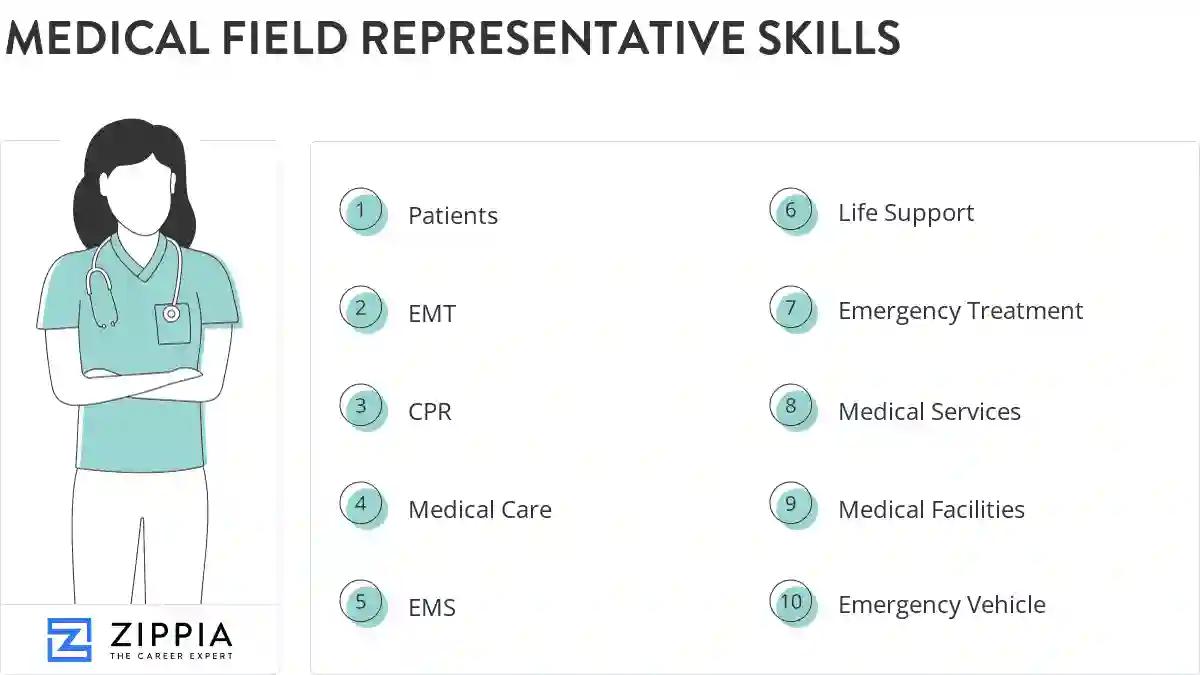
The most important skills for a medical field representative resume and required skills for a medical field representative to have include:
- Patients
- EMT
- CPR
- Medical Care
- EMS
- Life Support
- Emergency Treatment
- Medical Services
- Medical Facilities
- Emergency Vehicle
- IV
- Combat
- Medical Treatment
- Clinical Environment
- Medical Procedures
- Hippa
- Medical Support
- Vital Signs
- Medical Equipment
- Insurance Claims
- EMR
- Blood Pressure
- EKG
- Patient Care
- HIPAA
- Medical Terminology
- Blood Samples
- Patient History
- Medical Professionals
- Blood Draws
- Laboratory Analysis
Updated January 8, 2025
