Explore jobs
Find specific jobs
Explore careers
Explore professions
Best companies
Explore companies
Job outlook for merchandise analysts in the United States
Are merchandise analyst jobs in demand?
Merchandise analyst job and salary trends over time
Merchandise analyst jobs over time
Merchandise analyst job growth rate over time
| Year | # of jobs | % of population |
|---|---|---|
| 2021 | 1,214 | 0.00% |
| 2020 | 1,151 | 0.00% |
| 2019 | 1,132 | 0.00% |
| 2018 | 1,065 | 0.00% |
| 2017 | 995 | 0.00% |
Average merchandise analyst salary over time
Merchandise analyst salary by year
| Year | Avg. salary | Hourly rate | % Change |
|---|---|---|---|
| 2025 | $67,933 | $32.66 | +3.2% |
| 2024 | $65,848 | $31.66 | +1.1% |
| 2023 | $65,157 | $31.33 | --0.2% |
| 2022 | $65,270 | $31.38 | +1.1% |
| 2021 | $64,579 | $31.05 | +0.7% |
Merchandise analyst jobs by state
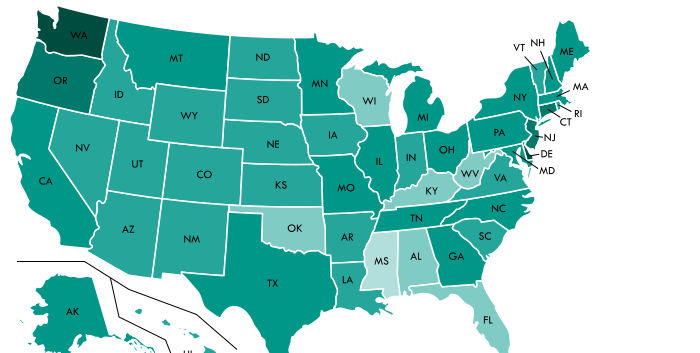
Most common states for merchandise analysts
| Rank | State | Population | # of jobs | Employment/ 1000ppl |
|---|---|---|---|---|
| 1 | District of Columbia | 693,972 | 152 | 22% |
| 2 | Virginia | 8,470,020 | 603 | 7% |
| 3 | Maryland | 6,052,177 | 447 | 7% |
| 4 | New Hampshire | 1,342,795 | 91 | 7% |
| 5 | Massachusetts | 6,859,819 | 428 | 6% |
| 6 | Colorado | 5,607,154 | 313 | 6% |
| 7 | North Dakota | 755,393 | 42 | 6% |
| 8 | Minnesota | 5,576,606 | 264 | 5% |
| 9 | Rhode Island | 1,059,639 | 55 | 5% |
| 10 | Delaware | 961,939 | 47 | 5% |
| 11 | Alaska | 739,795 | 40 | 5% |
| 12 | Vermont | 623,657 | 31 | 5% |
| 13 | New York | 19,849,399 | 843 | 4% |
| 14 | Illinois | 12,802,023 | 559 | 4% |
| 15 | Georgia | 10,429,379 | 395 | 4% |
| 16 | North Carolina | 10,273,419 | 387 | 4% |
| 17 | New Jersey | 9,005,644 | 370 | 4% |
| 18 | Missouri | 6,113,532 | 228 | 4% |
| 19 | Utah | 3,101,833 | 138 | 4% |
| 20 | Montana | 1,050,493 | 42 | 4% |
Most common cities for merchandise analysts
| Rank | City | # of jobs | Employment/ 1000ppl | Avg. salary |
|---|---|---|---|---|
| 1 | Paramus | 1 | 4% | $79,459 |
| 2 | Bowling Green | 1 | 2% | $49,049 |
| 3 | White Plains | 1 | 2% | $73,496 |
| 4 | Atlanta | 3 | 1% | $67,368 |
| 5 | Los Angeles | 2 | 0% | $69,656 |
| 6 | Dallas | 1 | 0% | $68,206 |
| 7 | Houston | 1 | 0% | $67,220 |
| 8 | New York | 1 | 0% | $73,460 |
| 9 | San Diego | 1 | 0% | $66,698 |
Merchandise Analyst job outlook: Expert opinions
Our panel of merchandise analyst experts
University of Nebraska - Omaha
Pepperdine University
Xavier University

Humboldt State University

Florida Gulf Coast University

Menlo College

Benjamin Franklin Institute of Technology
What general advice would you give to a Merchandise Analyst?
John Lyden: Research skills (ability to find and interpret information), oral and written communication skills (ability to present information clearly), data analysis and interpretation, language interpretation and translation. Computer facility will be highly valued. Employers will include those in higher education, government, non-profits, research institutes, and museums.
What will help Merchandise Analysts increase their earning potential?
Anna Penner: Methodological skills are important. Knowing how to construct a good survey or conduct an interview to get rich data is critical. But I think just as important as being able to analyze qualitative or statistical data, is finding ways to communicate results in clear and compelling ways so that stakeholders know what action to take is equally important. Some of the gaps we are seeing between science and the general public today could be ameliorated by someone explaining findings in concise and applicable ways that show why we should care about this information. You could be the bridge from expertise to the general public.
KATHERINE (KATE) Katherine Loveland Ph.D.
Chair & Associate ProfessorXavier University
Marketing
What will help Merchandise Analysts increase their earning potential?
KATHERINE (KATE) Katherine Loveland Ph.D.: I would probably give this advice to any graduate, but it is particularly important in marketing: work on building your personal connections. By this, I don't just mean building your online professional network, although this is important, I mean put in the actual face time. Pick up the phone, walk down the hall, go into the office, schedule the lunch (or coffee or drink), attend the networking event and then follow-up. We are social beings and I hear from managers all the time that the new hires who stand out are those who take the time to build relationships. Also, marketing is fundamentally about building connections between customer needs and organizational offerings. The best way to spot opportunities is to be actively engaged with a broad spectrum of people both within and outside the organization.
What soft skills should all Merchandise Analysts possess?
Dr. Anne Paulet Ph.D.: In terms of soft skills, those probably won't change much, they will simply be practiced differently. Being flexible is important since jobs may switch between home and office and since one may be dealing with someone else working from home and the challenges that can present-what cat owner hasn't had their cat walk in front of the camera or step on the wrong computer key? The ability to work in groups will continue to have importance as well as the ability to manage your own time and meet deadlines. At the same time, the nature of computer camera interaction means that people will have to learn to "read" others differently than they would in an in-person environment. Many recent articles have talked about how it is harder to read facial cues or detect emotional responses on the computer. Again, those presently taking synchronous classes have the opportunity to practice these skills--providing students turn on their cameras rather than relying only on audio. If the past year has demonstrated anything, it is that people need to be more culturally aware and sensitive and also be able to work with people of diverse backgrounds. History classes are a great way for students to better understand what others have gone through and how that might impact interaction today. Additionally, history classes-as well as college in general-should provide students with the skills to help create the kind of changes in institutions and companies that need to be made to make them more inclusive. Perhaps the greatest skill college students have is the ability to learn. I never intended to teach online, yet here I am doing just that. It required learning new ways to approach teaching, reconsideration of the ways students learned in the new environment, and figuring out new online programs to make all this happen. I was forced to do this as a result of the pandemic but most students will find that this sort of adjustment-whether foreseen or not-will be a regular part of their career path. The ability to learn these new skills, to apply new methods and to approach issues in new and innovative ways will help them stand out when it comes to looking for a job.
What are the biggest trends we'll see in the Merchandise Analyst job market given the pandemic?
Dr. Glenn Whitehouse: -Work from home arrangements are more common now and will probably continue after the pandemic - this should make it less necessary to migrate to a major city to find good work
-Along with virtual work goes the need to be able to do your job in a technologically mediated way. Workers in all fields will need to "tech up" and know workplace software, even if they are not employed in a "tech" field
-Career paths are likely to become less linear and less secure in an unstable economy. This puts a premium on career flexibility and the ability to pivot among opportunities and adapt to change. Philosophy majors actually have some advantages here, since the key skills of philosophy - critical thinking, problem solving, persuasion, writing - are all highly transferable between jobs.
What general advice would you give to a Merchandise Analyst?
Shalini Gopalkrishnan: Reskilling and upskilling rather than four year degrees. Already Google, Amazon, IBM, and other firms have removed the bachelor's degree requirement. Please be agile, keep an open mind, and learn new things. You will always be a student as the pace of change is rapid. Get into a growth mindset now.
What general advice would you give to a Merchandise Analyst?
Cheryl Dorsey: Overall, for a new graduate starting their career, I would suggest that you be flexible and try to learn as much as possible to develop additional skills. This will make you more marketable in the future.