
Automatically apply for jobs with Zippia
Upload your resume to get started.
Merchandise processor skills for your resume and career

15 merchandise processor skills for your resume and career
1. Customer Service
Customer service is the process of offering assistance to all the current and potential customers -- answering questions, fixing problems, and providing excellent service. The main goal of customer service is to build a strong relationship with the customers so that they keep coming back for more business.
- Provide exceptional customer service to all our donors/customers, including friendly and engaging interactions.
- Collaborate with customer service team members to provide exceptional shopping experience for customers.
2. Sales Floor
The sales floor is the area in a company or a business that is specified for retail activities or is designated as the selling area of the shop. A car showroom can be considered a sales floor, as it has cars in its display which are to be sold. A sales floor is generally crowded with sales assistants who are there to help you out while you can search and check out the products. Generally a sales floor has free access to the public and they can observe, view and get information about the product that is being sold.
- Price 20-25 totes of purses and accessories including putting them on the sales floor and keeping them neat and in order.
- Helped maintain the visual presentation and safety of the sales floor and warehouse through proper product and equipment placement.
3. Basic Math
- Use basic math, reading, and writing skills to perform daily tasks.
- Demonstrate basic math and computer skills Manage emails and daily reports Communicate customer expectations to vendors and dispatchers
4. Inventory Flow
- Ensured the thorough inspection and shipping of merchandise and managing inventory flow.
5. Math
- Utilize math skills to verify qualities, make adjustments, fill out worksheets and complete order paperwork correctly
- Packaged school suppliesPrepared science and math kits to be sent to schools
6. Customer Pick-Up
- Process in-store orders and web orders for customer pick-up generated through the TCS Order Management System.
- Load and unload trucks, locate merchandise, stock front-end, customer pick-up.
Choose from 10+ customizable merchandise processor resume templates
Build a professional merchandise processor resume in minutes. Our AI resume writing assistant will guide you through every step of the process, and you can choose from 10+ resume templates to create your merchandise processor resume.7. Facilitate Flow
- Track information to facilitate flow of merchandise through the distribution center.
- Track information to facilitate flow of merchandise.
8. Pallets
- Organized work area and provided basic maintenance to receiving equipment (e.g., cleaning, changing labels and pallets).
- Load and unload trucks, pallets and conveyors using a combination of pallet jacks, dollies and hand carrying.
9. RF Scanner
- Pick, pack, inspect, and ship merchandise to customers and accurately perform data entry with a PC/RF scanner
- Operated RF scanner, gladiator or laptop in receiving, returns, replenishment, IC and within the hospital/research.
10. Cross-Train
- Warehouse Exceeded productivity goals, which gave me the opportunity to cross-train within the department
11. Worksheets
- Created worksheets and training packets for those procedures.
- Inputted research results into Excel worksheets.
12. Management System
A management system is a set of policies, processes, and procedures taken by an organization or a business to ensure it can fulfill its tasks and achieve its objectives. A management system makes sure that the company excels financially and improves the user experience. The management system also takes care of the worker's and employees' needs and manages their workload and oversees their performance. Apart from interior matters of the company, a management system also deals with exterior matters like legislations, tax matters, and law issues.
- Operate warehouse management system, radio frequency scanners and other equipment to accurately process orders.
- Operated radio frequency scanners and the warehouse management system.
13. Retail Store
- Picked, sorted, packed, and audited product for direct to costumer and retail store orders.
- Picked and placed price tags and packed merchandise to be shipped to the retail store.
14. Customer Orders
- Utilized a wrist-mounted computer to locate individual units to complete customer orders.
- Processed customer orders, Received merchandise into inventory, Audited returns/outgoing merchandise.
15. Quality Standards
Quality standards are a specific level of standards of products that are set by the companies for the customers that have to be met and maintained throughout the process until the time of delivery. Quality standards are information that includes the customer's requirements, guidelines, and characteristics for the needed final product or service.
- Sorted merchandise by quality standards Kept store clean Maintained present production goals Priced hard-goods
- Prepared retail account orders and verified documents including labels and invoices while exceeding high production and quality standards.
5 Merchandise Processor resume examples
Build a professional merchandise processor resume in minutes. Browse through our resume examples to identify the best way to word your resume. Then choose from 5+ resume templates to create your merchandise processor resume.

What skills help Merchandise Processors find jobs?
Tell us what job you are looking for, we’ll show you what skills employers want.
List of merchandise processor skills to add to your resume
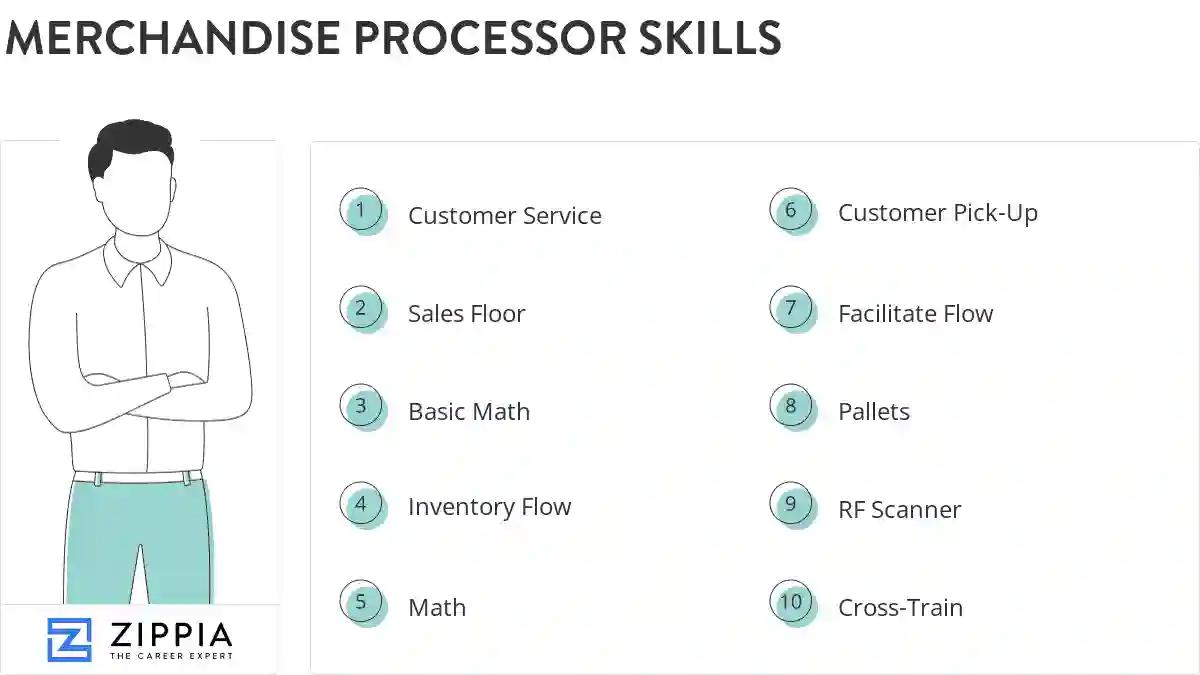
The most important skills for a merchandise processor resume and required skills for a merchandise processor to have include:
- Customer Service
- Sales Floor
- Basic Math
- Inventory Flow
- Math
- Customer Pick-Up
- Facilitate Flow
- Pallets
- RF Scanner
- Cross-Train
- Worksheets
- Management System
- Retail Store
- Customer Orders
- Quality Standards
- Pallet Jack
- Inventory Control
- WMS
- Process Rework
- Customer Returns
- Pkms
- Store Merchandise
- Radio Frequency Scanners
- Production Standards
- RF Gun
- Computer System
- Audit Merchandise
- Sort Merchandise
- Unload Trucks
- Scan Gun
- Assembly Line
- PC
- Cycle Counts
- Process Improvement
- IQA
- Refurbishment
- FedEx
Updated January 8, 2025
