
Automatically apply for jobs with Zippia
Upload your resume to get started.
Metal model maker skills for your resume and career
11 metal model maker skills for your resume and career
1. Prototype
A prototype is a model or sample of a product, created prior to its release with the goal of testing the product and observing its behavior and effectiveness in use. The results of this testing are then used to further alter and improve the product in question, often redesigning it, fixing any issues which may have come up, and otherwise upgrading the already existing design.
- Designed and machined tooling to fabricate prototype automotive car seats.
- Fabricate automotive prototypes to customer specifications.
2. MIG
MIG is a specific type of welding in which two base materials are welded together using a solid wire electrode fed through a welding gun and into the weld pool.
- Completed a 3 day training program at Lincoln Welding for Robotic MIG welding programming and maintenance.
- Build and assemble manufacturing fixtures for mig welding and spot welding.
3. Spot Welding
- Design and build of spot welding assembly fixtures.
4. TIG
TIG stands for "tungsten inert gas welding" and is also known as gas tungsten arc welding (GTAW). This particular type of weld is more difficult as it requires the welder to heat materials until they are liquid.
- Tool design, motor repair, cosmetic TIG welder.
- Operated 2 and 3 axis Prototrak milling machines, engine lathes and TIG welder.
5. CNC
CNC stands for Computer Numerical Control. It is a subtractive manufacturing technique that usually uses computerized controls and machine tools to strip layers of material from a stock piece.
- Program Acupressure CNC Break Press.
- Developed sheet metal prototypes Did CNC programming for various machines We were a precision sheet metal job shop
6. Lathe Operation
- Executed Bridgeport and lathe operations, including tube bending.
7. Non-Ferrous Metals
- Worked with ferrous and non-ferrous metals of all gauges.
8. Band Saws
A band saw is used to cut wood materials into different curves, lines, and forms to complete various tasks or projects. A band saw is typically long and sharp, containing toothed metal components that help cut materials smoothly and precisely. Additionally, a band saw can be dangerous to use, which requires a woodworker to be careful and proactive when operating them.
- Operated band saws and table saws.
9. CMM
CMM stands for "capability maturity model." This refers to the refinement of a company's processes, most commonly regarding software development. This methodology is achieved through five levels. Each of these levels attempts to refine the development process until the software is efficiently created, organized, and maintained. This may include security procedures for software or productivity among team members.
- Close tolerance inspection work and some experience Running a CMM
10. Micrometers
A micrometer is a measuring instrument used in various laboratories to measure even the tiniest components in-depth with great precision and accuracy and to make precise linear measurements of dimensions such as diameters, thicknesses, and lengths of solid bodies. They are essential measuring instruments used by mechanical engineers, machinists, and workers in other technical professions. They allow workers to take extremely precise measurements, which can be viewed either in imperial or metric format. Most micrometers are designed to measure within one-thousandth of an inch! It's a snug fit. Accurate measurements like this are needed when even the smallest distance between objects can cause problems or difficulties.
- Facilitated the Use of Micrometers, Calipers & Height Gauges.
11. Jigs
- Constructed and repaired tools, dies, jigs, and fixtures *Traveled out of state to utilize expertise in critical operations
- Saw rotary and flat dies with a labor saver or jig saw to the boxes design on the wood.

What skills help Metal Model Makers find jobs?
Tell us what job you are looking for, we’ll show you what skills employers want.
List of metal model maker skills to add to your resume
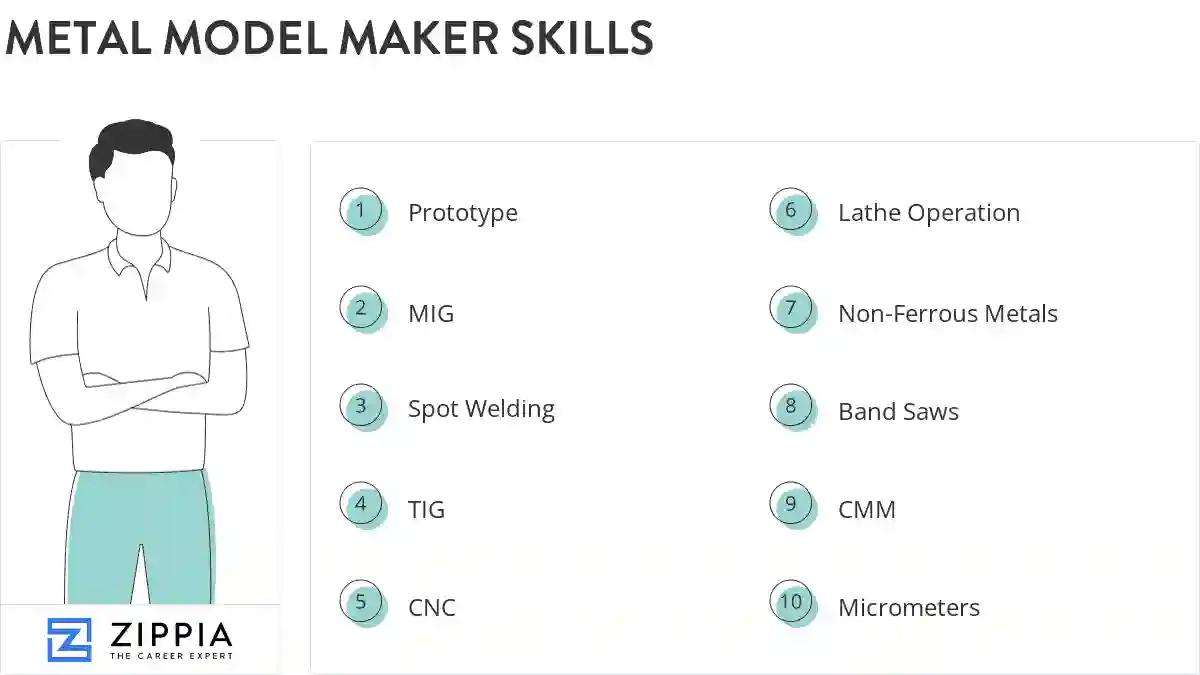
The most important skills for a metal model maker resume and required skills for a metal model maker to have include:
- Prototype
- MIG
- Spot Welding
- TIG
- CNC
- Lathe Operation
- Non-Ferrous Metals
- Band Saws
- CMM
- Micrometers
- Jigs
Updated January 8, 2025
