
Automatically apply for jobs with Zippia
Upload your resume to get started.
Middleware administrator skills for your resume and career
15 middleware administrator skills for your resume and career
1. Linux
Linux is a Unix-like operating system. Just like Windows, Mac OS, and IOS, Linux is an operating system used by millions across the globe. Android itself is powered by the Linux operating system. Linux manages all the hardware resources that are associated with your computer. The software is famous because of the protection it grants from viruses, malware, and crashes. The Linux operating system is entirely free and is an open-source software meaning it can be altered by those equipped with the knowledge to code.
- Designed and configured security users/user roles for Linux user access, WebLogic and SOA/BPM application user access.
- Performed Subversion Repository Migration from Windows to Linux.
2. Java
Java is a widely-known programming language that was invented in 1995 and is owned by Oracle. It is a server-side language that was created to let app developers "write once, run anywhere". It is easy and simple to learn and use and is powerful, fast, and secure. This object-oriented programming language lets the code be reused that automatically lowers the development cost. Java is specially used for android apps, web and application servers, games, database connections, etc. This programming language is closely related to C++ making it easier for the users to switch between the two.
- Deployed enterprise java beans, Web applications, enterprise applications and configuration, troubleshooting performance.
- Administer Java based external facing websites and ensure availability and stability of online web applications.
3. Windows
Windows is a chain of operating systems that controls a computer and is developed by Microsoft. Every version of Windows consists of GUI (graphical user interface), with a desktop that allows the user to open their files.
- Conducted Platform service changes that are in compliance with established maintenance windows and OCIO Configuration/Change Management policy.
- Installed and configured Application Server Network Deployment on Windows machines.
4. Infrastructure
Infrastructure includes the organizational and physical structures needed to run an area or a society smoothly. It is a group of basic facilities required for any society or firm to run sustainably and efficiently. The infrastructural system is a high investing area and helps majorly in flourishing the economy and prosperity of a country. It is an underlying system needed for ensuring the safety and comfort of the public and to run a country smoothly. All the tasks needed to be performed for a flourishing economy and a happy and healthy public are included in infrastructure.
- Performed Application Tuning, Monitoring and Configuration of the overall applications and Infrastructure components.
- Lead Application Management/ Infrastructure Management related activities including functional design and tech road map.
5. Web Servers
- Re-generated plugins after application deployments and copied over the updated plugins to web servers.
- Integrated and deployed applications into application and web Servers.
6. Tomcat
- General administration (deployment, configuration, redeployment, problem investigation and support) of applications running on Tomcat Application Server.
- Installed and configured Tomcat Jasper server to generate reports for government and business applications.
Choose from 10+ customizable middleware administrator resume templates
Build a professional middleware administrator resume in minutes. Our AI resume writing assistant will guide you through every step of the process, and you can choose from 10+ resume templates to create your middleware administrator resume.7. Unix
UNIX is a computer operating system that was first created in the 1960s and has been constantly updated since then. The operating system refers to the set of programs that enable a machine to function. It is a multi-user, multi-tasking device that works on computers, laptops, and servers. UNIX systems also have a graphical user interface (GUI), similar to Microsoft Windows, that makes it simple to use.
- Worked with UNIX team for the required server configuration/directory structure/credential/troubleshooting and patching activities.
- Automated project monitoring activities using Unix Scripts.
8. BEA Weblogic
- Deployed applications on multiple WebLogic Servers and maintained Load balancing, high availability and Fail over functionality.
- Performed WebLogic Server 10g/11g server administration tasks such as Installation, Configuration, Monitoring and Performance Tuning.
9. Application Server
- Clustered WebSphere Application Servers on multiple platforms using both horizontal and vertical scaling methods in both production and non-production.
- Configured JMS activation specifications in WebSphere Application Server Environment and Enabled SSL connectivity for them with MQ Manager.
10. SSL
- Created SSL and Digital Certificates for secured communication between applications using Key tool.
- Implement SSL certificates for secured communication between the administrative server and clients.
11. Production Environment
The term production environment is mainly used by software developers to describe the phase of production where the latest versions of products, updates, or software are pushed live to their intended users. In this phase, clients can see a live service of the product.
- Installed AppDynamics agent and configured with running WebLogic and JBOSS instances for performance monitoring in staging and production environment.
- Monitor applications in production environments and provide real time support for analyzing and troubleshooting issues.
12. Queues
- Experience in configuring queue manager to queue manager communication between queue managers on distributed environments.
- Suggested and implemented securing system default channels for preventing unauthorized access to queue mangers.
13. JMS
- Configured and monitored JMS on WebLogic environment.
- Configured and maintained of WebLogic server with JDBC, JMS, JNDI, SNMP and J2EE Services and Data sources.
14. JDBC
- Executed WLST scripts to monitor JDBC data sources Run time statistics and helped team to standardize the environments by updating configurations.
- Tune applications by analyzing the Operating System, TCP/IP parameters, JVM, JDBC Connection pools and Application Server performance.
15. LDAP
- Configured Security for WebSphere Portal environment using LDAP registry IBM Directory Server for authoring and rendering environments.
- Connect Lombardi servers with LDAP servers for user/role/group management, assign user attributes pertaining to Lombardi.
5 Middleware Administrator resume examples
Build a professional middleware administrator resume in minutes. Browse through our resume examples to identify the best way to word your resume. Then choose from 5+ resume templates to create your middleware administrator resume.

What skills help Middleware Administrators find jobs?
Tell us what job you are looking for, we’ll show you what skills employers want.
List of middleware administrator skills to add to your resume
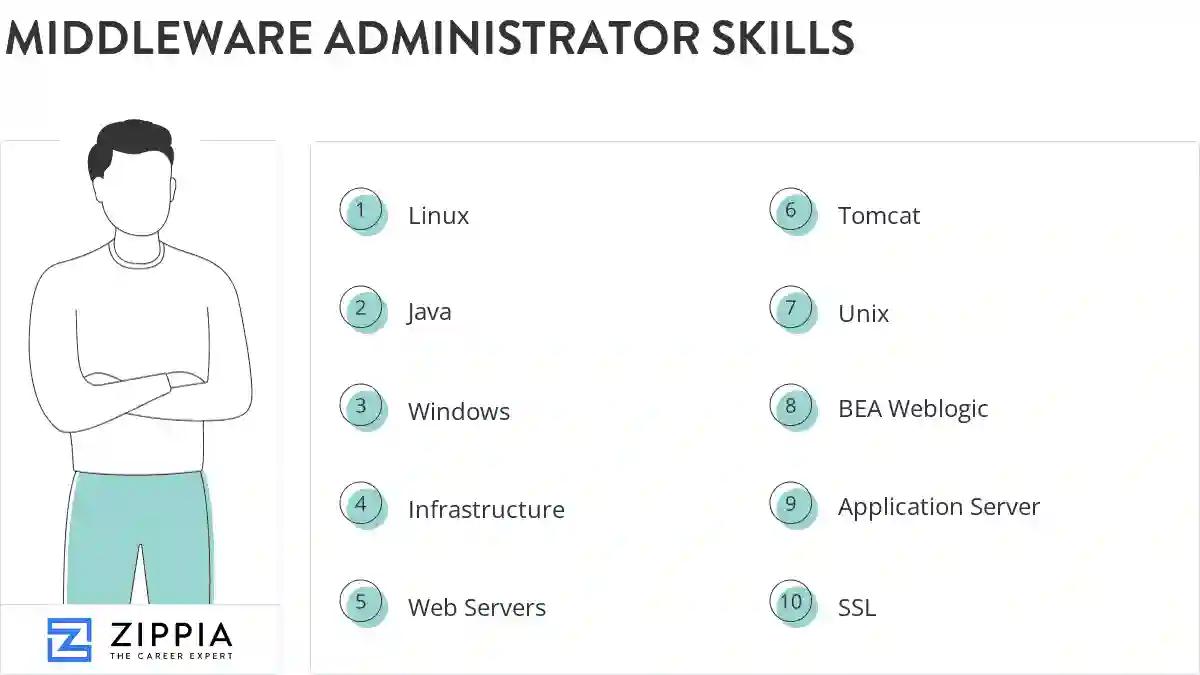
The most important skills for a middleware administrator resume and required skills for a middleware administrator to have include:
- Linux
- Java
- Windows
- Infrastructure
- Web Servers
- Tomcat
- Unix
- BEA Weblogic
- Application Server
- SSL
- Production Environment
- Queues
- JMS
- JDBC
- LDAP
- IBM Websphere
- J2EE
- Apache Tomcat
- IBM Http Server
- JVM
- AIX
- QA
- SQL
- Jenkins
- Websphere MQ
- Solaris
- Jboss EAP
- SOA
- IIS
- XML
- Jython
- RHEL
- Web Application
- Red Hat
- Node
- OS
- ANT
- DEV
- Perl
- Connection Pools
- Failover
- JDK
- DB2
- Remedy
- Garbage Collection
- SSO
- Tivoli
- Application Issues
Updated January 8, 2025
