
Automatically apply for jobs with Zippia
Upload your resume to get started.
Mill operator skills for your resume and career

15 mill operator skills for your resume and career
1. CNC
CNC stands for Computer Numerical Control. It is a subtractive manufacturing technique that usually uses computerized controls and machine tools to strip layers of material from a stock piece.
- Operated CNC machines in a safe and efficient manner to produce good Bearing and production parts to specifications.
- Operated rip, band, and chop saw: Cross-trained to off-bear operate CNC routers.
2. OSHA
- Completed OSHA and American Red Cross courses.
- Maintain a clean and safe work environment Follow all company and OSHA guidelines
3. Math
- Performed math converting metric to inches and converting fractions to decimals.
- Calculated requirements, using basic math.
4. Calipers
- Utilized a variety of micrometers, calipers, and thickness measuring instruments for final inspection.
- Verified size of rubber goods with calipers, ruler, plug gauge and template.
5. Hand Tools
- Dislodge and clear jammed materials or other items from machinery or equipment, using hand tools.
- Used all sorts of hand tools and electrical tools Inspected equipment daily to ensure proper operation.
6. Safety Rules
Principles or regulations that ensure the protection of people, objects, or the environment are called safety rules. These rules can be governing actions, devices, or procedures that help in minimizing the risks of loss, injury, or damage.
- Operated mobile equipment safely, according to safety rules and regulations.
- Demonstrate commitment to safety of all persons and property by abiding by all safety rules and regulations.
Choose from 10+ customizable mill operator resume templates
Build a professional mill operator resume in minutes. Our AI resume writing assistant will guide you through every step of the process, and you can choose from 10+ resume templates to create your mill operator resume.7. Safety Procedures
Safety procedures are a set of standardized procedures, that ensures minimal to no risk to people, resources, and the work environment. A company follows the step-by-step safety procedures as it they not only keep the customers and the employees safe, but also help in avoiding legal claims.
- Follow all safety procedures Accomplishments Well liked by all supervisors for quality of work and professionalism on the job.
- Removed 4 employees arms and hands from being stuck in steel coils Skills Used Follow all safety procedures.
8. Preventative Maintenance
- Perform routine preventative maintenance and minor repairs to ensure machine reliability.
- Conduct preventative maintenance of equipment.
9. Overhead Cranes
Overhead cranes are major industrial equipment used for lifting heavy objects, loads, and tools from one location to another in construction sites. Operating an overhead crane takes much expertise, experience, and skill, as there is no ''one size, fits all''. Overhead cranes come in different components for different specific functions.
- Learned shipping and receiving, loading steel sheets, and unloading coils with overhead cranes on to flatbed semi trucks.
- G&E 48/190 Gear Gasher, 1.5 to 2.5 ton Jib Cranes, 7-20 ton Overhead Cranes.
10. Troubleshoot
Troubleshooting is the process of analyzing and fixing any kind of problem in a system or a machine. Troubleshooting is the detailed yet quick search in the system for the main source of an issue and solving it.
- Operate, Troubleshoot, Repair Hammer mills.
- Operated four injection molding machines, Set up tools, Troubleshoot Operated a milling machine Inspected all finished products for quality
11. Asphalt
- Operated production mill that produced asphalt emulsions.
- Key Responsibilities: Set up, operate, or tend machines to mix or blend asphalt material.
12. Forklifts
Forklifts refer to a powerful industrial truck used to move and lift materials over short distances.
- Retrieved required raw materials, and loaded appropriate system by means of forklifts, front end loaders, or skid steers.
- Operated chain saws, forklifts, commercial trucks, all types of hand and power tools.
13. Safety Committee
A safety committee is in charge of promoting a safety culture in an organization, primarily by implementing various safety policies and regulations. They may arrange meetings and seminars, address issues and concerns, and conduct regular inspections to ensure different departments comply with the safety standards and regulations.
- Volunteered as Treasurer for the Local Union and Central Safety Committee.
- Helped develop program for ISO 9001 as part of safety committee.
14. End Loaders
- Operated and monitored equipment included in the waste-water treatment process including operating front end loaders.
- Operated power construction equipment such as pumps, shovels and front-end loaders.
15. G Code
- Set up and operate mills Forming metal to blue prints Altering programs and G codes
5 Mill Operator resume examples
Build a professional mill operator resume in minutes. Browse through our resume examples to identify the best way to word your resume. Then choose from 5+ resume templates to create your mill operator resume.

What skills help Mill Operators find jobs?
Tell us what job you are looking for, we’ll show you what skills employers want.
List of mill operator skills to add to your resume
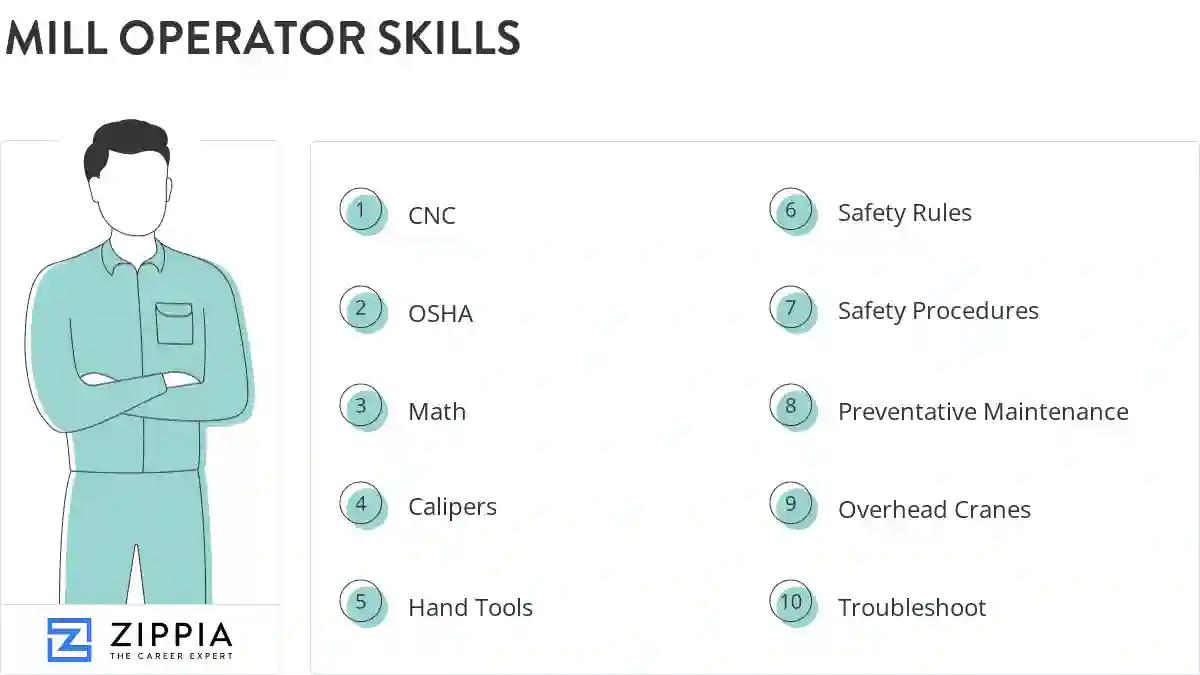
The most important skills for a mill operator resume and required skills for a mill operator to have include:
- CNC
- OSHA
- Math
- Calipers
- Hand Tools
- Safety Rules
- Safety Procedures
- Preventative Maintenance
- Overhead Cranes
- Troubleshoot
- Asphalt
- Forklifts
- Safety Committee
- End Loaders
- G Code
- Production Equipment
- Quality Checks
- Quality Standards
- Safety Standards
- PPE
- Mill Equipment
- GMP
- Mill Operations
- Tape Measure
- ISO
- MSHA
- Flotation
- Mill Machine
- Control Room
- Customer Specifications
- Product Quality
- Load Trucks
- Front End Loader
- Bobcat
- Machine Operation
- Hoists
- Production Schedules
- Mill Maintenance
- Rail Cars
- Equipment Operation
- Computer System
- Perform Routine Maintenance
- Manual Mill
- Steel Mill
- Grinding Wheels
- Conveyor Belts
- Torches
Updated January 8, 2025
