
Automatically apply for jobs with Zippia
Upload your resume to get started.
Molecular research technologist skills for your resume and career
15 molecular research technologist skills for your resume and career
1. CRISPR
- Established working protocols for targeted genome editing using CRISPR technology.
- Expanded multiple clones to verify CRISPR knock out of gene targets.
2. Lab Equipment
- Planned and executed experimental lab procedures -Operated lab equipment and maintained workspace -Presented results at multiple Q&A events
- Managed the laboratory including ordering supplies, maintained lab equipment and instruments, maintained environmental safety compliance.
3. Tissue Culture
- Live cell imaging, tissue culture, cloning, Matlab programing
- Conducted laboratory management duties, including tissue culture maintenance and ordering laboratory supplies and equipment.
4. Chemistry
Chemistry is the branch of science that tells us about the composition, properties, and structure of elements and compounds. The processes these elements undergo and how they undergo change all come under the branch of chemistry.
- Supervised and trained Bio-Medical Engineering and Chemistry graduate students in chemical methods, framework implementation for effective research and data analysis.
- Oversee daily management of organic/medicinal chemistry aspects while serving on a multidisciplinary team comprised of physical chemists and pharmacologists.
5. Extraction
- Worked continuously to improved processes at the NGS prep and DNA/RNA extraction levels.
- Developed the predictive scheduling algorithms for real-time image registration and feature extraction with the application to retinal image sequences.
6. Data Analysis
- Invented three new analysis methods and improved research capabilities by designing new experiments and developing new systematic approaches for data analysis.
- Developed automated data analysis routines, based on anti-correlative measurement strategies to differentiate instrument systematic error from physical mirror surface attributes.
Choose from 10+ customizable molecular research technologist resume templates
Build a professional molecular research technologist resume in minutes. Our AI resume writing assistant will guide you through every step of the process, and you can choose from 10+ resume templates to create your molecular research technologist resume.7. Laboratory Techniques
- Provided troubleshooting and problem solving for immunologic assays, performed experiments, developed laboratory techniques, evaluated and analyzed experiments.
- Teach associated laboratory techniques to successive peers and discuss and review data with researchers and improve on laboratory methods.
8. Research Projects
- Co-ordinated with external partners on research projects and published research outcomes.
- Conducted research projects utilizing protein induction and analysis, gel electrophoresis,transformation and SNA subcloning techniques.
9. Genotyping
- Isolated genetic material for genotyping large transgenic mouse colony & collected tissues for biochemical analysis and histology.
- Work with Transgenic Mice Genotyping starting from Mouse Tail Clippings Lab Maintenance and Cleaning Maintaining Laboratory notebook
10. Western Blotting
- Conducted experiments involving cells in culture, transient transfection, SDS-PAGE and Western Blotting techniques.
- Performed SDS-PAGE and Western Blotting analysis on proteins to elucidate their function in immunological pathways.
11. NIH
NIH stands for the National Institutes of Health. This organization oversees a series of research institutions, each focused on a different area of study involving anatomical systems or diseases. As the organization is affiliated with the government, a great deal of the funding institutions receive come from Congress.
- Reviewed information for Genetics Home Reference (http://ghr.nlm.nih.gov/) at the National Library of Medicine.
- Implemented NIH data management plan as the sole liaison between the lab and department IT.
12. Cell Lines
- Performed research on Breast Cancer Cell Lines using Digital Karyotyping techniques.
- Established stable cell lines expressing both NNAT RNA isoforms.
13. Protein Expression
- Analyzed specific alternations of cognitive phenotype and frontal-cortical gene-protein expressions in genetically different strains of mice.
- Developed mature protocols of CaChR1 membrane protein expression, purification and stability study.
14. Molecular Biology Techniques
- Used molecular biology techniques to research the genetics of autism in animal models.
- Supervised graduate and under-graduate students on various projects; provided training on various molecular biology techniques, including molecular marker development.
15. Electrophoresis
- Extracted embryonic and neonatal mouse/chick tissue for isolation of DNA/RNA for mutation detection, enzyme digestion and gel electrophoresis experiments.
- Established new assay protocols, including an Electrophoresis Mobility Shift Assay, through independent research and review of peer-reviewed scientific journals.
5 Molecular Research Technologist resume examples
Build a professional molecular research technologist resume in minutes. Browse through our resume examples to identify the best way to word your resume. Then choose from 5+ resume templates to create your molecular research technologist resume.

What skills help Molecular Research Technologists find jobs?
Tell us what job you are looking for, we’ll show you what skills employers want.
What soft skills should all molecular research technologists possess?
David Brown
Professor of History, Elizabethtown College
What hard/technical skills are most important for molecular research technologists?
Jan Levine
Professor of Law and Director, Legal Research & Writing Program, Duquesne University
List of molecular research technologist skills to add to your resume
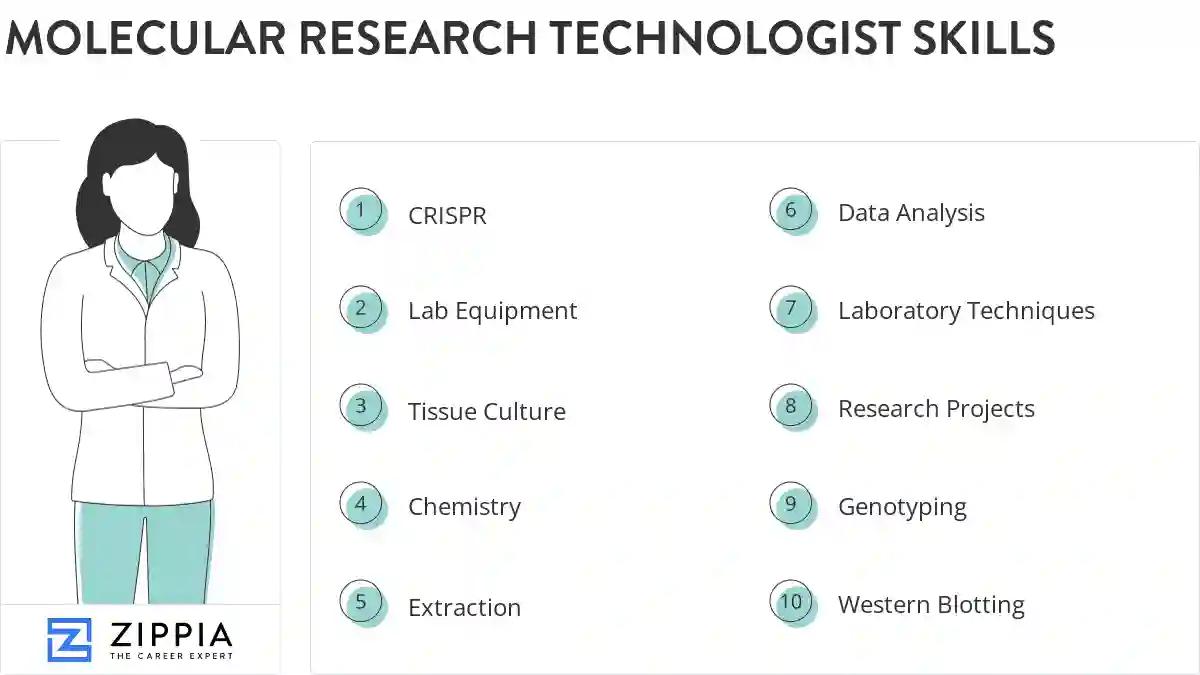
The most important skills for a molecular research technologist resume and required skills for a molecular research technologist to have include:
- CRISPR
- Lab Equipment
- Tissue Culture
- Chemistry
- Extraction
- Data Analysis
- Laboratory Techniques
- Research Projects
- Genotyping
- Western Blotting
- NIH
- Cell Lines
- Protein Expression
- Molecular Biology Techniques
- Electrophoresis
- Pathogens
- Immunology
- Statistical Analysis
- Elisa
- Animal Models
- RT-PCR
- Biomarkers
- Scientific Research
- Autism
- Neuroscience
- Research Support
- SDS-PAGE
- Laboratory Meetings
- Experimental Design
- HPLC
- Experimental Data
Updated January 8, 2025
