
Automatically apply for jobs with Zippia
Upload your resume to get started.
Mri and ct technologist skills for your resume and career
15 mri and ct technologist skills for your resume and career
1. Patients
- Interviewed patients and accurately completed documentation of medical history, triage patients.
- Interact with patients to obtain pertinent medical history and ensuring patient safety.
2. Patient Care
Patient care entails the diagnosis, recovery, and control of sickness as well as the maintenance of physical and emotional well-being through the use of healthcare providers' services. Patient care is described as services provided to patients by health practitioners or non-professionals under guidance.
- Assumed patient care role performing Magnetic Resonance Imaging examinations in an out-patient and clinical setting.
- Maintain professionalism and utilize exceptional patient care.
3. ARRT
- Followed radiation safety measures and used radiation protection devices in accordance with ARRT standards and governmental regulations.
- Obtained ARRT certification in Computed Tomography
4. Radiology
Radiology means a division of medicine that concentrates on the use of radiant energy or any other radioactive material in the process of diagnosis and ailment treatments. It deals specifically with X-rays and radiations bearing high-energy, used in medicine and diagnosis.
- Delegated various management and administrative tasks by Radiology Manager.
- Secured accreditation from the American College of Radiology.
5. Magnetic Resonance Imaging
- Provided health care services in Computed Tomography and Magnetic Resonance Imaging to assist in diagnosis or treatment.
- Specialized Magnetic Resonance Imaging (MRI) scans of the breast; both routine protocols as well as MR guided biopsies.
6. IV
- Increased department earnings significantly by identifying lack of IV contrasts being performed, and implementing stringent quality controls regarding this issue.
- Performed routine and emergent exams in MRI and Cat Scan including IV starts and completing in PACS.
Choose from 10+ customizable mri and ct technologist resume templates
Build a professional mri and ct technologist resume in minutes. Our AI resume writing assistant will guide you through every step of the process, and you can choose from 10+ resume templates to create your mri and ct technologist resume.7. Magnetic Resonance
- Provide temporary relief staffing to various imaging facilities in need of either a Computerized Tomography or Magnetic Resonance Technologist.
- Perform all Magnetic Resonance and CT Imaging in an independent environment.
8. CPR
Cardiopulmonary resuscitation or CPR is a medical procedure that involves chest compression to help a patient breathe. This artificial ventilation helps in keeping the brain function in place and regulates blood throughout the body. CPR is a lifesaving procedure that is used in emergencies.
- Provided emergency first aid and initiated CPR if needed.
- Maintain books to ensure all employees are current on licenses as well as CPR and TB.
9. Ct Scan
- Serve as a backup Technologist at the Baptist M&S Clinic, performing both MRI and CT scans.
- Operated GE Max 0.5T Magnet and GE 2000 CT Scanner at an outpatient center owned by neurologists.
10. Pacs
Picture archiving and communication system or, as is more commonly shortened, PACS, is a type of imaging scan used in medical treatment and other such work which provides effective storing and access to images and scans created by a large variety of machinery and medical tools. This might include scans such as CTs and MRIs and even basic X-rays and the system can also potentially be used to store digitised versions of originally physical paper documents.
- Utilized the PACS System for the delivery of volume rendered, MPR, and MIP images.
- Provided additional support to PACS administrator by training for exam merging and maintenance.
11. Tomography
Tomography is the process of generating a CT scan to create a detailed two-dimensional image of a cut or section of internal organs, bones, soft tissues, and blood vessels by using a 3D penetrating wave object.
- Received certification in computed tomography.
- Computerized Axial Tomography scans of outpatient, inpatient, and emergency cases.
12. Patient History
- Make sure the appropriate exam is ordered for patient history, consult with radiologists and doctors.
- Make sure that we have all patient history needed for the radiologist reading the exam.
13. Patient Safety
- Performed patient safety screenings and answered any questions by phone and in person.
- Demonstrated competency in requisition evaluation, patient assessment, patient safety, positioning skills, and image evaluation.
14. MRI Safety
- Conducted quality assurances testing, successfully passed the MRI safety course.
- Trained and monitored other personnel for MRI safety practices.
15. Contrast Administration
- Performed venipuncture with angiocaths and butterflies for contrast administration.
- Involved with in- and out-patient scheduling, contrast administration, supply inventory, doctor/technologist interaction and patient care.
5 MRI And CT Technologist resume examples
Build a professional mri and ct technologist resume in minutes. Browse through our resume examples to identify the best way to word your resume. Then choose from 5+ resume templates to create your mri and ct technologist resume.

What skills help MRI And CT Technologists find jobs?
Tell us what job you are looking for, we’ll show you what skills employers want.
List of mri and ct technologist skills to add to your resume
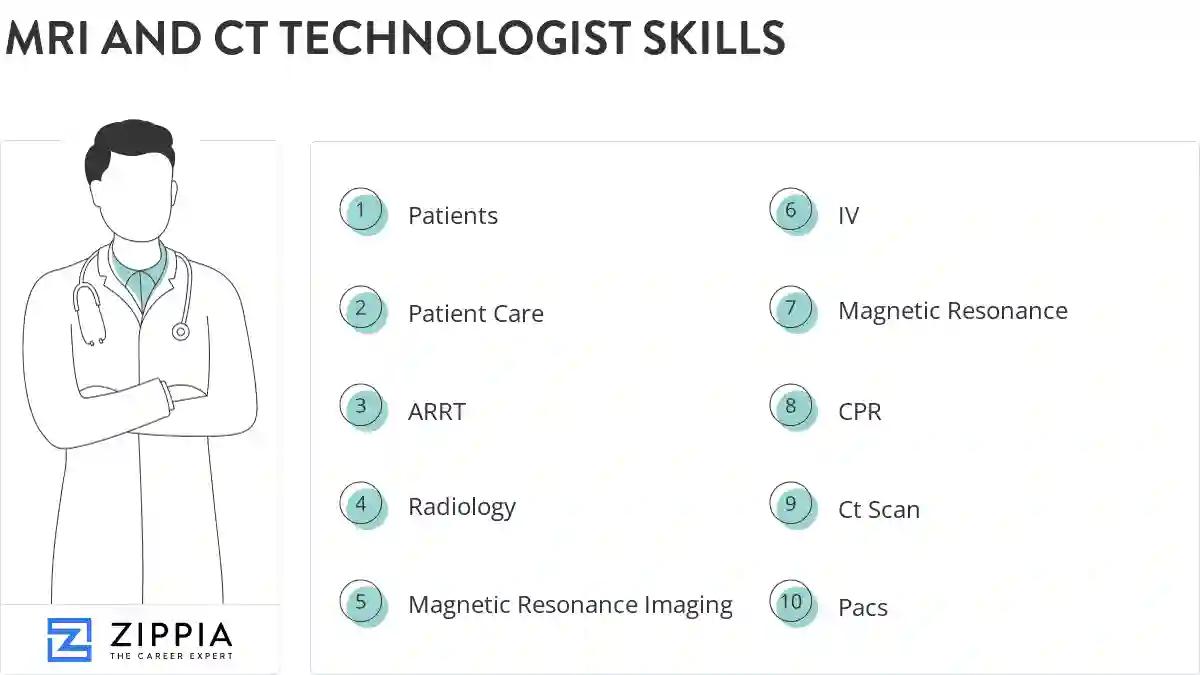
The most important skills for an mri and ct technologist resume and required skills for an mri and ct technologist to have include:
- Patients
- Patient Care
- ARRT
- Radiology
- Magnetic Resonance Imaging
- IV
- Magnetic Resonance
- CPR
- Ct Scan
- Pacs
- Tomography
- Patient History
- Patient Safety
- MRI Safety
- Contrast Administration
- Image Quality
- Routine Exams
- Post Processing
- ACR
- Diagnostic Images
- MRI Tech
- RIS
- QC
- Patient Data
- Perform MRI
- Mr
- Ct
- ALARA
- Epic
- Cat Scan
- Diagnostic Purposes
- Power Injectors
- Xray
- C-Arm
- Toshiba
- QA
- Inpatients
- Contrast Injections
- Diagnostic Procedures
- Medical History
- Allergies
- Catheter
- Informed Consent
- Physician Orders
- Hippa
- DR
- Outpatient Facility
- DEXA
- Bone Density
Updated January 8, 2025
