
Automatically apply for jobs with Zippia
Upload your resume to get started.
Network engineer/analyst skills for your resume and career
15 network engineer/analyst skills for your resume and career
1. Switches
- Configure, update software, troubleshoot and maintain various enterprise network devices such as Cisco Nexus/Catalyst switches and Opus switches.
- Configured Cisco routers and switches (2500, 2820, 2940), NT Servers and Oracle/MS-SQL database engines.
2. Routers
A router is a device that gives a computing device the capability to connect to the internet and transfer data between different devices whether at a home or office. It may include several network ports to connect many devices at one go.
- Key Contributions * Network Hardening -Upgraded and configured 40 remote location VPN routers.
- Installed new WAN routers, completed circuit turn-up and router configuration.
3. Troubleshoot
Troubleshooting is the process of analyzing and fixing any kind of problem in a system or a machine. Troubleshooting is the detailed yet quick search in the system for the main source of an issue and solving it.
- Analyze, identify and troubleshoot data communications problems related to networking hardware and software.
- Partnered with network engineers, field technicians, and equipment vendors to troubleshoot and resolve network trouble reports and outages.
4. Network Infrastructure
- Oversee and execute planned network infrastructure maintenance activity while minimizing impact to services.
- Created and Implemented Network Infrastructure for Multiple Branches of Fidelity Investments connecting to the HQ at Durham, NC.
5. VoIP
- Sole engineer on a maintaining a Multi-county VoIP GenBand & MetaSwitch SIP Call Managers.
- Maintained QoS of VOIP service using Cisco ACE load balancers.
6. Lan
- Administrated and implemented Wireless LAN.
- Experienced with the implementation and support of Layer 2 & 3 WAN / LAN optimization & monitoring technologies.
Choose from 10+ customizable network engineer/analyst resume templates
Build a professional network engineer/analyst resume in minutes. Our AI resume writing assistant will guide you through every step of the process, and you can choose from 10+ resume templates to create your network engineer/analyst resume.7. TCP/IP
- Configured Exchange Servers for use with the X.400 Connector, TCP/IP MTA Stack and Directory Replication.
- Configure workstations to use TCP/IP, NET, RAS and PPP.
8. Lan Wan
- Work on different networking concepts and routing protocols like OSPF and other LAN WAN technologies.
9. Network Operations
- Worked closely with the Network Operations Center troubleshooting existing equipment.
- Filled in as acting Head of Network Operations for several weeks while permanent Head of Network Operations was unavailable.
10. Technical Support
Technical support or tech support are the services provided by any hardware or software company to users. They help in solving the technical difficulties the customers face with their products or services. Moreover, the tech support employees maintain, manage, and repair the IT faults. They are also responsible for resolving the network problems, installing and configuring hardware and software.
- Provided phone and online technical support for remote locations overseas staff ensuring projects and deadlines could be met on time.
- Managed and served on Level III/IV technical support team in charge of handling high level issues within DISA network.
11. Network Security
- Network Security products (including IDS, IPS, etc.)
- Maintained and supported users with network hardware, backbone connectivity modifications, workstation/server software, printing, and network security.
12. Firewall
- Manage and administer corporate firewalls and related security policies based on Checkpoint/Nokia platform.
- Designed and implemented network perimeter defense systems based on 2-tiered Checkpoint/Nokia firewalls.
13. DNS
Domain Name Systems, or DNS for short, is the internet's system for converting readable language, i.e., google.com, to machine language, i.e, 192.168. For a simple analogy, some call it the phonebook of the internet. Any website has its own IP address, for example, 192.168.160. Understandably this is hard to remember. So what a DNS does is link the domain name, google.com, with its IP address, 192.168.160.
- Assigned IP addresses and updated DNS entries for all Lab Development Servers allowing timely access to servers/hosts.
- Configured, verified and performed troubleshooting of DHCP and DNS operation on a router.
14. Network Performance
- Monitored and maintained network engineering using network management tools on a daily basis resulting in 100% network performance.
- Established and maintain network performance by building net configurations and connections; troubleshooting network problems for test lab.
15. VMware
- Managed day to day operation of VMware infrastructure, production system consisting of 50+ guest servers plus 8+ ships.
- Monitored, managed and resolve all data network circuit outages while working independently using VMware.
5 Network Engineer/Analyst resume examples
Build a professional network engineer/analyst resume in minutes. Browse through our resume examples to identify the best way to word your resume. Then choose from 5+ resume templates to create your network engineer/analyst resume.

What skills help Network Engineers/Analyst find jobs?
Tell us what job you are looking for, we’ll show you what skills employers want.
What network engineer/analyst skills would you recommend for someone trying to advance their career?
Laura Kier
Network Design and Administration Instructor
List of network engineer/analyst skills to add to your resume
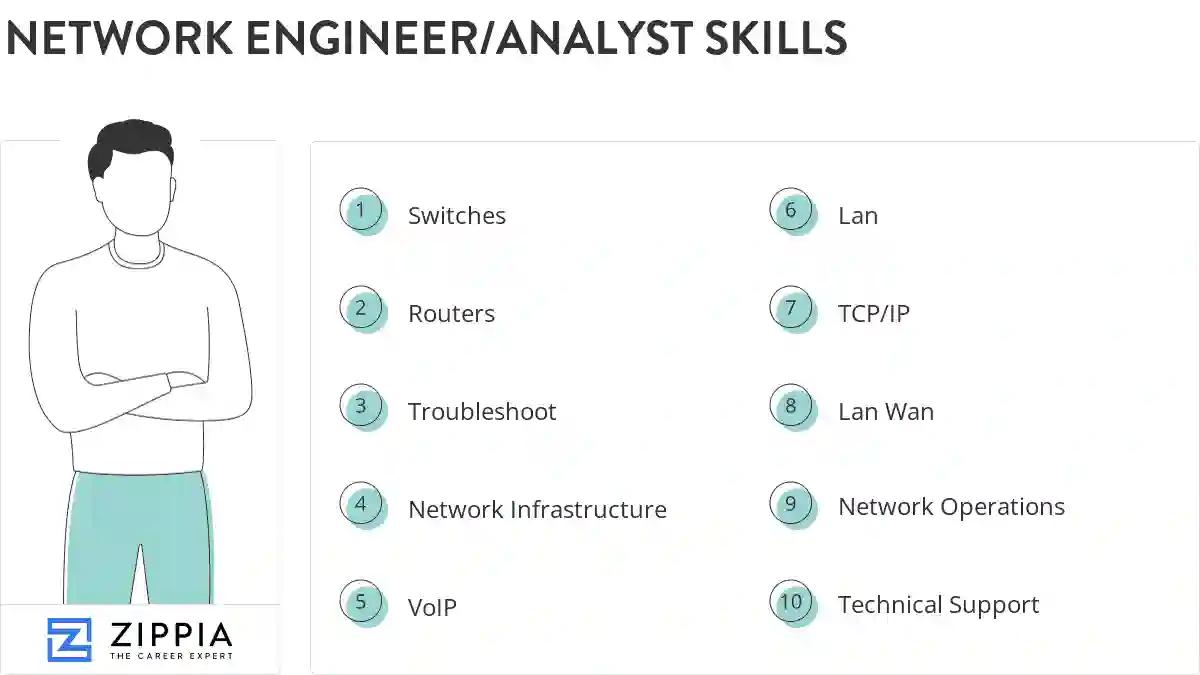
The most important skills for a network engineer/analyst resume and required skills for a network engineer/analyst to have include:
- Switches
- Routers
- Troubleshoot
- Network Infrastructure
- VoIP
- Lan
- TCP/IP
- Lan Wan
- Network Operations
- Technical Support
- Network Security
- Firewall
- DNS
- Network Performance
- VMware
- Network Design
- Linux
- VPN
- Network Devices
- DOD
- Network Hardware
- Network Systems
- DHCP
- IOS
- SQL Server
- Wireshark
- Network Troubleshooting
- Juniper
- Network Connectivity
- OSPF
- BGP
- Datacenter
- Ethernet
- Network Issues
- MPLS
- SolarWinds
- Network Equipment
- IPv6
- NOC
- EIGRP
- National Security
- Cisco Ios
- Provisioning
- Unix
- Nexus
Updated January 8, 2025
