
Automatically apply for jobs with Zippia
Upload your resume to get started.
Network systems engineer, lead skills for your resume and career
15 network systems engineer, lead skills for your resume and career
1. Switches
- Work with UNIX and Windows teams to establish connectivity through the switches and storage replication over the WAN links.
- Redesigned entire office area network replacing Cisco 6500 & HP Switches with Nexus 9K and Cisco 2960-X Stack Switches.
2. Linux
Linux is a Unix-like operating system. Just like Windows, Mac OS, and IOS, Linux is an operating system used by millions across the globe. Android itself is powered by the Linux operating system. Linux manages all the hardware resources that are associated with your computer. The software is famous because of the protection it grants from viruses, malware, and crashes. The Linux operating system is entirely free and is an open-source software meaning it can be altered by those equipped with the knowledge to code.
- General user administration on Solaris, AIX, and Linux through telnet and SSH.
- Managed Windows & Linux servers, VMWare & XenServer virtual servers, ID Mgmt.
3. Technical Support
Technical support or tech support are the services provided by any hardware or software company to users. They help in solving the technical difficulties the customers face with their products or services. Moreover, the tech support employees maintain, manage, and repair the IT faults. They are also responsible for resolving the network problems, installing and configuring hardware and software.
- Research and respond to requests for technical support and information.
- Consolidated and upgraded aging technical support documentation into a shared central site, developed, deployed a multitier documentation database.
4. Firewall
- Collaborated with Network Engineering for all layer 3 configuration issues and bandwidth aggregation as well as firewall port issues.
- Designed high-availability networks, core routing/switching systems, and network security perimeters (firewalls, IDS/IPS, authentication).
5. Tcp Ip
- Trouble shooting issues related TCP IP and Network configurations.
6. Emerging Technologies
- Foster strong vendor partnership leading to innovation and proactive measures to understand the trend of new emerging technologies and markets.
- Installed new and emerging technologies to maximize capacity and guarantee 24/7 reliability for SMB clients with dynamic connectivity requirements.
7. Juniper
Juniper Networks, Inc. develops and markets networking products and software which include routers, network management software, and network security products. Many large enterprises use Juniper products and software as part of their larger networking operating management suite.
- Installed, Configured and troubleshooting performed on Cisco ASA 5500, Juniper Net screen ISG200 and Palo alto PA-2050 firewalls.
- Delivered a cohesive solution managing Juniper firewalls and containing all IDP software.
8. DOD
Definition of Done (DoD) is a set of deliverables that are needed to devise software. These deliverables are valuable to the system and can be exemplified by writing code, coding comments, unit testing, integration testing, design documents, release notes, and so on.
- Developed a computer and communication system support database repository in support of USNORTHCOM/J6 organizational architecture efforts using DOD Architecture Framework model.
- Performed security assessment and security vulnerability mitigation and lock down on windows servers to meet requirements for operating on DoD networks.
9. Architecture
- Led the IP Network Services architecture portion of MITRE's Airborne Networking Initiative, concentrating in mobile routing and network services.
- Created the 1st DOIM network architecture diagram spanning over 1,300 devices - while meeting DIACAP accreditation requirements.
10. Cisco Asa
- Installed, configured, maintenance and troubleshoot two Cisco ASA Firewalls as inside Firewalls.
- Worked on migration from PIX and FWSM to Cisco ASA for Service Delivery Network.
11. Windows Server
- Performed hardware and software installations, configuration, upgrades, and troubleshooting on client workstations, and Windows Server 2003/2008.
- Led technical customer support encompassing installation, configuration, and standardization for Windows server builds throughout multiple fast food chain locations.
12. VoIP
- Configured and implemented VoIP circuits for simulation of inter-device radio traffic.
- Configured voice compression devices, VoIP gateway/signaling protocols: H.323, MGCP, and SCCP.
13. Virtualization
- Recruited to establish and manage Virtualization\Storage\Backup environments.
- Lead enterprise-wide virtualization effort, overseeing and personally completing vendor/hardware qualifications, architecture/design, installation, configuration, migration and documentation.
14. SCCM
- Implemented stand-alone SCCM environment for a newly-acquired regional medical center migrating 600 endpoints to comply with institutional standards.
- Provided senior engineer expertise to install/implement Microsoft's SCCM 2012 Configuration Manager utility for the TRUEBLUE corporation.
15. Configuration Management
Configuration management is a technical system of management controls that includes decisions, actions, and approvals that are applied throughout the life cycle of a program or system and that maintain the consistency of its performance, functional and physical attributes from the conceptual phase to production and finally to post-production support.
- Performed enterprise configuration management and security update administration.
- Developed data repository for configuration management.

What skills help Network Systems Engineers, Lead find jobs?
Tell us what job you are looking for, we’ll show you what skills employers want.
What skills stand out on network systems engineer, lead resumes?
Austin McCoy
Director of Javelina Engineering Student Success Center, Texas A&M University - Kingsville
-Internship/co-op experience -Research experience
-Good leadership skills and involvement on campus and in the community and activities where the individual works as part of a team.
-Well written resume can tell a lot about the technical writing skill; a resume needs to be clean and comfortable to read; recruiters can find what they are looking for easily.
-Less is sometimes more because students sometimes will put more information on a resume than is pertinent to the position applying for.
What soft skills should all network systems engineer, leads possess?
David Garaventa
Director, Computer Information Systems and Cybersecurity Programs, Assistant Professor, CIS, Albertus Magnus College
This is not to say that technical skills don't matter, because they do, especially in the IT field. But suppose an employee brings a strong set of soft skills to an IT team (e.g., collaboration, communication, critical thinking, etc.). In that case, they probably also can learn more technical skills as part of their job function. I once had a colleague say to me that when she is hiring, she has found that technical skill is all over the place...but it's the soft skills that are harder to find. Lastly, having the ability - and a desire - to be continually learning is essential. Technology is not static, and businesses are not static, so thinking critically in different settings across various technology platforms is very important. The tools your department uses today may not be the tools they are using tomorrow, so being fluid, adaptable, and constantly learning is the name of the game.
What hard/technical skills are most important for network systems engineer, leads?
David Garaventa
Director, Computer Information Systems and Cybersecurity Programs, Assistant Professor, CIS, Albertus Magnus College
Going deeper into the subject, technical skills around project management, cloud infrastructure, security, and end-user support bridge across all industries. Having knowledge and skills in these areas will serve IT professionals well, no matter what field or industry they end up in. Again, it is challenging to recommend specific technical skills because the field of IT is so broad.
What network systems engineer, lead skills would you recommend for someone trying to advance their career?
Dr. Galen Duree
Head of the Department of Physics and Optical Engineering and Professor, Rose-Hulman Institute of Technology
General reading about technologies or reading available articles about subjects the graduate is interested in will help generate questions they can ask potential graduate schools. This time would also be a chance to improve areas where the graduate may feel weak while an undergraduate. Many online resources can help them brush up on week background topics. Do not worry about transfer credits because that is usually not helpful in graduate school, but improve knowledge and experience in areas where the graduate feels weak. If the graduate has identified a graduate school and program to study in, the graduate school might have some recommendations about what to review. All of this will help improve success in graduate school.
If the next step is a job with a company or lab, taking courses to improve communication will help. Many technically competent or even technically brilliant people struggle with effective communication. Techniques about writing reports, making oral presentations, or communicating technical information will help improve success. The gap year also provides time to investigate technologies that the graduate wants to be involved in and the companies or labs in those areas.
Once the graduate has identified areas of interest and companies or labs that the graduate might want to work for, they can be contacted to either answer questions or point the graduate in a direction for further investigation.
In either case, a gap year can provide a chance to refine the graduate's choice for the next steps and help them prepare other skills overlooked during the undergraduate years.
What type of skills will young network systems engineer, leads need?
John Ring
Director Engineering Outreach, Elon University
List of network systems engineer, lead skills to add to your resume
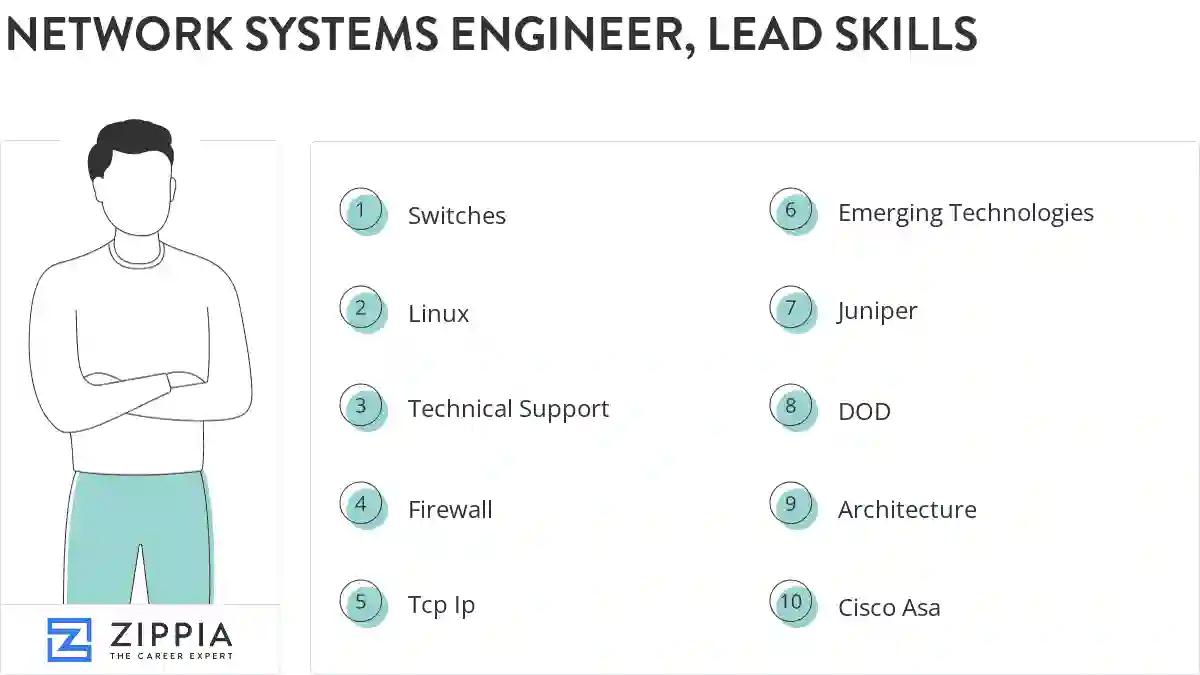
The most important skills for a network systems engineer, lead resume and required skills for a network systems engineer, lead to have include:
- Switches
- Linux
- Technical Support
- Firewall
- Tcp Ip
- Emerging Technologies
- Juniper
- DOD
- Architecture
- Cisco Asa
- Windows Server
- VoIP
- Virtualization
- SCCM
- Configuration Management
- DNS
- OSPF
- Unix
- BGP
- Nexus
- Network Infrastructure
- VLAN
- Windows XP
- Network Operations
- Network Services
- Remedy
- TCP/IP
- Desktop
- Solaris
- Provisioning
- SQL
- Inspection Procedures
- VPN
- Disaster Recovery
- Network Devices
- SAN
- VMS
- SLA
- System Upgrades
- Ethernet
- System Reviews
- Network Management
- Lan
Updated January 8, 2025
