
Automatically apply for jobs with Zippia
Upload your resume to get started.
Network/telecom engineer skills for your resume and career
15 network/telecom engineer skills for your resume and career
1. Switches
- Installed, tested and tuned T1 switches and cable installations to include all T1 service from DSX to VDU's.
- Provided Tier 3 support relating to all Class 4/5 switches, TDM trunks and related in-house networking gear.
2. VoIP
- Increased carrier connections; simulated VoIP traffic to verify that hardware upgrades were successful and correctly implemented.
- Provide highly skilled voice network planning, engineering and VOIP architecture for all levels including help desk.
3. Lan Wan
- Designed, planned, installed and migrated Lucent IBM/Xylan WAN (ATM) equipment to Cisco Ethernet LAN.
4. SIP
- Set enterprise course for SIP conversion strategy while providing options to avoid a rip-and-replace scenario for business units.
- Coordinated and supervised installation of SIP, T1, TIE trunk, PRI s, ISDN, 1FB lines.
5. Firewall
- Perform Firewall and Hardware upgrades including Arbor Peak Flow Threat Management Service devices.
- Managed project to migrate over to the new managed firewall system.
6. Telecom
- Managed the overall relationships with Telecom Vendors, and Service Providers maintain reliable Communication Services Globally.
- Supported company network and telecom infrastructures across a four building campus.
Choose from 10+ customizable network/telecom engineer resume templates
Build a professional network/telecom engineer resume in minutes. Our AI resume writing assistant will guide you through every step of the process, and you can choose from 10+ resume templates to create your network/telecom engineer resume.7. Servers
Servers are computers or systems that provide services to other computers known as clients connected to them via a network. The services can range from data, resources, programs, or any other service that has to do with computing and computers.
It may also refer to someone at a restaurants that delivers the food to patrons from the kitchen.
- Assisted system administration staff responsible for administration of approximately 100 servers, and 500 workstation computers.
- Position multiple web servers into the DMZ with redundancy spread to 1 of 2 disaster bunkers in Dallas and Fort Worth.
8. TCP/IP
- Received and transmitted encrypted video/voice/data over ISDN lines via TCP/IP to support US Army video teleconference operations
- Configured TCP/IP manually and automatically using (DHCP Server) Dynamic Host Configuration Protocol.
9. RF
- Coordinated with RF Engineers, Field Operation managers and Field Technicians as required troubleshooting network problems.
- Provide RF data savings analysis resulting from the data optimization project implementation.
10. Network Performance
- Monitor network performance and utilization to ensure SLA is being met.
- Respond quickly to network performance issues and service interruptions.
11. Unity
Unity is a universal power word that has the same meaning of strength for everyone, regardless of race, nationality, or gender. It connotes equality, togetherness or oneness, and synchronized thinking and opinions to ultimately achieve a specific goal or mission.
- Manage Lifesize Unity 50 a Team 220 Video conference units.
- Designed, Configured & Implemented Cisco Call Manager Express (CME) & Cisco Unity Express.
12. QoS
- Provided an end-to-end QoS solution for prioritizing application and database traffic that was implemented on Apple's network.
- Field QoS implementation to continue to maintain Voice and Data integrity and ensure proper Voice quality.
13. BGP
The Border Gateway Protocol (BGP) is a procedure that facilitates the exchange of routing information among different networks connected through the internet. It also refers to the electronic language used among internet routers, to determine how a piece of information is sent from one router to the other over the network. This process is extremely quick that occurs within mini-seconds, enabling the internet to function properly.
- Carried out Route-redistribution between different routing protocols like BGP and EIGRP for increased efficiency.
- Modified BGP attributes to steer traffic over a preferred path on high available networks to effectively utilize the available WAN bandwidth.
14. DNS
Domain Name Systems, or DNS for short, is the internet's system for converting readable language, i.e., google.com, to machine language, i.e, 192.168. For a simple analogy, some call it the phonebook of the internet. Any website has its own IP address, for example, 192.168.160. Understandably this is hard to remember. So what a DNS does is link the domain name, google.com, with its IP address, 192.168.160.
- Full DNS server and zones configuration and functionality audit plus zone export documentation provided.
- Developed automation platforms to expedite daily and bulk DNS operations.
15. Unified Communications
- Unified Communication Implementation and Troubleshooting - Installed and maintained Cisco Unified Communications solutions.
- Configured Cisco Unified Communications Manager to support on-cluster calling in a single-site deployment.
5 Network/Telecom Engineer resume examples
Build a professional network/telecom engineer resume in minutes. Browse through our resume examples to identify the best way to word your resume. Then choose from 5+ resume templates to create your network/telecom engineer resume.

What skills help Network/Telecom Engineers find jobs?
Tell us what job you are looking for, we’ll show you what skills employers want.
What skills stand out on network/telecom engineer resumes?
David Garaventa
Director, Computer Information Systems and Cybersecurity Programs, Assistant Professor, CIS, Albertus Magnus College
What network/telecom engineer skills would you recommend for someone trying to advance their career?
Dr. Wayne Wakeland Ph.D.
Professor and Systems Science Program Chair, Portland State University
What type of skills will young network/telecom engineers need?
Marc Lessard
Professor, University of New Hampshire
What is more valuable, of course, is being able to use a broad-based background to provide new and creative solutions, or at least to suggest new ideas and engage in discussions to further develop those ideas. The cliche of "thinking outside the box" will always be important.
List of network/telecom engineer skills to add to your resume
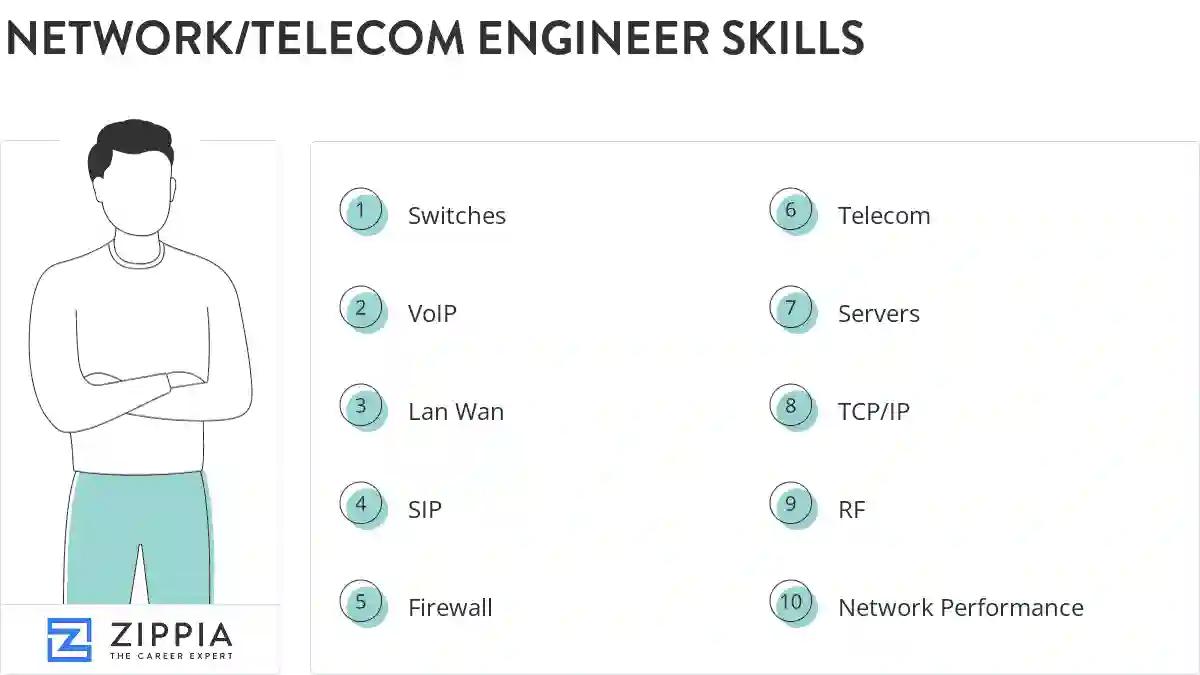
The most important skills for a network/telecom engineer resume and required skills for a network/telecom engineer to have include:
- Switches
- VoIP
- Lan Wan
- SIP
- Firewall
- Telecom
- Servers
- TCP/IP
- RF
- Network Performance
- Unity
- QoS
- BGP
- DNS
- Unified Communications
- VPN
- OSPF
- Avaya
- Network Problems
- Linux
- Capacity Planning
- PBX
- CUCM
- SolarWinds
- ATM
- STP
- Series Routers
- Cisco Asa
- PRI
- Cisco Voip
- Troubleshoot
- Telecommunication
- Technical Issues
- SCADA
- Windows
- F5
- UCCX
- Phone System
- Broadband
- Network Issues
- Nortel
- Radius
- Data Centers
- ACD
- Provisioning
Updated January 8, 2025
