What does a neurodiagnostic technologist do?
A neurodiagnostic technician specializes in operating digital medical equipment and running tests such as electroencephalograms and polysomnograms to help physicians diagnose brain abnormalities and nervous system issues. Among their responsibilities include assisting patients by reviewing their medical information and history, explaining the extent of tests and procedures, letting them know what they are about to feel and experience, and making them feel comfortable in every process. Moreover, a neurodiagnostic technician must present the results to the physicians accurately and promptly.
Neurodiagnostic technologist responsibilities
Here are examples of responsibilities from real neurodiagnostic technologist resumes:
- Open and close department independently and also assist surgical staff by managing QC and providing radiopharmaceuticals as needed for procedures.
- Score sleep stages, seizures, respiratory, and clinical events by applying AASM guidelines.
- Maintain safe, clean EEG lab and equipment as well as EEG and EKG supplies.
- Perform EKG and EEG procedures.
- Perform diagnostic, split and titration studies.
- Conduct tests or studies such as electroencephalography (EEG).
- Perform all RPSGT duties including: scoring and generating reports.
- Conduct long term epilepsy monitoring (LTME) on all ages.
- Verify and process insurance using ICD-9 / CPT billing and coding software.
- Calibrate, troubleshoot, or repair equipment and correct malfunctions as needed.
- Develop education plan to result in all sleep technicians to become RPSGT.
- Perform QC for all diagnostic equipment including hot lab instruments and dosimeter.
- Work closely with the manager of the neurology team and other neurology staff.
- Pay attention to clinical findings and alert the neurology in charge as needed.
- Calibrate, evaluate, and adjust testing equipment; troubleshoot and repair equipment problems.
Neurodiagnostic technologist skills and personality traits
We calculated that 28% of Neurodiagnostic Technologists are proficient in Patients, Patient Care, and Epilepsy. They’re also known for soft skills such as Detail oriented, Math skills, and Physical stamina.
We break down the percentage of Neurodiagnostic Technologists that have these skills listed on their resume here:
- Patients, 28%
Recognized artifact and properly documented the patient's condition and archived patients when finished.
- Patient Care, 12%
Collaborated across teams between necessary health contacts in line with patient care and confidentiality.
- Epilepsy, 8%
Performed long term epilepsy monitoring.
- Intraoperative, 6%
Performed intraoperative monitoring with various types of monitoring equipment to collect diagnostic patient data.
- CPR, 6%
Maintained CPR certification with yearly credits.
- Nerve Conduction Studies, 4%
Performed nerve conduction studies in numerous doctor's offices around the state of Arizona.
Common skills that a neurodiagnostic technologist uses to do their job include "patients," "patient care," and "epilepsy." You can find details on the most important neurodiagnostic technologist responsibilities below.
Detail oriented. One of the key soft skills for a neurodiagnostic technologist to have is detail oriented. You can see how this relates to what neurodiagnostic technologists do because "radiologic and mri technologists must follow instructions exactly to get the images needed for diagnoses." Additionally, a neurodiagnostic technologist resume shows how neurodiagnostic technologists use detail oriented: "crossed trained in eegs and eps and provided detailed documentation of patient outcome to attending physician/surgeon. "
Math skills. Another essential skill to perform neurodiagnostic technologist duties is math skills. Neurodiagnostic technologists responsibilities require that "radiologic and mri technologists may need to calculate the proper amount of radiation or magnetic resonance emitted in imaging procedures." Neurodiagnostic technologists also use math skills in their role according to a real resume snippet: "document statistics, type transcription, schedule patients, and maintain inventory. "
Physical stamina. This is an important skill for neurodiagnostic technologists to perform their duties. For an example of how neurodiagnostic technologist responsibilities depend on this skill, consider that "radiologic and mri technologists often work on their feet for long periods during their shift and must be able to lift and move patients who need help." This excerpt from a resume also shows how vital it is to everyday roles and responsibilities of a neurodiagnostic technologist: "create a patient history and physical for physician review. ".
Technical skills. neurodiagnostic technologist responsibilities often require "technical skills." The duties that rely on this skill are shown by the fact that "radiologic and mri technologists must understand how to operate complex machinery." This resume example shows what neurodiagnostic technologists do with technical skills on a typical day: "completed eeg's with technical impressions. "
The three companies that hire the most neurodiagnostic technologists are:
- WakeMed34 neurodiagnostic technologists jobs
- BayCare Health System16 neurodiagnostic technologists jobs
- Phoenix Children's16 neurodiagnostic technologists jobs
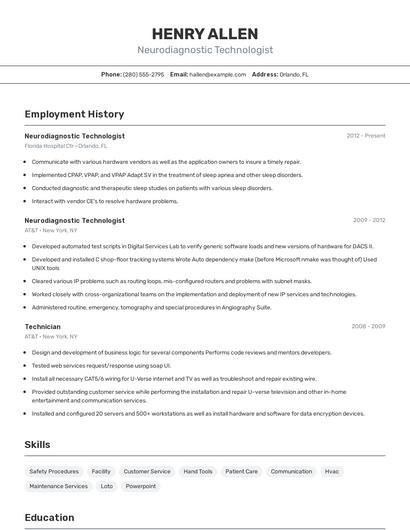
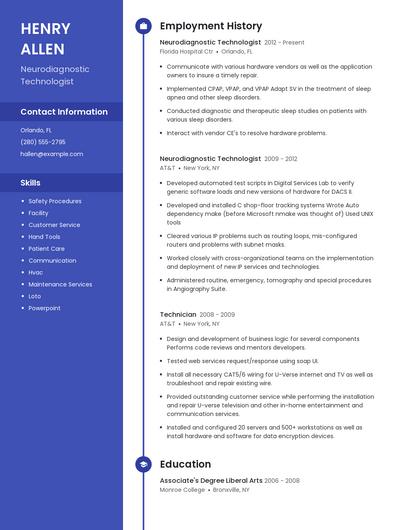
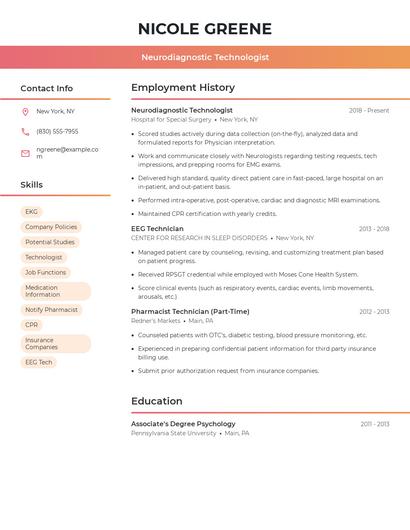
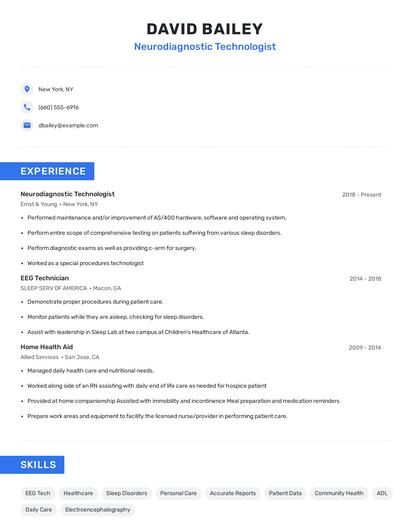
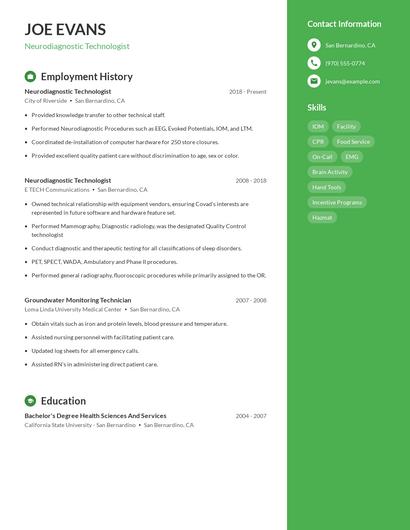
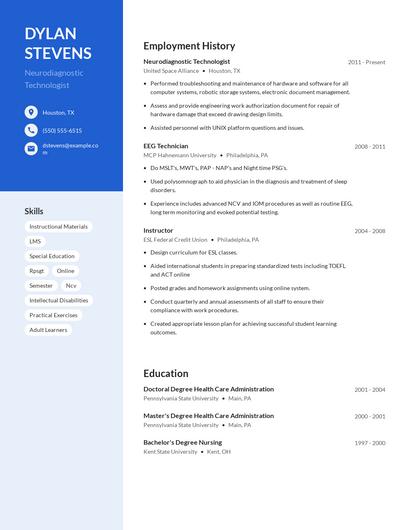
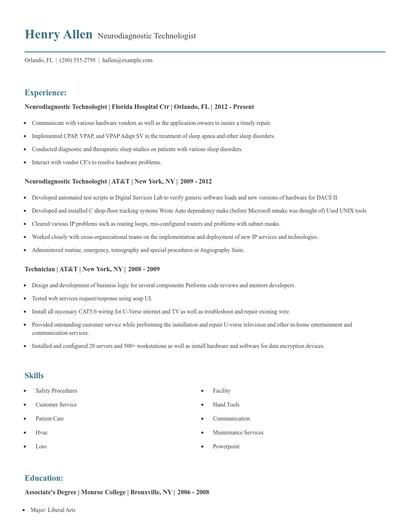
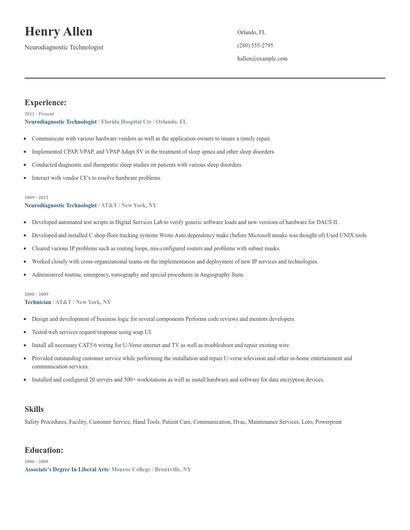
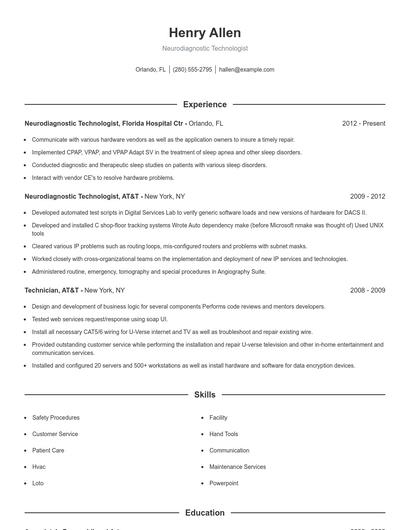
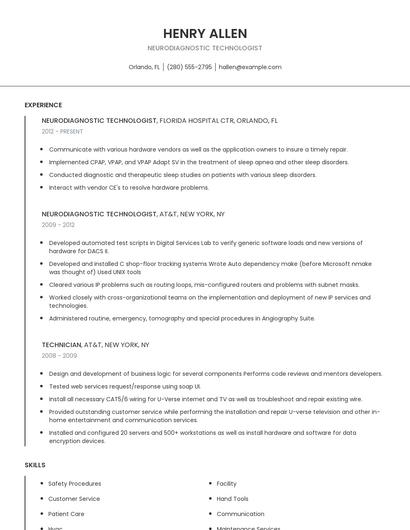
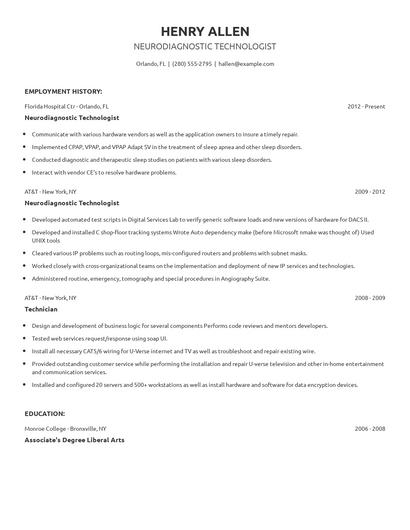
Choose from 10+ customizable neurodiagnostic technologist resume templates
Build a professional neurodiagnostic technologist resume in minutes. Our AI resume writing assistant will guide you through every step of the process, and you can choose from 10+ resume templates to create your neurodiagnostic technologist resume.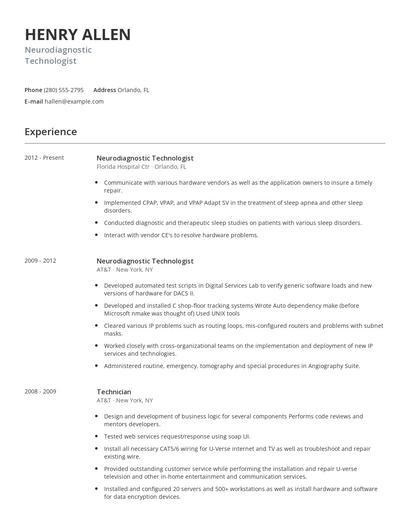
Compare different neurodiagnostic technologists
Neurodiagnostic technologist vs. Clinical supervisor, epilepsy monitoring unit
These skill sets are where the common ground ends though. The responsibilities of a neurodiagnostic technologist are more likely to require skills like "patients," "patient care," "epilepsy," and "intraoperative." On the other hand, a job as a clinical supervisor, epilepsy monitoring unit requires skills like "critical care," "coordinators," "appeals," and "service recovery." As you can see, what employees do in each career varies considerably.
On average, clinical supervisors, epilepsy monitoring unit reach higher levels of education than neurodiagnostic technologists. Clinical supervisors, epilepsy monitoring unit are 15.1% more likely to earn a Master's Degree and 5.8% more likely to graduate with a Doctoral Degree.Neurodiagnostic technologist vs. Lead neurodiagnostic technologist
In addition to the difference in salary, there are some other key differences worth noting. For example, neurodiagnostic technologist responsibilities are more likely to require skills like "patients," "epilepsy," "intraoperative," and "cpr." Meanwhile, a lead neurodiagnostic technologist has duties that require skills in areas such as "neurodiagnostic," "aset," "bed facility," and "american association." These differences highlight just how different the day-to-day in each role looks.
In general, lead neurodiagnostic technologists achieve similar levels of education than neurodiagnostic technologists. They're 3.7% less likely to obtain a Master's Degree while being 5.8% less likely to earn a Doctoral Degree.Updated January 8, 2025
