
Automatically apply for jobs with Zippia
Upload your resume to get started.
Non-destructive testing technician skills for your resume and career
15 non-destructive testing technician skills for your resume and career
1. NDT
Non-Destructive Testing, NDT, is a combination of different test techniques used individually or collectively to evaluate the integrity and properties of a material, component, system, or structure without permanently altering it. NDT is important for safe operation, as well as for quality control and lifetime evaluation of the system. It is used in industries such as aerospace, oil, and gas, nuclear, power generation, medical, rail, general manufacturing, etc.
- Show continuous progression within the NDT certification process based on feedback from others as well as successfully passing various examinations.
- Perform NDT testing VT, PT., MT, and UT in accordance with ASNT standards and customer specifications.
2. Destructive Testing
- Provide superior Quality Assurance/Quality Control for government and contracted companies using scientific non-destructive testing methods.
- Calibrated and maintained over 100 pieces of sensitive non-destructive testing equipment.
3. Magnetic Particle
Magnetic Particle testing, also known as Magnetic Particle Inspection, is a method or examination used to determine the flaws of the surface and subsurface materials like nickel, iron, cobalt, and alloy.
- Inspected pipes using established methods such as wet/dry or magnetic particle inspection to detect abnormalities in ferrous materials.
- Worked with magnetic particle, dye penetration and ultrasound testing.
4. Radiographic Procedures
- Establish radiation areas for radiographic operations.
- Produce images of objects on film using radiographic techniques.
5. PT
PT which stands for Prothrombin Time is a test to evaluate the body's ability to properly form blood clots using one's blood sample. PT results are used to calculate the International Normalized Ratio (INR) which detects the effectiveness of blood-thinning medications like Warfarin taken by patients that have blood-clotting disorders.
- Experience with: Digital video cameras, Computers, Power drills, Olympus-brand Ultrasonic inspection equipment, PT and MT procedures.
- Performed PT, MT, VT and RT methods on refurbished turbine engine components to customer specifications.
6. Level II
Level II often marks a grade of experience one gains in the workplace. Depending on the field, a Level II certification may require a certain class or number of years of on-site work and training. For instance, in a medical or therapeutic field, a Level II designation is applied to individuals that achieve professionalism in their career, who demonstrate a higher level of clinical reasoning, and that help a certain number of clients.
- Worked as a Level II Radiographer; X-Ray pipeline and various pipeline facilities in accordance with various code and safety guidelines.
- Worked as a Level II Radiographer.
Choose from 10+ customizable non-destructive testing technician resume templates
Build a professional non-destructive testing technician resume in minutes. Our AI resume writing assistant will guide you through every step of the process, and you can choose from 10+ resume templates to create your non-destructive testing technician resume.7. Liquid Penetrant
- Review the parts previous repairs along with engineering drawings to apply the most efficient method of applying the liquid penetrant.
- Performed radiographic and liquid penetrant inspections in an aerospace foundry on aluminum castings.
8. Test Results
- Interpreted and evaluated test results and maintained equipment.
- Interpreted or evaluated test results in accordance with ASNT recommended practice SNT-TC-1A and applicable procedures, standards and/or codes.
9. Ultrasound
Ultrasound refers to an imaging method that uses high-frequency sound waves to produce images of structures within your body.
- Performed general metals and weld strength testing using Radiography and Ultrasound Technology.
- Performed inspection using x-ray, ultrasound, fluorescent, oil analysis and magnetic techniques.
10. Test Equipment
Test equipment is a mechanical tool or a device which is used create signals and gather response from an electronic device under test. It helps in detecting any faults in the device and it also proves the proper operation of the electronic device.
- Calibrated test equipment such as eddy current and ultrasonic contact machines to standard settings.
- Repaired test equipment (maintenance) Preventive Maintenance Lubrication of equipment Plant Maintenance Hydraulics & Pneumatics Electrical Repair
11. NDI
- Completed two of four series of the NDI Career Development Courses to obtain a Level 5 Journeyman status.
- Trained and mentored over 10 other NDI technicians vastly increasing their knowledge base in NDI techniques and theory.
12. NDE
Nondestructive evaluation (NDE) is a term used in describing quantitative measurements and locating a defect. It helps identify material properties like formability and fracture toughness. Majority of people know the technology used in NDE from the medical industries such as x-ray and ultrasound.
- Perform as Lead NDE Technician on Capital Projects for various contractors.
- Developed and maintained procedures and techniques in all NDE methods.
13. Inspection Methods
- Used X-ray and isotope inspection methods to verify engine component integrity.
- Complete frequent training on various inspection methods
14. ET
- Performed Level II inspections in UT and ET areas on the same aircraft.
- Eddy Current Testing (ET), Radiography Testing(RT); film and digital.
15. Ultrasonic Inspection
- Instructed the Air Force how to perform specific ultrasonic inspections on the 3rd fan hub of F-100 engines.
- Aided in critical Ultrasonic inspections at two different CAT facilities.
5 Non-Destructive Testing Technician resume examples
Build a professional non-destructive testing technician resume in minutes. Browse through our resume examples to identify the best way to word your resume. Then choose from 5+ resume templates to create your non-destructive testing technician resume.

What skills help Non-Destructive Testing Technicians find jobs?
Tell us what job you are looking for, we’ll show you what skills employers want.
List of non-destructive testing technician skills to add to your resume
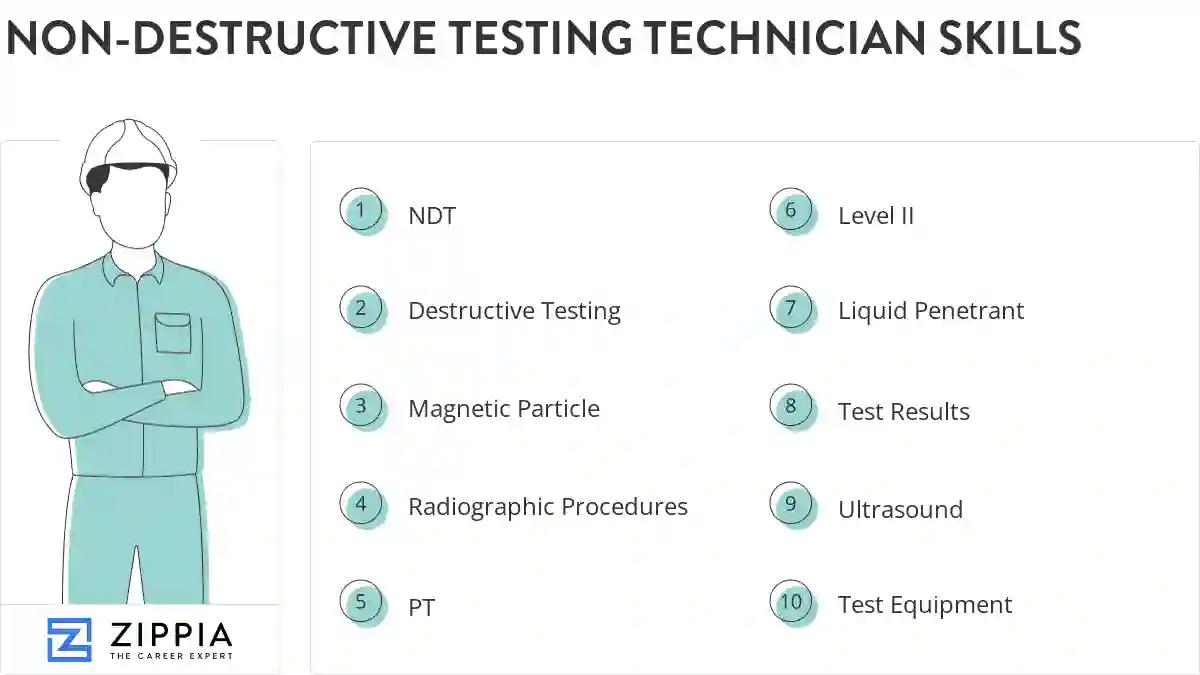
The most important skills for a non-destructive testing technician resume and required skills for a non-destructive testing technician to have include:
- NDT
- Destructive Testing
- Magnetic Particle
- Radiographic Procedures
- PT
- Level II
- Liquid Penetrant
- Test Results
- Ultrasound
- Test Equipment
- NDI
- NDE
- Inspection Methods
- ET
- Ultrasonic Inspection
- Inspection Results
- OSHA
- AWS
- Ultrasonic Testing
- Dye Penetrant
- API
- Inspection Equipment
- Snt-Tc-1A
- Aircraft Components
- Structural Integrity
- Acceptance Criteria
- Visual Inspections
- Autocad
- FPI
- Hardness Testing
- Pressure Vessels
- Inspection Reports
- Etching
- PMI
- Aerospace Components
- ISO
- Ground Support Equipment
- Shear Wave
Updated January 8, 2025
