
Automatically apply for jobs with Zippia
Upload your resume to get started.
Nursing service administrator skills for your resume and career
15 nursing service administrator skills for your resume and career
1. Patients
- Monitored patients during exercise and recognized and quickly responded to the changing patient condition.
- Consulted with nutritionist to maintain adequate caloric intake of patients in compromised state.
2. CPR
Cardiopulmonary resuscitation or CPR is a medical procedure that involves chest compression to help a patient breathe. This artificial ventilation helps in keeping the brain function in place and regulates blood throughout the body. CPR is a lifesaving procedure that is used in emergencies.
- Assist with all emergency operational procedures including Initiate basic CPR in event of emergency situations related to dialysis treatment.
- Initiate basic CPR measures in the event of cardiac and/or pulmonary arrest and respond to emergency situations related to dialysis treatment
3. Blood Products
Blood products refer to the therapeutic substances that can be obtained from human blood. This includes blood plasma, blood platelets, and red blood cells as well as "whole blood." These components are used for several medical purposes, such as blood transfusions and assisting those with blood diseases.
- Establish intravenous access, administration of blood and blood products; thrombolytics, sympathomimetics, anesthetics, and anti-arrhythmic drugs.
4. Home Health
- Provided home health visits to patient in home.
- Home Health Nurse Provide pediatric/adult home health care for critical or chronic illness or injury.
5. Surgery
- Verify that consents are signed and the correct site is marked for the procedure and surgery.
- Organize, review, and ensure all patient consent forms are signed before surgery begins.
6. Infection Control
Infection control describes the principles and practices used in hospitals and other healthcare facilities to control and minimize the spread of infections with the aim of lowering rates of infection. Infection control refers to the process of detecting and controlling pathogens in order to reduce their spread.
- Participated in quality improvement initiative, staff development, safety, and infection control activities.
- Participated in the implementation and maintenance of the facility Infection Control program.
Choose from 10+ customizable nursing service administrator resume templates
Build a professional nursing service administrator resume in minutes. Our AI resume writing assistant will guide you through every step of the process, and you can choose from 10+ resume templates to create your nursing service administrator resume.7. Hemodialysis
- Maintained strict monitoring, diagnosis, and troubleshooting of specialized hemodialysis equipment to ensure patient safety.
- Provide hemodialysis to acute as well as chronic renal failure patientshospitalized for various illness.
8. Physician Orders
Physician orders are an instruction or a set of instructions given to a patient by a doctor. This could range from being put on bedrest to being given a prescription to fill and take.
- Administered direct nursing care as ordered and defined by physician order and incompliance with the established nursing practice guidelines.
- Transcribed physician orders accurately and complete necessary paperwork for follow through and completion of orders.
9. Patient Safety
- Assess and intervene on trends that are detrimental to patient safety and patient care
- Uphold all institutional policies regarding confidentiality, patient safety, communication, and the minimization of hazards.
10. Rehabilitation
- Provide rehabilitation training for independent living, referrals for needed services and service coordination with other providers.
- Provided medical assistance and performed duties as a licensed nursing assistant at local nursing home and rehabilitation centers.
11. Patient Education
- Coordinated and developed patient education materials.
- Assisted physicians with examinations and in-office procedures as well as patient education
12. IV
- Provided training and orientation to staff on the usage of IV drips, and precept students in an outpatient setting.
- Assisted the Nurse Manager in the daily operations of the PICC and IV services.
13. Term Care
- Coordinated the care and services of long-term care participants across the continuum of illness for 175 to 200 active participants.
- Reviewed medical records and assessed residents in long term care facilities for levels of care for Medicaid reimbursement.
14. EKG
- Combined pieces of information to form general rules or conclusions which included reading EKG machines.
- Set up telemetry units, EKG removed hep locks, stock order, assisted patients with healing and recovery after surgery.
15. Medical Care
- Provided emergency medical care to approximately 120 per day within a 19-bed Emergency/Trauma Department.
- Coordinated medical care for two eight-bed ICF and one, two-bed IRA Home.
5 Nursing Service Administrator resume examples
Build a professional nursing service administrator resume in minutes. Browse through our resume examples to identify the best way to word your resume. Then choose from 5+ resume templates to create your nursing service administrator resume.

What skills help Nursing Service Administrators find jobs?
Tell us what job you are looking for, we’ll show you what skills employers want.
What skills stand out on nursing service administrator resumes?
Comora Sarah
Assistant Clinical Professor, Merrimack College
What soft skills should all nursing service administrators possess?
Comora Sarah
Assistant Clinical Professor, Merrimack College
List of nursing service administrator skills to add to your resume
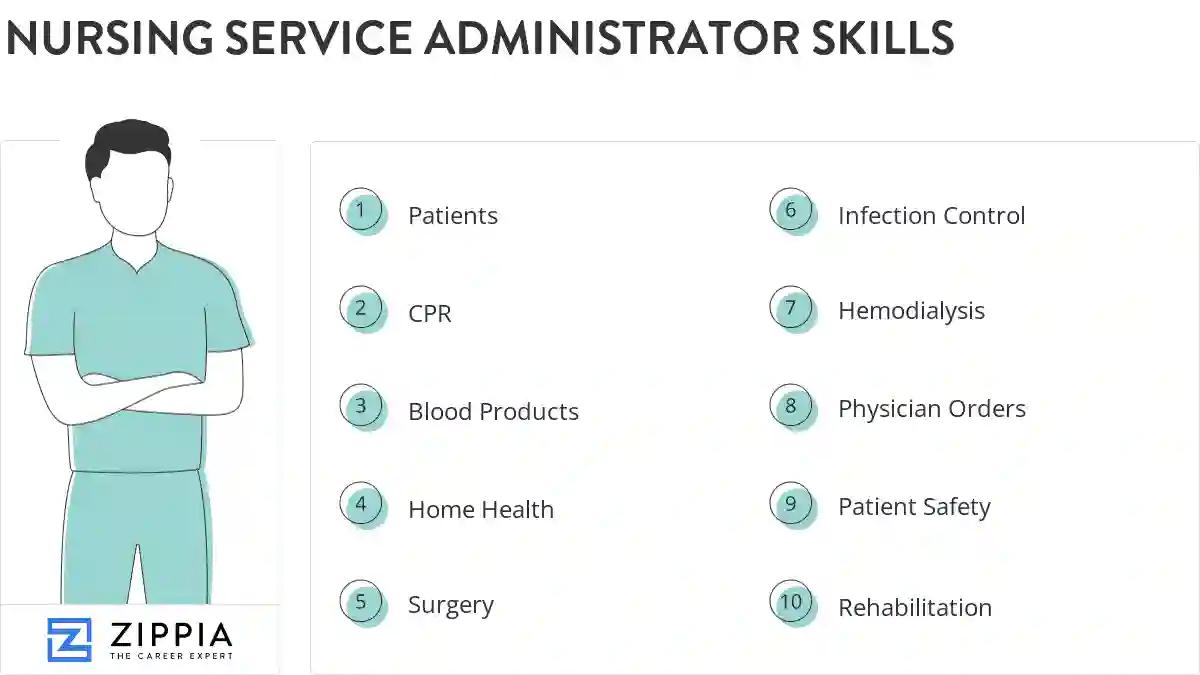
The most important skills for a nursing service administrator resume and required skills for a nursing service administrator to have include:
- Patients
- CPR
- Blood Products
- Home Health
- Surgery
- Infection Control
- Hemodialysis
- Physician Orders
- Patient Safety
- Rehabilitation
- Patient Education
- IV
- Term Care
- EKG
- Medical Care
- Healthcare Professionals
- Medication Administration
- Direct Patient Care
- Social Work
- Resuscitation
- Chemotherapy
- PICC
- Patient Assessment
- Blood Draws
- Vital Signs
- Medical History
- EMR
- Lab Values
- Correctional
- State Regulations
- Catheter
- Blood Pressure
- GYN
- Labor Delivery
- Test Results
- Vital Statistics
- Direct Supervision
Updated January 8, 2025
