Explore jobs
Find specific jobs
Explore careers
Explore professions
Best companies
Explore companies
Job outlook for office administration instructors in the United States
Are office administration instructor jobs in demand?
Office administration instructor job and salary trends over time
Office administration instructor jobs over time
Office administration instructor job growth rate over time
| Year | # of jobs | % of population |
|---|---|---|
| 2021 | 1,090 | 0.00% |
| 2020 | 1,094 | 0.00% |
| 2019 | 1,160 | 0.00% |
| 2018 | 1,141 | 0.00% |
| 2017 | 1,178 | 0.00% |
Average office administration instructor salary over time
Office administration instructor salary by year
| Year | Avg. salary | Hourly rate | % Change |
|---|---|---|---|
| 2025 | $56,181 | $27.01 | +1.8% |
| 2024 | $55,171 | $26.52 | +2.8% |
| 2023 | $53,656 | $25.80 | +2.9% |
| 2022 | $52,121 | $25.06 | +1.9% |
| 2021 | $51,171 | $24.60 | +2.4% |
Office administration instructor jobs by state
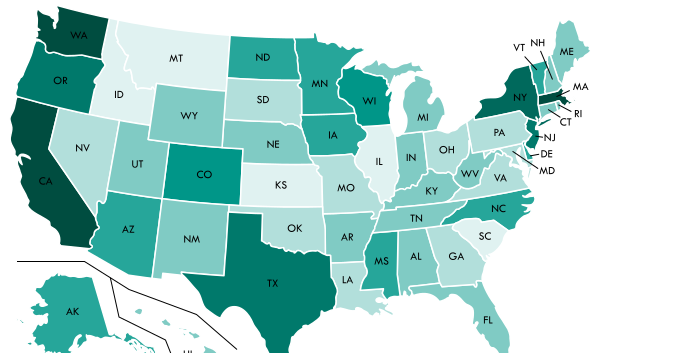
Most common states for office administration instructors
| Rank | State | Population | # of jobs | Employment/ 1000ppl |
|---|---|---|---|---|
| 1 | Alaska | 739,795 | 129 | 17% |
| 2 | District of Columbia | 693,972 | 103 | 15% |
| 3 | Wyoming | 579,315 | 82 | 14% |
| 4 | Colorado | 5,607,154 | 755 | 13% |
| 5 | Virginia | 8,470,020 | 1,001 | 12% |
| 6 | Montana | 1,050,493 | 118 | 11% |
| 7 | Delaware | 961,939 | 107 | 11% |
| 8 | North Dakota | 755,393 | 83 | 11% |
| 9 | Vermont | 623,657 | 70 | 11% |
| 10 | Georgia | 10,429,379 | 1,050 | 10% |
| 11 | Massachusetts | 6,859,819 | 697 | 10% |
| 12 | South Carolina | 5,024,369 | 522 | 10% |
| 13 | Oregon | 4,142,776 | 430 | 10% |
| 14 | Iowa | 3,145,711 | 302 | 10% |
| 15 | Florida | 20,984,400 | 1,919 | 9% |
| 16 | North Carolina | 10,273,419 | 889 | 9% |
| 17 | Minnesota | 5,576,606 | 477 | 9% |
| 18 | Utah | 3,101,833 | 270 | 9% |
| 19 | New Hampshire | 1,342,795 | 121 | 9% |
| 20 | California | 39,536,653 | 3,147 | 8% |
Most common cities for office administration instructors
| Rank | City | # of jobs | Employment/ 1000ppl | Avg. salary |
|---|---|---|---|---|
| 1 | Herndon | 1 | 4% | $50,798 |
| 2 | Huntington Park | 2 | 3% | $75,132 |
| 3 | Garden Grove | 2 | 1% | $74,617 |
| 4 | Shreveport | 2 | 1% | $48,062 |
| 5 | Albany | 1 | 1% | $47,516 |
| 6 | Fort Collins | 1 | 1% | $62,311 |
| 7 | Oceanside | 1 | 1% | $73,491 |
| 8 | Pompano Beach | 1 | 1% | $52,487 |
| 9 | Salinas | 1 | 1% | $81,306 |
| 10 | West Covina | 1 | 1% | $75,061 |
| 11 | Jacksonville | 2 | 0% | $53,166 |
| 12 | Fayetteville | 1 | 0% | $59,007 |
| 13 | Hialeah | 1 | 0% | $52,443 |
| 14 | Houston | 1 | 0% | $67,188 |
| 15 | Los Angeles | 1 | 0% | $75,333 |
| 16 | Miami | 1 | 0% | $52,422 |
| 17 | Orlando | 1 | 0% | $52,793 |
| 18 | Tampa | 1 | 0% | $52,949 |
Office Administration Instructor job outlook: Expert opinions
Our panel of office administration instructor experts
Tiffin University

Eastern Washington University

Wayland Baptist University
University of California, Santa Barbara

Columbus State University

Grambling State University

University of Nebraska-Lincoln
Clemson University

Washington University in St Louis

Santa Clara University
The University of North Carolina Greensboro
University of Minnesota Crookston
University of Central Florida
Elmira College

Pennsylvania State University
Dr. Stephanie Opfer
Associate Professor of English, Assistant Dean of the School of Creative and Media ArtsTiffin University
Visual And Performing Arts
What will help Office Administration Instructors increase their earning potential?
Dr. Stephanie Opfer: Unfortunately, teaching as an adjunct does not pay well. Students should keep their full-time jobs and teach part-time until they find a full-time job at a college or university. That part-time teaching provides them valuable experience and connections that make them more competitive candidates for full-time positions because they'd also be competing with candidates who have PhDs. So adjunct work is more of a long-term investment rather than an immediate return. Also, even full-time teaching jobs don't pay particularly well, so they'll really need to love teaching if they want to do it full-time. If they don't like teaching as an adjunct, they won't like doing it full-time.
Will there be an enduring impact of the coronavirus pandemic on Office Administration Instructors?
Jillene Seiver Ph.D.: Of course. I am in psychology, and there are two main types of psychologists: Applied (counseling, clinical, I/O, and school) and Basic Research/Academia.
Applied: One known change is the increase in telehealth. Psychology pioneered this method of treatment, but it has really become mainstream, and I suspect many clinical psychologists and counselors will spend at least part of their day in this type of therapy session.
Basic Research/Academia:
-More classes will be online and hybrid, now that everyone has been forced to adopt this strategy.
-More research studies will be conducted online in one way or another.
-Fewer faculty jobs will be tenure-track.
Will there be an enduring impact of the coronavirus pandemic on Office Administration Instructors?
Dr. Perry Collins: I am not convinced that there will be an enduring impact. However, graduating students need to understand that it may take longer to find their first professional job and to not get discouraged. The economy wants to get back on track.
Spencer Mermelstein
Graduate Student Researcher and InstructorUniversity of California, Santa Barbara
Psychological & Brain Sciences
What certifications/licenses/courses can have the biggest impact for Office Administration Instructors?
Spencer Mermelstein: I have two responses to this question. First, during your time in your degree program, you should try to find the topic or subject that just captivates you. Find out what your passion is and learn what career options are available to enact that passion. Perhaps beyond a particular course or license, I would say to try to speak with someone in that career and from there begin working in that field even as an intern or assistant. For example, to gain research experience in preparation for graduate school, meeting with professors whose work interests you and gaining a position in their lab as a research assistant is invaluable. Assistantships and internships will open all sorts of doors to where you want to go.
Secondly, what often makes Psychology graduates valuable to employers is our research skills. Increasingly, this means computer skills. Computer programming and coding is such a powerful, desirable, and just useful skill. Within Psychology, we need programming for putting together surveys and experiments and for analyzing data. Outside of Psychology, programming and data analysis are in huge demand by all sorts of industries. So I would recommend any and all courses, certificates, licenses in computer programming. RStudio, JavaScript, and/or Python seem to be the most commonly used languages. Along with this, expertise in psychological research methods and statistics is highly marketable.
Dr. Diana Riser Ph.D.
Associate Professor of PsychologyColumbus State University
Psychology Department
What are the biggest trends we'll see in the Office Administration Instructor job market given the pandemic?
Dr. Diana Riser Ph.D.: I think while we are likely to see some jobs becoming more limited, we are seeing an increased need for other jobs. For example, there has been a greater demand for helping positions and positions that support positive mental health & wellbeing (e.g., counselors). In terms of all jobs, there is an increased demand for flexibility and well-rounded skills. Job places may need candidates with more flexible schedules or candidates with the ability to work remotely with proficiency. It's an interesting and changing phase in our world as we get a better sense of what jobs can operate in a work from home/telehealth capacity versus those that truly need to be in person. We are also seeing a focus on increasing diversity in mental health fields as there is a clear need for practitioners from underrepresented or historically marginalized groups.
What Office Administration Instructor skills would you recommend for someone trying to advance their career?
Dr. Cheyrl Ensley: Training to be essential is critical. Increasing skills in using technology are necessary. Keeping students engaged and actively learning through technology is a crucial tool that will be extremely important to a teacher, whether teaching in person or virtually. Additionally, the gap year should be used to identify an area of interest for work. Once the site is specified, the graduate should build professional relationships and learn the site's culture.
What Office Administration Instructor skills would you recommend for someone trying to advance their career?
Suzanne Kemp Ph.D.: They need to stay engaged in some level of working with people with disabilities. If they do something that isn't relevant to the field, they won't be as marketable as a new graduate.
Bo Clements
Lecturer of American Sign LanguageClemson University
Department of Languages
What experience really stands out on Office Administration Instructor resumes?
Bo Clements: 1) teaching ASL included four parts: Educational background, Teaching background, Professional Development evidenced with hours, and Deaf Community Service. 2)Degrees (Must have MA or higher). 3) ASLPI score of 4 or higher, SLPI: ASL rating of Advanced Plus or higher or other proficiency interviews approved in the future. 4) List of courses you took to teach ASL - ASL Literature, ASL Linguistics, Deaf Culture/Deaf Community, Teaching Methods (ASL or Foreign Language), Assessment Tools, and Curriculum Development or Language Acquisition. Hold certification of American Sign Language Teachers Association, Inc. Also, show your expertise in using technology, such as the ZOOM platform, plus know how to edit a video, etc.
Will there be an enduring impact of the coronavirus pandemic on Office Administration Instructors?
Bo Clements: Pandemic during life after Graduation is very obviously tricky. Look at the unemployment rates. Millions of job positions are in a freeze. No jobs out there. A positive note that a student has a degree in American Sign Language with specialization in Interpretation Education & Training, Wireless Technology, or Development & Innovative of Social Media allows working from home to create thousands of online jobs - Teaching, Marketing, Engineering, Spectrum of Technology, and many more.
We cannot remove our masks, making it so difficult to communicate, as it's hard to read people's lips. That is the number 1 communication barrier for all of us. We cannot be close or touch each other in a public place, even at work, to communicate in person. That makes it so difficult to find jobs.
What type of skills will young Office Administration Instructors need?
Catherine Dunkin: A public relations career offers challenge, variety, and a unique chance to combine strategy and creativity to accomplish business objectives. Some critical competencies include:
Communication Skills:
- Writing
- Speaking and oral presentations
- Research
- Traditional and social media
- Active listening
- Relationship-building
- Speaking and oral presentations
Business Acumen:
- Critical thinking, problem-solving, decision-making
- Time management and ability to prioritize/meet deadlines
- Adaptability
- Data gathering and analysis
- Strategic planning
- Awareness of the global impact
- Entrepreneurial and consulting approaches
Creativity and Design Skills:
- Graphic design and data visualization
- Ability to produce useful materials from documents to presentations to online blogs, newsletters, websites, etc.
Are there any particularly good places in the United States for Office Administration Instructors to find work opportunities?
Catherine Dunkin: Graduates who can combine healthy critical thinking and communication skills should find positions available nearly anywhere they would like to live and work. They will find growth areas in healthcare, management consulting, technology, and operations/supply chain.
Graduates have an opportunity to think carefully about and pursue rewarding careers in line with their personal goals, values, and geographical preferences. They may consider entrepreneurial start-ups, local nonprofits with compelling community missions, or larger management consulting firms and corporations offering global clients and projects exposure.
How do you envision technology impacting Office Administration Instructors in the next 5 years?
Catherine Dunkin: Technology will continue to transform the public relations professional's job over the next five years. Today's professional will continue managing with a dramatically reduced number of traditional media outlets and an ever-increasing array of social media platforms, all with 24/7 deadline requirements.
To grow as leaders and trusted advisors to business executives, public relations professionals must continue to understand how to use data and technology in developing strategies, messages, and plans to engage sophisticated stakeholders. Technology will help measure results and show the impact of public relations efforts, which will continue to be critical in showing value and implications for their organizations.
What type of skills will young Office Administration Instructors need?
Dr. Radhika Grover: Graduates entering the workforce will need strong critical thinking skills and the ability to wear multiple hats. For example, the data scientist may need to understand, or even work on, web programming. Job seekers will need strong programming skills in one or more of these programming languages - Python, Java, C, C++, and Javascript. Graduates should also consider getting a second degree in another field, such as bioengineering or electrical engineering, because the intersection of disciplines can provide new research and development opportunities. A student once asked me, "If machines can do everything we do and do it better, what will we do in the future?" Graduates have to be ready to refresh their skill sets periodically so that they are irreplaceable.
April Dawkins Ph.D.
Assistant ProfessorThe University of North Carolina Greensboro
Library & Information Science Department
What experience really stands out on Office Administration Instructor resumes?
April Dawkins Ph.D.: Across the United States, most school librarians are required to have a graduate degree in either education or library and information science with licensure as a school librarian (school library media coordinator). The most likely experience to benefit them in their job search is a previous experience as a classroom teacher. Teaching is one of the significant roles that school librarians play in schools, through direct and indirect instruction with students, and professional development for classroom teachers.
Dr. Margaretha Rudstrom
LecturerUniversity of Minnesota Crookston
Agriculture and Natural Resources Department
What experience really stands out on Office Administration Instructor resumes?
Dr. Margaretha Rudstrom: I take this from the skill sets that experiences provide, rather than a particular job a student may have had. Experiences where you have to deal with people, will stand out. Those experiences could be where you are a member of a team where your contributions helped contribute to the group's success.
Experiences working with customers or clients is also a big plus. People who have good communication skills and interpersonal skills are valuable employees in an organization. This skill set allows you to represent your organization professionally.
For many of my students, these people skills are developed in their part-time jobs while they are students and during their internships required to complete their Bachelor of Science degree. The internships allow students to develop their people skills and apply their knowledge from their courses in the real world.
Another experience that stands out on resume is studies abroad. In the Pre-Covid time, I highly encouraged my students to take part in a study abroad experience. That could be anything from studying abroad over spring break to a semester-long study abroad at another University. This experience shows a person who is willing to get out of their comfort zone and try something new. From an employer's perspective, it is good to have people willing to try new things. The study abroad allows students to experience something different, to see things through different lenses or perspectives.
Will there be an enduring impact of the coronavirus pandemic on Office Administration Instructors?
Dr. Kathleen Hohenleitner: Sure, I think a negative economic impact is almost inevitable. The good news is that the pandemic caused a lot of companies to operate primarily via the internet, even more so than did before, so I can only hope that means that more internet writing and editing will be available for our graduates.
Are there any particularly good places in the United States for Office Administration Instructors to find work opportunities?
Dr. Kathleen Hohenleitner: Well, many students come to school intending to work in "book publishing," which I think means they want to read manuscripts at Penguin. That's not a super realistic goal for anyone unless they are in New York City, are independently wealthy, and are willing to start at the very bottom of the ladder. But there are nonetheless many other jobs for good writers, editors, and researchers all around the country. We were seeing more writers telecommuting even before the pandemic too, so I hope that indicates that such jobs are more about performance than about location.
There were also many jobs being advertised for English teachers in local public schools before the pandemic. I hope that continues.
What general advice would you give to an Office Administration Instructor?
Rebecca Sarver: Listen more than you talk. There is so much to be learned from clients, seasoned human service workers, and the community that you work within. By listening and observing versus always feeling compelled to speak, you will learn job skills, people skills, and your clients' needs.
Will there be an enduring impact of the coronavirus pandemic on Office Administration Instructors?
Rebecca Sarver: Yes, coronavirus pushed many disciplines, including human services, into virtual service provision. Some clients and some staff may prefer to work remotely. I have read that some organizations found their employees to be more productive when working from home. Conducting some work from home and having virtual meetings with other service providers even while at the job site can be a real time saver and money saver for all parties involved.
Will there be an enduring impact of the coronavirus pandemic on Office Administration Instructors?
Stephen Feldbauer: The need for Materials Engineers will continue to be healthy, and one may argue that it will grow. As the workforce ages and people leave, young engineers will be needed to backfill the workplace and work in new opportunities created by advancing technology and industry.
The pandemic and resultant online teaching approach have caused many students to take a gap year, attend a local college, or defer college altogether. So few universities offer a Materials Engineering program. Those who do typically graduate a small number of Materials Engineers; hence, fewer graduates will fill the vacancies and the growing need.