
Automatically apply for jobs with Zippia
Upload your resume to get started.
Operations sergeant skills for your resume and career
15 operations sergeant skills for your resume and career
1. Combat
Combat is a violent conflict between two parties. Combat can be held by using weapons or unarmed. The fighting between the armed forces of different countries can also be called combat and the main purpose of the combat is to eliminate and stop your opponent from achieving their goal.
- Led detachment planning, preparations and execution of Pre-Mission Training and deployment to Afghanistan for combat operations with Afghan Commando Battalion.
- Provided purpose and direction on maintaining running estimates, determining predictive analysis, and making recommendations to senior level combat commanders.
2. Logistical Support
- Established unit and individual training goals and submitted logistical support requisitions for unit training requests and plans.
- Planned logistical support to include ammunition, transportation, medical and personnel considerations.
3. Professional Development
Professional development means to have the essential training certification or education with the purpose of earning and having a successful career. Every job requires a different set of skills. However, new skills may be needed in the future. Professional development, in this regard, helps people to develop and polish the skills and become efficient workers.
- Evaluated personnel performance with continuous tracking of necessary training to ensure 100% readiness as well as individual professional development.
- Advised the Support Operation Officer of matters concerning logistics and managed their assignments and professional development of enlisted solders.
4. Tactical Operations
- Operated the Tactical Operations Center as the Senior Administrator providing tactical updates and advising on battlefield situations to executive officials.
- Boosted efficiency of systems and improved functionality while limiting needed assets through restructuring of Tactical Operations Center.
5. Training Programs
- Processed timely submission of documentation required for training programs and conducted quarterly inventories of all equipment and shortages.
- Developed and monitored new and revised training programs that pertained to organizational elements as they implement training programs.
6. Law Enforcement
Law enforcement is the task of certain members of the community who work together to uphold the law by identifying, preventing, rehabilitating, or prosecuting others who break society's laws and norms. The phrase refers to the police, the judiciary, and the correctional system.
- Established and maintained systems to certify soldiers on all requirements and certifications to work in a law enforcement capacity.
- Coordinated criminal information with local and federal law enforcement agencies; testified before both military and civilian courts.
Choose from 10+ customizable operations sergeant resume templates
Build a professional operations sergeant resume in minutes. Our AI resume writing assistant will guide you through every step of the process, and you can choose from 10+ resume templates to create your operations sergeant resume.7. S3
S3 is a storage service by Amazon. Amazon Simple Storage Service (Amazon S3) stores data and files like objects.
- Assisted in establishing overall S3 objectives and accomplishing assigned missions.
- Review, consolidate, and prepare technical, personnel, and administrative reports daily to the Battalion S3 Officer in Charge.
8. Training Events
- Planned and supervised two major training events for 150 personnel exceeding the standard for overseas deployment eligibility.
- Published standard operating procedures and executed various training events to include tank and
9. TOC
- Prepared and deployed Brigade TOC in numerous mission dependent configurations.
- Ensured continuous internal/external security of the TOC.
10. Platoon
Platoon is a smaller group or subdivision of military officers often used for tactical missions. The military unit includes around 50 military officers, all of whom are commanded by a lieutenant. A platoon may include between two to four squads or sections, which may include anywhere from 8 to 14 people per squad.
- Trained and developed platoon for deployment to Sarajevo.
- Planned, implemented, and managed the maintenance of 16 CH-47D helicopters and all platoon equipment, valued at $528M.
11. Training Resources
- Conducted and attended coordination/resource meetings to verify training resources and manage possible land scheduling conflicts.
- Procured training resources and maintained inventory.
12. Training Management
- Reestablished training management programs after redeployment that resulted in all subordinate units attaining a 96% operational readiness rate.
- Coordinated ceremonies, installation support functions and training management for all personnel assigned to the organization.
13. US Army
The United States Army is the branch of the United States Armed Forces that employs land services. It is one of the eight U.S. uniformed services and its five core competencies are land combat, combined arms operations special operations, sustain the area for the joint force, to integrate national, multinational, and joint power on land. The Army's includes combined arms maneuver and wide-area security, armoured and mechanised operations, and airborne assault operations.
- Enforced training and safety in accordance with EM 385-1-1 US Army Corps of Engineers, OSHA, and TRADOC safety standards.
- Coordinated all training area requests, ammunition and successfully delivered it aboard US Army and Texas National Guard bases.
14. Technical Guidance
Technical guidance refers to the various guidelines or resources in the form of handbooks, checklists, tools/toolkits, or surveillance protocols, that reflects the generally accepted technical practices necessary to meet a requirement.
- Provided tactical and technical guidance to the staff and subordinate organizations to support training and operations objectives.
- Planned and coordinated engineer support and provided technical guidance command on all engineer efforts and requirements.
15. Physical Security
Physical security refers to the services of protection offered by guards, surveillance, barriers, access controls, or other specially designed security systems. All of these aforementioned security systems are an integral part of physical security and ensure the safety of not just people but also of physical property including valuable items, resources, and more. It further includes the provision of security against potential intruders, thefts, and even attacks.
- Streamlined physical security procedures at Bachelor Enlisted Quarters through recommendations and guidance on resolving conflicts and neutralizing dangerous situations.
- Conducted routine inspections of unit areas to ensure compliance with personnel and physical security regulatory requirements.
5 Operations Sergeant resume examples
Build a professional operations sergeant resume in minutes. Browse through our resume examples to identify the best way to word your resume. Then choose from 5+ resume templates to create your operations sergeant resume.

What skills help Operations Sergeants find jobs?
Tell us what job you are looking for, we’ll show you what skills employers want.
List of operations sergeant skills to add to your resume
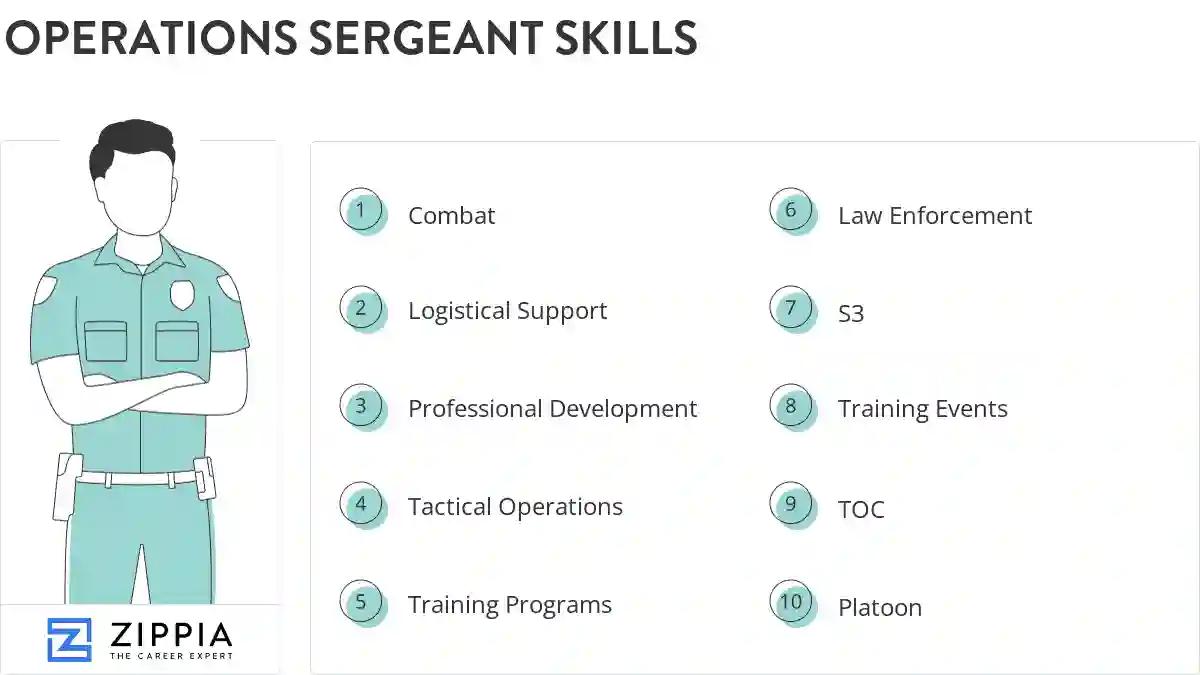
The most important skills for an operations sergeant resume and required skills for an operations sergeant to have include:
- Combat
- Logistical Support
- Professional Development
- Tactical Operations
- Training Programs
- Law Enforcement
- S3
- Training Events
- TOC
- Platoon
- Training Resources
- Training Management
- US Army
- Technical Guidance
- Physical Security
- DOD
- Support Operations
- Training Schedules
- Incident Reports
- Direct Support
- Operational Readiness
- Reconnaissance
- Unit Training
- Operations Orders
- PowerPoint
- Administrative Actions
- Situational Awareness
- Personnel Actions
- III
- Administrative Functions
- Ammunition
- Redeployment
- Physical Fitness
- Training Exercises
- Bragg
- Communications Equipment
- Upper Level Management
- Personnel Management
- Defense Travel System
- Technical Advice
- BN
- Contingency Operations
- VIP
- Operations NCO
- Professional Support
- S-3
- Unit Readiness
- Dtms
- Missile
- Food Service Operations
Updated January 8, 2025
