
Automatically apply for jobs with Zippia
Upload your resume to get started.
Overhead crane operator skills for your resume and career
15 overhead crane operator skills for your resume and career
1. Cranes
- Achieved overhead crane, standing and sitting forklift certifications * Safely and proficiently transferred * Effectively navigated customers to appropriate merchandise
- Transported steel tubing throughout plant using multiple overhead and remote cranes Provided assistance to general labor assignments as necessary
2. Overhead Cranes
Overhead cranes are major industrial equipment used for lifting heavy objects, loads, and tools from one location to another in construction sites. Operating an overhead crane takes much expertise, experience, and skill, as there is no ''one size, fits all''. Overhead cranes come in different components for different specific functions.
- Loaded materials onto customer and company equipment with overhead cranes.
- Crane American Service Operations and safety of overhead cranes/hoists.
3. Determines Safety
- Operate overhead crane to lift, move, and position loads using hoisting Observe load hookup and determines safety of load.
- Load trailers and cargo onto trains Obverses load hookup and determines safety of load.
4. Steel Coils
- Trained to load, unload, move, and locate steel coils in a designated storage area.
- Guided steel coils through a line that cut different widths and lengths according to customers order specifications.
5. Hoisting
- Performed precision rigging and hoisting operations and obtained rigging certification through McDal Corporation.
- Calculated load ratings for daily hoisting operations.
6. Tape Measure
A tape measure is a thin, flexible strip of plastic or metal that can be rolled up when it is not being used. The tape measure has numbers marked on it linearly which is used for measuring length.
- Read tape measure for measurement of steel to be cut according to customers orders.
- Measured and verified materials using a tape measure, micrometer, and calipers.
Choose from 10+ customizable overhead crane operator resume templates
Build a professional overhead crane operator resume in minutes. Our AI resume writing assistant will guide you through every step of the process, and you can choose from 10+ resume templates to create your overhead crane operator resume.7. Load Trucks
- Operate Forklift to move pallets of steel and unload trucks Accomplishments Obtaining Crane Certification by passing crane test with 91%.
- Move large steel beams from one end of shop to other, load trucks and set up steel for fabrication
8. Rail Cars
Rail Cars, also called railroad cars, are large containers set on a railway and pulled by a locomotive. Rail cars are frequently used for shipping large quantities of product or material, such as metal, chemicals, or livestock; however, a rail car may also transport people such as a subway system. A locomotive often pulls numerous cars that attach to each other, which then form a train.
- Work on a production line Welding decks for triple deck rail cars that transport vehicles.
- Operated overhead crane loading/unloading scrap metal from rail cars to supply SSAB Steel mill.
9. Hoist Movement
- Operate a crane box to regulate speed and direction of a crane and hoist movement according to written and signal instructions.
- Check all the hoist movements to long travel and cross travel for abnormal sounds coming from wheels and abnormal speeds.
10. Steel Beams
- Executed daily operations of loading Steel beams, pipes an angle iron, steel plating.
- Operated forklift to transport steel plates; moved steel beams throughout the plant.
11. Aluminum
Aluminum is the most common nonferrous metal and the most prevalent metallic material in the Earth's crust. Aluminum is never found in its metallic form in nature, but its compounds can be found in varying degrees in nearly all minerals, vegetation, and animals. Cans, foils, cooking utensils, door frames, kegs, and aeroplane pieces are all made of aluminum.
- Operated 70-ton overhead crane in lifting/transporting coils of aluminum for production processing.
- Operated Overhead Crane in Aluminum Smelter pot room @ 6 yrs*Operated Overhead Crane in Aluminum Anode Dept.
12. Bulk Materials
- Load coke into barges by operating barge haul system and associated bulk material handling equipment.
- Delivered bulk material to fabrication areas.
13. Load Weights
- Determine load weights and check them against lifting capacities to prevent overload.
- Determine load weights and check them against lifting capacities to prevent overload.
14. MIG
MIG is a specific type of welding in which two base materials are welded together using a solid wire electrode fed through a welding gun and into the weld pool.
- Welded mainly carbon steel pipes and stainless steel; operating MIG and TIG welders.
- Used MIG, flux core, 309 stainless to carbon
15. Position Loads
- Operate traveling or stationary overhead crane to lift, move, and position loads, such as machinery, equipment etc.
- Operated traveling overhead crane to lift, move and position loads, equipment and coils, using magnet & tongs.
5 Overhead Crane Operator resume examples
Build a professional overhead crane operator resume in minutes. Browse through our resume examples to identify the best way to word your resume. Then choose from 5+ resume templates to create your overhead crane operator resume.

What skills help Overhead Crane Operators find jobs?
Tell us what job you are looking for, we’ll show you what skills employers want.
List of overhead crane operator skills to add to your resume
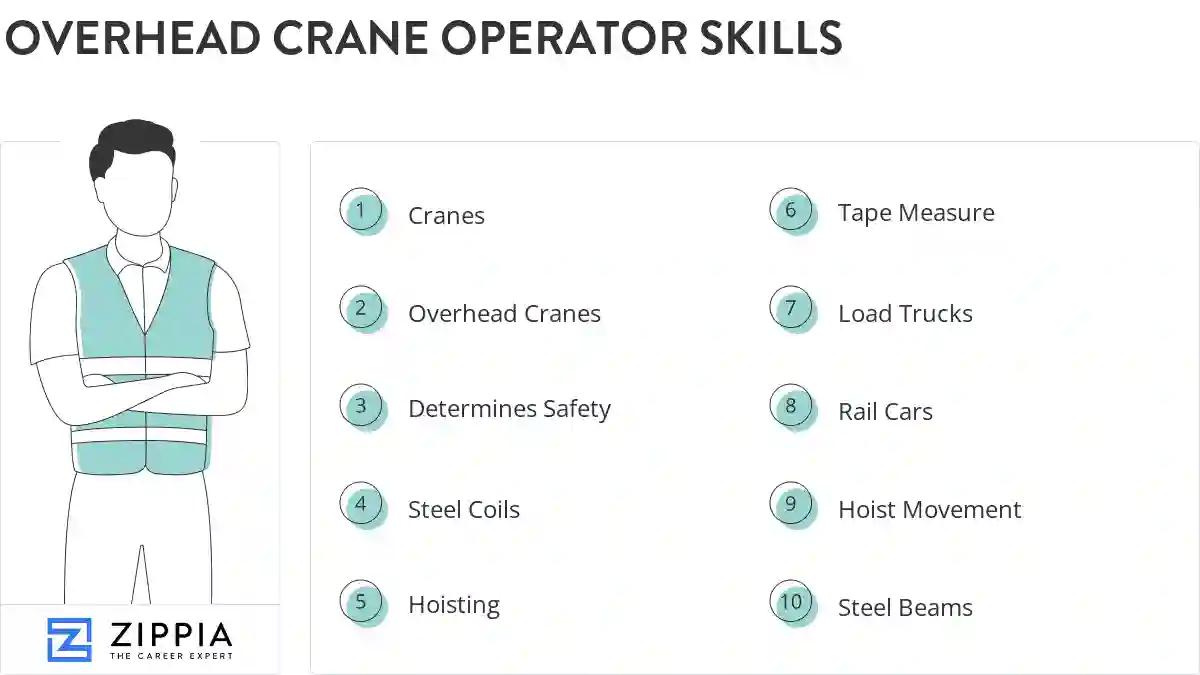
The most important skills for an overhead crane operator resume and required skills for an overhead crane operator to have include:
- Cranes
- Overhead Cranes
- Determines Safety
- Steel Coils
- Hoisting
- Tape Measure
- Load Trucks
- Rail Cars
- Hoist Movement
- Steel Beams
- Aluminum
- Bulk Materials
- Load Weights
- MIG
- Position Loads
- CNC
- Steel Plates
- Hand Signals
- Semi Trucks
- Slings
- Remote Control
- Assembly Line
- Load Hookup
- Tractor Trailer
- Tongs
- Semi Trailers
- Hoists
- Safety Rules
- Bobcat
- Storage Bins
- Safety Procedures
- Customer Specs
- Machine Operators
- Inventory Control
- Steel Mill
- Tow Motor
- Hi-Lo
- Structural Steel
- RF
- Cherry Pickers
- Production Lines
- Safety Standards
- Customer Orders
- Flatbed Trailers
- Burn Table
- Torches
- Drill Press
- Steel Products
Updated January 8, 2025
