
Automatically apply for jobs with Zippia
Upload your resume to get started.
Paraoptometric skills for your resume and career

15 paraoptometric skills for your resume and career
1. Patients
- Educate patients in putting in and removing contact lenses, as well as the proper care for the actual contact lenses.
- Assisted patients in frame and lens selection, as well as contact lens orders.
2. Scheduling Appointments
Scheduling appointments is the practice of finding a free slot with the person(s) you want to meet. The process of scheduling appointments involves finding mutually free time, negotiating follow-ups, sending reminders, and creating new appointments. Scheduling appointments is important to ensure that the timings of consecutive meetings do not clash with each other.
- Performed administrative duties of scheduling appointments, handling phone calls, entering welcome forms, and accepting payments.
3. Patient History
- Documented patient history and performed preliminary examination of patient.
- Collected and entered preliminary patient data including obtaining patient history, lens types and life style requirements.
4. Visual Acuity
Visual acuity refers to how clear or sharp a person's vision is. To determine this, eye doctors or optometrists use a series of visual tests including reading letters on a wall at decreasing sizes. Depending on the accuracy, each eye is assigned a number, such as 20/20. If an eye has 20/20 vision, this means the eye can clearly see something 20 feet away that should be seen or easily read 20 feet away.
- Measure visual acuity, including near, distance, pinhole, or dynamic visual acuity, using appropriate tests.
- Performed pre-testing procedures including auto-refraction, retinal photos, tonometry, and visual acuity.
5. Blood Pressure
- Scheduled appointments, pretesting, including VA's, blood pressure, visual field testing, contact lens ordering and dispensing.
- Assist in obtaining vital signs including blood pressure, pulse rate, temperate and weight.
6. Medical History
- Gathered and documented patient's chief complaint and medical history into electronic medical records prior toexamination.
- Utilize MaximEyes and Revolution to document medical history and scribing.
Choose from 10+ customizable paraoptometric resume templates
Build a professional paraoptometric resume in minutes. Our AI resume writing assistant will guide you through every step of the process, and you can choose from 10+ resume templates to create your paraoptometric resume.7. Visual Fields
- Conducted visual fields tests to measure field of vision.
- Obtained thorough patient history and performed many diagnostic test including ocular coherence tomography, retinal photography, and visual fields.
8. OCT
OCT is an optical test used to identify and diagnose many eye conditions including Glaucoma, macular degeneration and more. Light waves are used to capture images of the retina. These results allow the ophthalmologist or eye specialist to locate abnormalities in the eyes and provide appropriate diagnoses for the problems.
- Assisted doctor with examinations, obtained OCT ONH and/or MAC scans, Visual Field measurements.
- Operated Cirrus OCT and retinal photography machines.
9. Exam Rooms
An exam room in a hospital is a place where patients are examined by medical representatives. In several cases, the exam room distinguishes the doctor-patient relationship and is a critical component of the overall care process.
- Open, disinfect and close exam rooms.
- Answered phones * Worked on insurance billing and posting of payments * Assisted in exam rooms with patients * Filing
10. DR
DR is an academic title used as a designation for a person(s) who already has obtained a doctorate (Ph.D.) in a particular field of discipline. In medicine, DR is used by medical practitioners whose job is to tend to the sick and diseased regardless of whether or not they hold a doctoral-level degree.
- Project management and event coordinator responsibilities; Dr. Garcia hosts and attends numerous continuing education events yearly.
- Utilize organization skills in managing business operation keeping Dr. Rivera on schedule.
11. Color Vision
- Conduct preliminary testing: visual field, color vision, tonometry and retinal photography.
- Conducted preliminary screening examinations including external examination, central and peripheral visual fields and color vision tests.
12. Patient Education
- Coordinated and provided group and individual outpatient education to adult clients having cataract surgery.
- Created Patient Education Manual for Seniors regarding cataract post-operative eye care.
13. Fundus Photos
- Perform pre-tests including Auto-Refraction, Fundus Photos, and GDX.
- Capture Fundus Photos and Auto Refactor readings.
14. Eye Exams
- Preform preliminary testing for eye examination.
- Work with optometrist to assist in carrying out eye examinations and treatments.
15. EHR
Electronic Health Records, or simply EHR, contains all the information about a patient whether they are new or old. It includes the record of diagnosis, medication, progress note, medical history, radiology, and laboratory results. A health facility or hospital has this kind of document to track a patient's record electronically.
- Aided the doctor during the exam and documented the findings in the EHR.
- Obtained proficiency in EHR documentation and chart management.
5 Paraoptometric resume examples
Build a professional paraoptometric resume in minutes. Browse through our resume examples to identify the best way to word your resume. Then choose from 5+ resume templates to create your paraoptometric resume.

What skills help Paraoptometrics find jobs?
Tell us what job you are looking for, we’ll show you what skills employers want.
List of paraoptometric skills to add to your resume
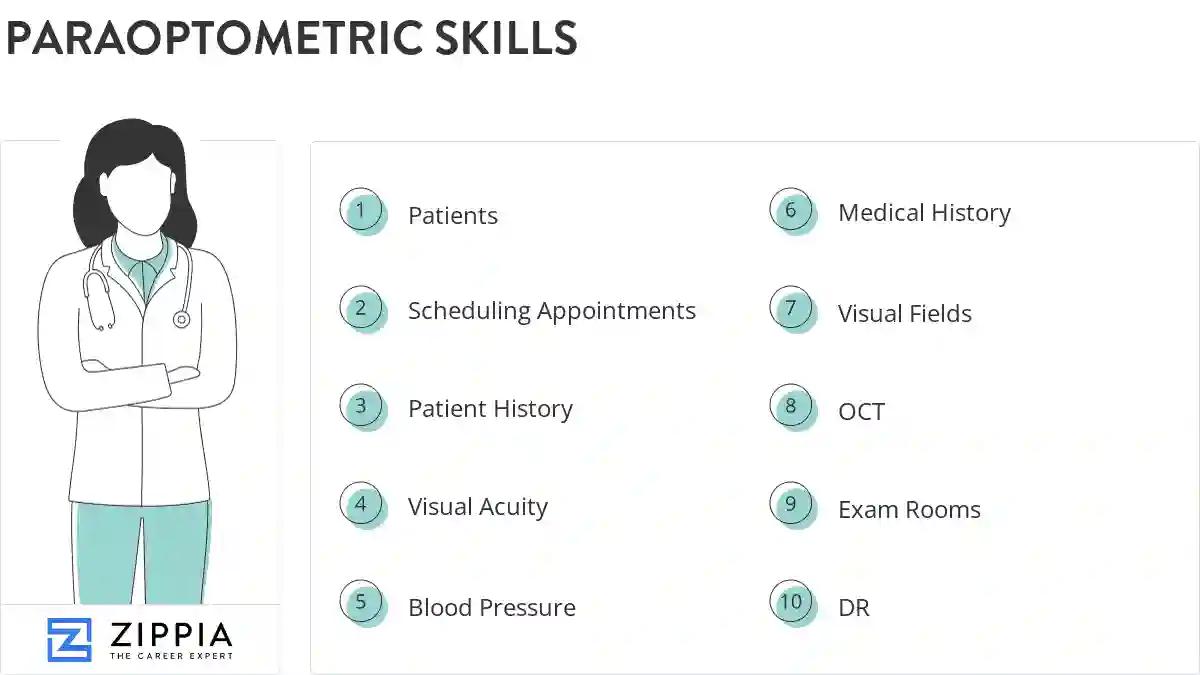
The most important skills for a paraoptometric resume and required skills for a paraoptometric to have include:
- Patients
- Scheduling Appointments
- Patient History
- Visual Acuity
- Blood Pressure
- Medical History
- Visual Fields
- OCT
- Exam Rooms
- DR
- Color Vision
- Patient Education
- Fundus Photos
- Eye Exams
- EHR
- Insurance Claims
- Patient Appointments
- Field Testing
- EMR
- Patient Flow
- Hippa
- Insurance Verification
- Patient Charts
- Test Results
- IOP
- Patient Scheduling
- HIPAA
- Eye Care
- Eye Drops
- CPO
- Health History
- Oral Medications
- Medical Billing
- Direct Calls
Updated January 8, 2025
